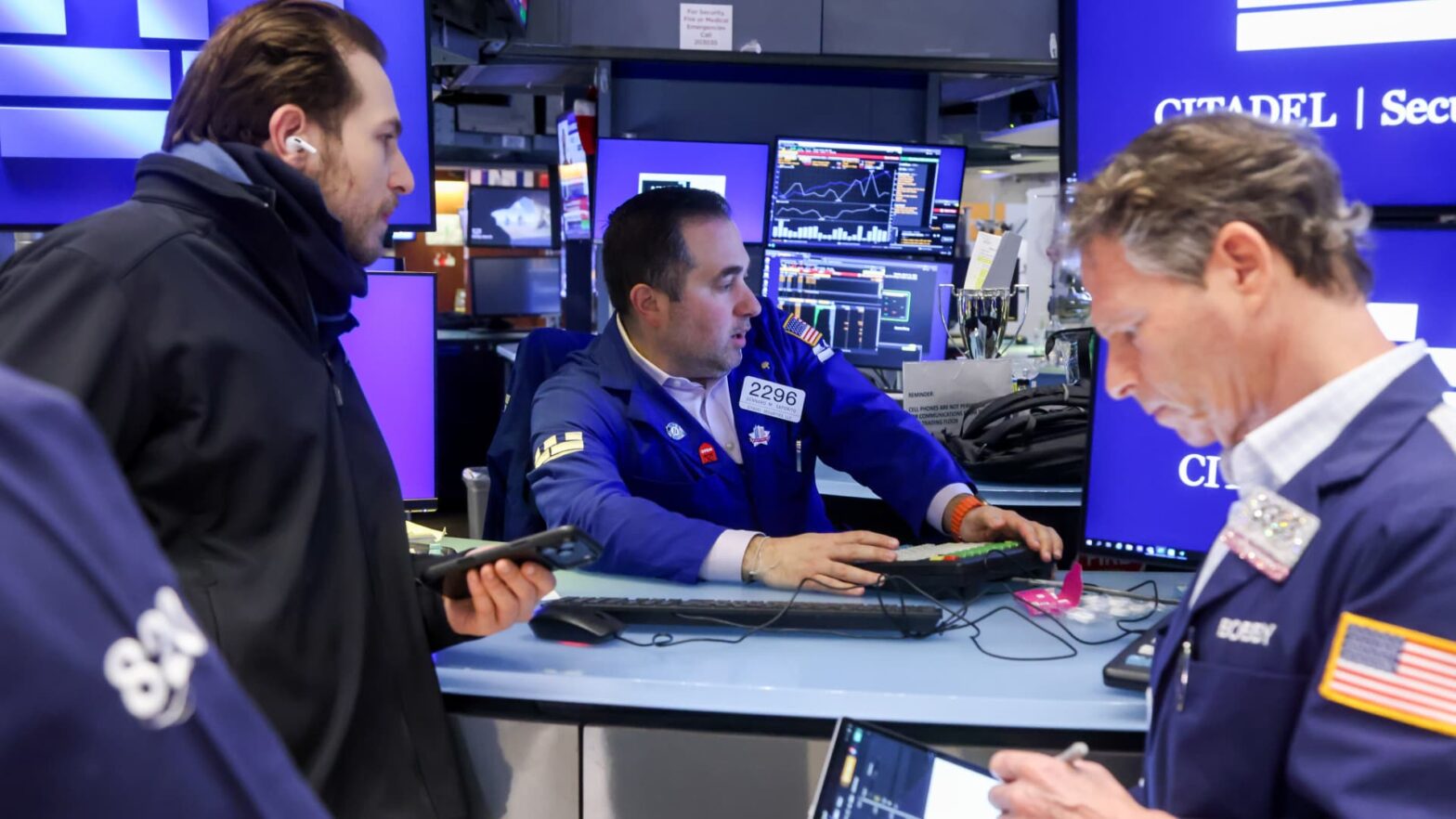
Traders work on the floor of the New York Stock Exchange (NYSE) in New York, US, on Monday, March 16, 2026.
Michael Nagle | Bloomberg | Getty Images
S&P 500 futures were near the flat line Monday night after the major averages bounced in light of cooling oil prices.
S&P 500 futures slipped 0.1%, while Nasdaq 100 futures declined nearly 0.2%. Futures tied to the Dow Jones Industrial Average lost 47 points, or 0.1%.
Major averages rebounded in the regular session as oil prices eased from the previous week’s surge. The S&P 500 added 1%, after the broad-market index closed last week at its lowest level of the year amid the U.S.-Iran war. The Dow gained roughly 388 points, or 0.8%, and the tech-heavy Nasdaq Composite gained 1.2%.
Each of the 11 S&P sectors closed higher on the day, led by gains in tech. Nvidia shares advanced about 1.7% after CEO Jensen Huang said during the company’s annual GTC conference that he expects $1 trillion in orders for Nvidia’s Blackwell and Vera Rubin systems through 2027.
Monday’s decline in oil prices boosted sentiment behind U.S. equities. Brent crude settled down about 2.8% to $100.21 a barrel on Monday. West Texas Intermediate crude fell about 5.3% to settle at $93.50 a barrel.
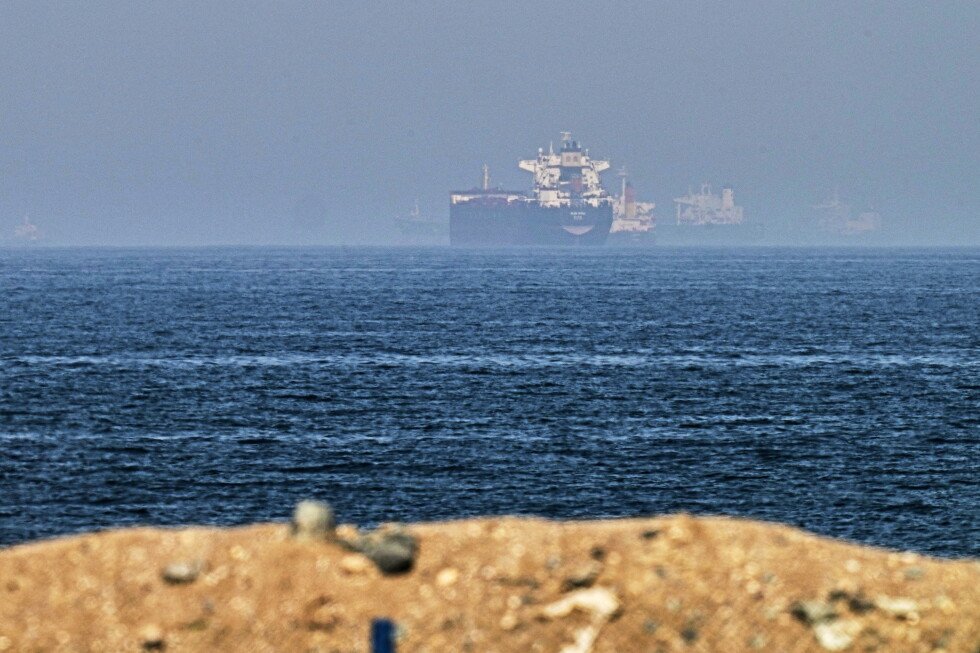
Oil prices have surged since the start of the U.S.-Israel attacks on Iran on worries that a prolonged closure of the Strait of Hormuz could lead to a global disruption of energy supplies. Although Treasury Secretary Scott Bessent told CNBC that the U.S. is allowing Iranian oil tankers to pass through the key waterway, President Donald Trump on Monday signaled that a coalition to escort tankers through the strait is not yet finalized.
Investors are watching for further developments on the war. Many are crediting a relatively strong economy, contained inflation and strong earnings for continued momentum behind the stock market, but Bartlett Wealth Management president Holly Mazzocca said on Monday that “risks to that growth story are mounting.”
“We came into this year with a pretty strong foundation, but especially the labor market has weakened pretty significantly. So that’s the big question for investors right now, is just being realistic that the overall risks to that continued growth story are higher today than they were just a few weeks ago,” Mazzocca said on CNBC’s “Closing Bell.”
On the earnings front, Lululemon, Docusign and Oklo are expected to post results Tuesday.
Separately, investors are awaiting this year’s second Federal Reserve interest rate decision, which is scheduled for Wednesday. Expectations for rate cuts have diminished as inflation worries have ramped up since the start of the Iran war, according to CME Group’s FedWatch tool.
Trump says he thinks he will have the ‘honor’ of ‘taking Cuba’
President Donald Trump on Monday said he thinks he will have the “honor” of “taking Cuba,” further supporting his aggressive foreign policy amid the ongoing war in Iran and after the U.S. military operation in Venezuela.
“Whether I free it, take it, I think I can do anything I want with it,” Trump told reporters in the Oval Office with Vice President JD Vance standing behind him. “They’re a very weakened nation right now.”
Trump earlier this month threatened a “friendly takeover” of Cuba, which has been an adversary of the U.S. for decades except for a brief thaw when Barack Obama was president.
— Garrett Downs, Pia Singh
Nvidia bets big on orbital data centers with new Vera Rubin Space-1 chip system
Nvidia CEO Jensen Hwang introduces Vera Rubin, a next-generation AI data center platform, and Rubin Ultra, a next-generation AI GPU architecture, during the keynote address at the company’s annual GTC developers conference in San Jose, California, on March 16, 2026.
Josh Edelson | AFP | Getty Images
Nvidia just unveiled its new computing platform for orbital data centers, marking a significant step towards building AI space infrastructure.
“Space computing, the final frontier, has arrived,” CEO Jensen Huang said Monday during the company’s annual GTC 2026 conference. “As we deploy satellite constellations and explore deeper into space, intelligence must live wherever data is generated.”
The company said in a press release that its Vera Rubin Space-1 Module, which includes the IGX Thor and Jetson Orin, will be used on space missions led by multiple companies. The chips are specifically “engineered for size-, weight- and power-constrained environments.”
Huang said Nvidia is working with partners on a new computer for orbital data centers, but there are still engineering hurdles to overcome. Partners include Axiom Space, Starcloud and Planet.
“In space, there’s no convection, there’s just radiation,” Huang said during his GTC keynote, “and so we have to figure out how to cool these systems out in space, but we’ve got lots of great engineers working on it.”
Nvidia’s ambitions to build data centers in space come just a few months after Nvidia-backed Starcloud successfully launched a satellite with a H100 graphics processing unit.
— Lola Murti, Pia Singh