

G0d4ather/iStock/Getty Images Plus
If you’re investing in traditional value or growth index funds, you might be unknowingly holding stocks that are neither value nor growth—and they’re likely dragging down your returns. A recent paper from Research Affiliates reveals a structural flaw in how the investment industry constructs style indices and proposes a compelling alternative.
What the Researchers Examined
Chris Brightman, Campbell Harvey, Que Nguyen, and Omid Shakernia, authors of the November 2025 paper, “Why Hold Expensive Slow-Growing Stocks? An Alternative Framework for Value and Growth Indices,” investigated a fundamental problem with traditional style investing. They examined how major index providers like Russell, S&P and MSCI construct their value and growth indices using what’s called the “completeness principle.”
This principle requires that all stocks be classified as either value, growth or both, ensuring that an equal mix of value and growth indices recreates the full market. While this sounds elegant in theory, it creates a significant practical problem: it forces these indices to hold expensive stocks. Thus, the researchers asked the simple question: Why do they include expensive stocks of slow-growing companies in either index? “We think doing so is illogical, unnecessary, and costly.”
Related:Triad Wealth CIO: We Want to Introduce More Cyclicality in Our Models
The authors analyzed over 55 years of data (March 1970 through June 2025) to test whether an alternative framework could eliminate this weakness. They measured value as book-to-price and measured growth as five-year sales growth. “Unlike earnings growth, sales growth may be calculated consistently across the entire market, including young, innovative companies that are not yet profitable.” Stocks were then sorted by book-to-price and sales growth. Combining these measures, they placed stocks in a 2-by-2 matrix, with valuation on one axis and growth on the other.
Defining the value portfolio as cheaply priced stocks (regardless of the companies’ growth rates) and the growth portfolio as fast-growing companies (regardless of their stocks’ valuation ratios), they excluded the expensive/slow-growth quadrant from both value and growth portfolios. They then formed portfolios by cap-weighting stocks in each quadrant.
The Key Findings
The results are striking. The researchers found that expensive, slow-growing stocks underperformed the broader market by 2.1% per year (11.1% versus 9.0%) over the study period. On the other hand, by creating portfolios that combine only the cheapest and fastest-growing stocks—explicitly excluding the expensive, slow-growth quadrant—the researchers achieved meaningful outperformance. An equal-weighted blend of these “Cheap” and “Fast” portfolios beat the market by 0.8% per year (11.9% versus 11.1%) with minimal tracking error.
Related:OnePoint BFG CIO: It’s Not Too Late to Invest in Commodities
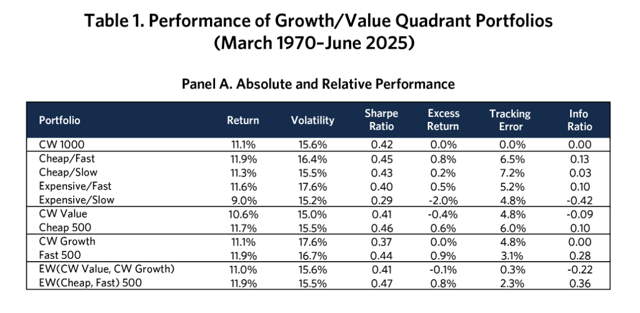
They also found that excluding stocks in the expensive, slowing-growing quadrant improved risk-adjusted performance—the four-factor alpha increased from 0.1% to 0.6% (t-stat of 2.7).
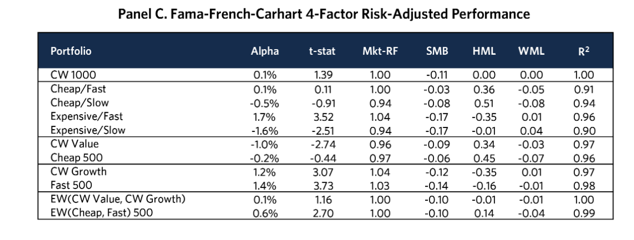
The advantages multiply with concentration. Moving from the top 500 stocks in each category to just the top 100 increased excess returns substantially. The most concentrated version, combining the 100 cheapest and 100 fastest-growing stocks, delivered impressive results while also improving risk-adjusted performance measures.
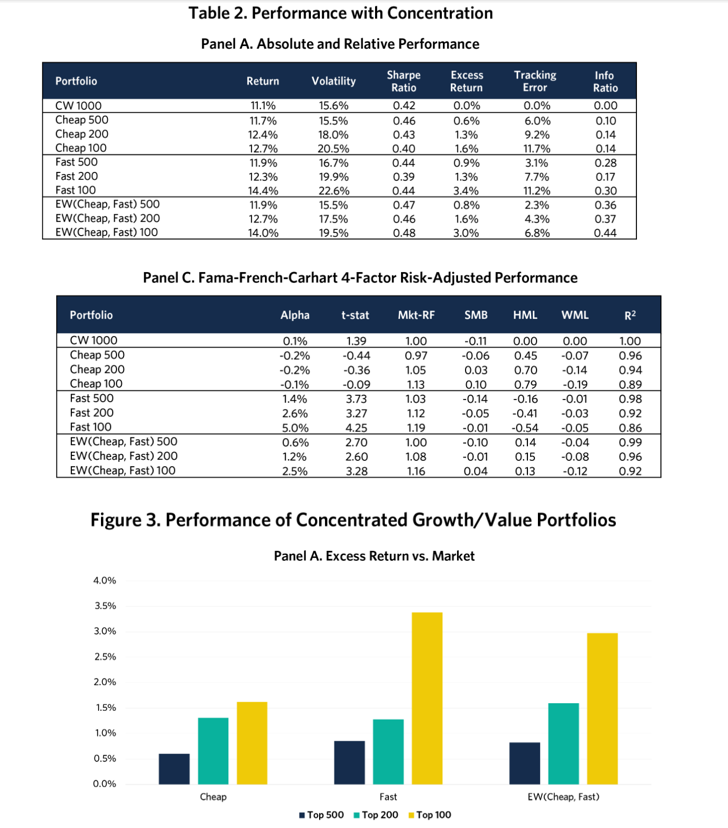
Another important finding was that factor loadings also intensify performance. “The HML loading of the cheap portfolio becomes more strongly positive, and the HML loading of the fast portfolio, more strongly negative. As a result, the excess returns of the two portfolios become more negatively correlated, improving diversification.”
Perhaps most intriguingly, the researchers found that the timing between value and growth styles using momentum signals could further enhance returns. Their timing approach builds on a growing body of research documenting factor momentum. These studies show that factor returns display short to intermediate-term persistence. Their momentum turning points approach (see here), which switches between styles only when trend signals genuinely diverge, produced an 18.2% annual return for the most concentrated portfolio versus 11.1% for the broad market.
Related:Why Clients Should Care About Capex
Their findings led the authors to conclude: “Our analysis shows that combining a value portfolio defined solely as cheaply priced with a growth portfolio defined solely as fast growth produces a portfolio that significantly outperforms the market and the combination of traditional style indexes.”
Key Investor Takeaways
Understand what you own. If you’re invested in traditional style index funds, recognize that you are likely to hold expensive, slow-growth stocks that have historically been performance drags. The $14 trillion in tracking traditional-style indices represents roughly 23% of the U.S. stock market—this isn’t a niche issue.
Consider the alternative. A framework that defines value purely as cheap stocks and growth purely as fast-growing companies, without forcing completeness, has shown persistent outperformance. This approach creates cleaner, more intuitive style exposures.
Concentration can help. More concentrated portfolios of cheap, fast stocks have historically produced higher excess returns and better information ratios. This suggests that signal strength increases when you focus on the most compelling opportunities rather than broadly diversifying across styles.
Style timing may add value. Rather than maintaining a static allocation between value and growth, systematic timing based on momentum signals has historically enhanced returns. The key is using a disciplined approach that filters out false signals during persistent trends.
Question convention. Just because an approach is widely adopted doesn’t make it optimal. The completeness principle exists more for structural convenience—making it easy for asset managers to create and sell funds—than for investor benefit. Understanding the “why” behind index construction can help you make better investment decisions.
The Bottom Line
The research suggests that investors seeking improved style exposure have compelling alternatives to traditional value and growth indices. By eliminating the structural weakness of expensive slow-growth stocks, a sturdier framework becomes possible—one built on the solid foundations of cheap valuations and genuine business growth.