
What do computers, cell phones, televisions and other electronic devices depend on? Rare earth minerals. These critical metals power everything from EV motors to wind turbines and defense systems — yet they remain largely invisible to most investors.
As global demand for clean energy and advanced electronics accelerates, rare earths stocks — companies mining or processing these crucial minerals — offer exposure to a fast-growing, strategically vital sector often overlooked by the mainstream market.
Geopolitical tension is adding fuel to the trend. U.S.–China competition over critical resources, trade restrictions, and government incentives for domestic production have made rare earth stocks a proxy for global economic power. Shares of U.S. producers like MP Materials and developers like USA Rare Earth have surged on news of policy support and supply-chain deals.
With clean-tech buildout and supply-chain reshoring likely to remain multi-year themes, companies with credible rare earth exposure stand to benefit from durable tailwinds. Below, we spotlight some of the best rare earth stocks to consider now, based on Zacks Rank, Style Scores and underlying fundamentals:
Top 5 Best Rare Earth Stocks to Buy Today
| Company (Ticker) | 12 Week Price Change | Forward PE | Price | Proj EPS Growth (1 Year) | Projected Sales Growth (1Y) | Report |
|---|---|---|---|---|---|---|
| Sociedad Quimica y Minera (SQM) | 8.77% | 12.36 | $77.11 | 202.82% | 60.89% | |
| Albemarle (ALB) | 13.37% | 20.41 | $166.32 | 1,131.66% | 9.42% | Free Research Report: ALB |
| SIGMA LITHIUM (SGML) | -13.94% | 14.89 | $11.61 | 322.86% | 132.79% | |
| Uranium Royalty (UROY) | -0.27% | NA | $3.71 | 66.67% | 275.81% | |
| NioCorp Developments Ltd. (NB) | -15.88% | NA | $4.98 | -98.57% | NA |
Sociedad Quimica y Minera (SQM)
$77.11 USD +0.76 (1.00%)
3-Year Stock Price Performance
- Market Cap:$21.81 B (Large Cap)
- Projected EPS Growth:202.91%
- Last Quarter EPS Growth:3.23%
- Last EPS Surprise:-14.67%
- Next EPS Report date:May 27, 2026
Our Take:
Reasons to Buy
SQM produces lithium chemicals and iodine, giving it direct exposure to battery supply chains and the demand for critical minerals. In Q4 2025, lithium volumes held up even as realized prices stayed well below the 2022–2023 peak, underscoring the advantage of its low-cost Salar de Atacama assets and steadier iodine cash flow. Targeted debottlenecking and downstream capacity can sharpen operating leverage as pricing improves.
Potential Risks
Weaker EV demand or Chilean regulatory shifts could squeeze margins. Execution risk rises as SQM expands capacity, while FX moves and rapid supply responses can reset profitability.
Forecast
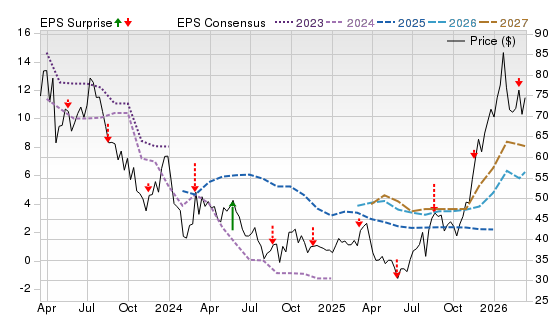
A Zacks Rank #1 (Strong Buy) signals upward revisions, but Style Scores of D for Value and Growth and F for Momentum show skepticism. The Price, Consensus & EPS Surprise chart shows 2026–2027 lines turning higher as the stock rebounds, with surprises mixed, suggesting that estimate repair is underway.
Albemarle (ALB)
$166.32 USD +3.88 (2.39%)
3-Year Stock Price Performance
- Market Cap:$19.11 B (Large Cap)
- Projected EPS Growth:1,131.65%
- Last Quarter EPS Growth:-178.95%
- Last EPS Surprise:-32.50%
- Next EPS Report date:April 29, 2026
Our Take:
Reasons to Buy
Albemarle is a major lithium producer, with smaller bromine and catalysts units, giving it scale exposure to battery materials. In Q4 2025, Energy Storage volumes increased and cost reductions helped blunt lower lithium pricing. With spending focused on higher-return projects, ALB offers leverage to any recovery in EV demand and pricing.
Potential Risks
Lithium’s cycle is the story: prolonged weak prices, contract resets, or fresh supply from China and Australia can keep margins thin. Execution missteps at conversion assets or capex overruns would undermine cash-flow goals, and the rebound can reverse quickly if guidance disappoints.
Forecast
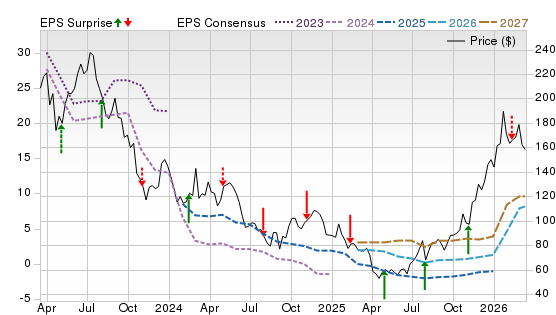
A Zacks Rank #1 points to favorable revisions. Still, D for Value and Growth alongside an A for Momentum suggest price action is leading. The chart suggests 2027 EPS expectations are stabilizing and beginning to edge higher, implying upside depends on estimates continuing to firm as execution improves.
SIGMA LITHIUM (SGML)
$11.61 USD +0.27 (2.38%)
3-Year Stock Price Performance
Premium Research for SGML
- Market Cap:$1.26 B (Small Cap)
- Projected EPS Growth:23.91%
- Last Quarter EPS Growth:41.18%
- Last EPS Surprise:0.00%
- Next EPS Report date:March 30, 2026
Our Take:
Reasons to Buy
Sigma Lithium produces spodumene concentrate in Brazil, giving it direct exposure to lithium feedstock for EV batteries. In the last reported quarter, output increased and management emphasized further cost reductions and improved cash position, reinforcing a disciplined posture. A high-grade resource and Brazil’s access to Atlantic customers can support competitive unit economics through the cycle.
Potential Risks
Due to single-asset concentration, risks of grade variability, plant uptime, or shipping disruptions can quickly pressure results. Lithium pricing is still the main driver, and a prolonged oversupply backdrop could constrain cash generation.
Forecast
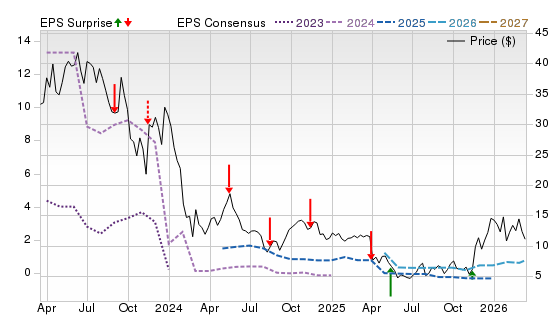
A Zacks Rank #2 (Buy) with an A for Growth, B for Momentum and D for Value is a constructive signal, but not cheap. The chart shows 2026 EPS consensus drifting down then flattening near breakeven, while surprises skew negative with only intermittent beats, so upside likely requires estimates to start stair-stepping higher.
Uranium Royalty (UROY)
$3.71 USD +0.04 (1.09%)
3-Year Stock Price Performance
Premium Research for UROY
- Market Cap:$537.57 M (Small Cap)
- Projected EPS Growth:66.67%
- Last Quarter EPS Growth:150.00%
- Last EPS Surprise:200.00%
- Next EPS Report date:July 15, 2026
Our Take:
Reasons to Buy
Uranium Royalty is a royalty-and-physical-uranium vehicle, offering exposure to nuclear-fuel demand that investors often group with critical minerals. In the latest period, the company emphasized strong liquidity and continued deployment into royalties, streams and uranium holdings, creating NAV torque if uranium prices stay firm without taking on mining operating risk. A growing portfolio can also spread exposure across projects.
Potential Risks
Production cuts, delays, or permitting issues at underlying mines can defer royalty receipts. Portfolio marks can swing with uranium and small-cap equities. Any reliance on equity issuance can dilute holders.
Forecast
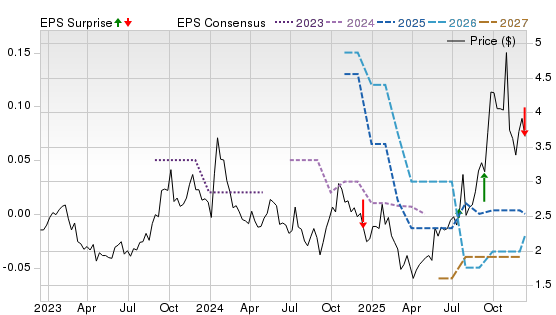
A Zacks Rank #3 (Hold) sends a neutral signal, while Growth A points to improving expectations. Momentum C and Value F suggest the market hasn’t fully embraced the story and the shares are not cheap. The chart shows sparse, choppy consensus estimates and a price uptrend into 2026 alongside a mixed surprise pattern.
NioCorp Developments Ltd. (NB)
$4.98 USD +0.04 (0.81%)
3-Year Stock Price Performance
- Market Cap:$705.07 M (Small Cap)
- Projected EPS Growth:-100.00%
- Last Quarter EPS Growth:54.55%
- Last EPS Surprise:94.32%
- Next EPS Report date:May 14, 2026
Our Take:
Reasons to Buy
NioCorp is a development-stage critical-minerals name advancing the Elk Creek project, targeting niobium, scandium and titanium with potential rare earth byproducts. At 2025-end, cash balance grew to $307 million after financings, giving the company a longer runway for engineering, site work and permitting that can de-risk Elk Creek. The long-term appeal is a potential U.S. supply of specialty metals.
Potential Risks
NB remains a pre-revenue developer, so the stock can fall if Elk Creek’s project financing takes longer than expected. Project economics are sensitive to commodity-price assumptions and processing scale-up risk.
Forecast
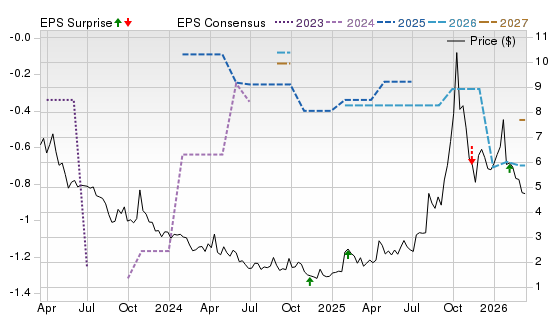
A Zacks Rank #3 with Value F, Growth C and Momentum D signals that the stock is still more speculative than trend-driven. The chart shows EPS expectations staying negative and uneven, while the share price has swung sharply. Near-term performance is likely to be driven by financing and project progress.
Methodology
The Zacks Rank is a proprietary stock-rating model that uses trends in earnings estimate revisions and earnings-per-share (EPS) surprises to classify stocks into five groups: #1 (Strong Buy), #2 (Buy), #3 (Hold), #4 (Sell) and #5 (Strong Sell). The Zacks Rank is calculated through four primary factors related to earnings estimates: analysts’ consensus on earnings estimate revisions, the magnitude of revision change, the upside potential and estimate surprise (or the degree in which earnings per share deviated from the previous quarter).
Zacks builds the data from 3,000 analysts at over 150 different brokerage firms. The average yearly gain for Zacks Rank #1 (Strong Buy) stocks is +23.62% per year from January, 1988, through June 2, 2025.
Selections for Best Rare Earth Stocks are based on the current top ranking stocks based on Zacks Indicator Score and other Zacks style scores. All information is current as of market open, March 17, 2026.
What are Rare Earth Stocks?
“Rare earth” stocks refer to companies involved in the extraction, processing, refining, recycling or production of rare earth elements (REEs) — a group of around 17 metallic elements (like neodymium, praseodymium, dysprosium, terbium) that play pivotal roles in modern technologies such as electric vehicles, wind turbines, high-end magnets, defense applications and electronics.
Global production of rare earth metals reached about 390,000 metric tons in 2024, up from about 132,000 in 2017, underscoring the growth of this sector.
Because of their critical nature and complex supply chains (heavily dominated by China), companies that supply or refine rare earths are often lumped into the “critical minerals” or clean-tech-materials investment theme. That means when you see “rare earth stocks,” you should also think about lithium, other battery metals, magnet supply chains and so on.
Is It a Good Time to Invest in Rare Earth Stocks?
Yes — with caveats. The timing looks favorable for several reasons:
- Geopolitical / supply-chain tailwinds: Governments (especially the U.S.) are increasingly focused on securing domestic rare earth supply chains and reducing dependence on China for minerals and refining
- Investor sentiment / deal activity: Many rare earth stocks have surged steeply. For instance, MP shares soared about 51% following a major deal, and others followed the rally. There is clear momentum.
- Increasing demand from clean tech / defense / EVs: Rare earths are critical for high-performance magnets (used in EV motors, wind turbines, defense systems). Supply constraints are real.
However, there are risk-factors:
- Many rare-earth stocks have very stretched valuations and limited current profitability, making them speculative.
- The theme is highly sensitive to commodity-price swings, export policy changes (especially China), regulatory risks, project delays and environmental issues.
- Timing matters: If much of the “good news” is already baked into prices, returns may be muted or risk a pull-back higher.
In short: Yes — it appears to be a timely set-up for rare earth and critical minerals investing, especially if you’re willing to accept higher risk and long-term payoff. But it’s not a guaranteed “easy” win.
Guide to Rare Earth Stocks
Types of Rare Earth Stocks
- Primary rare-earth companies: Firms directly mining, refining, separating or producing rare-earth elements, such as, MP Materials.
- Junior/exploration companies: Smaller, earlier-stage firms exploring rare-earth deposits — higher risk/higher upside.
- Diversified mining/critical-minerals companies: Firms where rare earth is one part of a broader portfolio (e.g., lithium, cobalt, base metals). These offer exposure to the theme with different risk/return profiles.
Benefits of Investing in Rare Earth Stocks
- High strategic importance: Rare earths are critical to defense, clean energy, EVs — giving structural demand.
- Supply-chain shift: With efforts to decouple from China, Western production/refinement is gaining focus — creating investment opportunities.
- Potential for outsized gains: Given bottlenecks and scarcity, companies that successfully scale may see large value appreciation.
- Diversification: Rare earths offer exposure to a different kind of commodity/tech-supply chain than traditional stocks.
Risks of Investing in Rare Earth Stocks
- Commodity price risk: When prices of rare earth oxides fall (or oversupply emerges), companies suffer.
- Execution risk: Mines and processing facilities can face delays, cost overruns, regulatory/environmental hurdles.
- Valuation risk: Given hype, many stocks may have inflated expectations baked in, limiting upside or increasing downside.
- Global trade/regulation risk: China still dominates refining and can influence prices/export controls.
- Sensitivity to subsidies/policy: Much of the upside may depend on continued supportive policy (e.g., U.S. government investing). If that pullsback, companies suffer.
How Sensitive Are These Companies to Global Trade Dynamics?
Very sensitive. For example:
- A major U.S. rare-earth producer’s share price surged after a U.S. Department of defense deal and Apple partnership, demonstrating how policy/trade events drive value.
- On the flip side, increased Chinese export volumes made investors cautious about future pricing and led to share-price pull-backs.
Hence, when you evaluate rare-earth stocks you must account for not just the company fundamentals, but global trade flows, export restrictions, government incentives, and commodity-price dynamics.
How to Select Rare Earth Stocks
What Metrics Should I Use to Evaluate a Rare Earth Company?
- Production volume / growth rate: How much rare earth oxide (or separated elements) is the company producing or projecting?
- Cost structure / margin: What are mining and refining costs? A low cost producer has an edge in a volatile commodity environment.
- Vertical integration: Does the company only mine, or also refine/separate/process into usable materials? Companies with downstream capability may command higher margins (e.g., magnets).
- Off-take agreements / contracts: Does the company have binding agreements with large OEMs, governments or defense-related customers? That provides visibility and de-risking.
- Valuation metrics: Traditional P/E may not apply for early stage companies; metrics like EBITDA multiples, resource value, cash flow forecasts, asset-to-market cap ratio are especially relevant.
- Balance sheet strength: Mining/refining is capital intensive — debt levels, capital-expenditure commitments and cash runway matter.
- Jurisdiction & ESG / permitting risk: Mining regulations, permitting environment, environmental footprint and community risks can delay projects significantly.
What is the Total Addressable Market (TAM) for These Rare Earth-Theme Segments?
- The global rare earth element market is driven by EVs, wind turbines, consumer electronics, defense systems and emerging technologies like quantum or 5G/6G.
- Given the expansion of these sectors, the TAM is growing: e.g., neodymium-praseodymium (NdPr) oxide demand is expected to grow strongly as magnets go into EV motors and wind-turbine generators.
- A useful way to think about TAM: Estimate future demand growth for key end-markets (EVs, wind), look at the rare-earth elements required per unit, then estimate the volume of elements and the price per unit.
- Many analysts believe that new supply (especially outside of China) must ramp significantly to meet future demand, which gives upside potential for rare Earth producers. (See e.g., the production jump globally).
Should I Pick Individual Stocks or Use Rare Earth ETFs / Funds?
- Individual stocks: Offer highest upside potential but also highest risk (company-specific execution risk, mining risk, financing risk). Example: MP Materials, USA Rare Earth, etc.
- ETFs / funds: Provide broader diversification across multiple companies, reducing idiosyncratic risk. For example, REMX (VanEck Vectors Rare Earth/Strategic Metals ETF) holds a portfolio of ~27 global names.
- If you are bullish about the theme but less comfortable picking winners, an ETF may be a better choice. If you have conviction and are willing to do detailed company-analysis (and accept risk), then individual stocks may give more reward.
Portfolio Fit and Impact for Rare Earth Stocks
How Do Rare Earth-Theme Stocks Fit Into My Overall Portfolio?
- They can serve as a thematic/strategic allocation — e.g., a small portion of your portfolio (5-10%) dedicated to “critical minerals / supply-chain transformation”.
- They often act as a growth / high-volatility sleeve rather than core stable income stocks.
- When included, they should complement your broader holdings (e.g., tech, defense, commodities, clean energy) rather than dominate them.
- Because of the high risk/high reward nature, it’s prudent to treat them as part of the “satellite” portfolio rather than the “core”.
Can I Invest for Both Financial Return and Environmental Impact (ESG or Sustainability Goals)?
Yes — rare earth stocks can offer that dual exposure:
- Financial return: through growth in demand for EVs, wind, electronics, defense supply chains.
- Environmental / sustainability impact: supporting the clean-tech transition (e.g., wind turbines, EV motors rely on rare earth magnets), domestic supply chain de-risking, recycling of materials.
- However, you must still evaluate the ESG risks (mining footprint, tailings, community impact). A sustainable theme doesn’t guarantee sustainable business practices.
What Is the Exit Strategy for These Stocks If the Theme Fades or the Company Fails to Execute?
- Set target metrics: e.g., share price target, resource milestones, contract wins.
- Use stop-loss or position size limits: because execution risks are high, you may want to cap exposure or set alerts if certain milestones aren’t met.
- Consider time-horizon: rare-earth infrastructure build-out may take years; if your investment horizon is short, you risk being early without returns.
- Diversify: don’t depend on a single rare-earth stock.
- Be willing to exit if fundamentals deteriorate (e.g., contracts drop, production delays, commodity price crash, policy reversals).
Alternative Investment Options for Rare Earth Stocks
- ETFs / thematic funds: e.g., REMX (VanEck Rare Earth/Strategic Metals) for diversified exposure.
- Battery / critical-minerals funds: Some funds combine lithium, cobalt, nickel and rare earths, offering broader critical-minerals exposure. For example, some articles group “critical minerals stocks such as lithium” alongside rare earth stocks.
- Junior exploration companies: Very high risk/high reward. For investors comfortable with volatility, early-stage explorers may deliver outsized gains — but many fail.
- Mining commodity funds: Broader commodity/mining ETFs or funds that include rare earths as part of a basket.
- Corporate bonds / private placements: Some rare-earth projects may issue debt or private-equity funding; less liquid but potentially interesting for sophisticated investors.
- Recycling and downstream stocks: Think about companies that refine, separate, recycle rare-earth magnets rather than just mine. Sometimes less risky and higher margin potential.
Zacks Research is Reported On:
- MSN
- Marketwatch
- Nasdaq
- Forbes
- Investors.com
- Morningstar


This page has not been authorized, sponsored, or otherwise approved or endorsed by the companies represented herein. Each of the company logos represented herein are trademarks of Microsoft Corporation; Dow Jones & Company; Nasdaq, Inc.; Forbes Media, LLC; Investor’s Business Daily, Inc.; and Morningstar, Inc.
Copyright 2026 Zacks Investment Research 101 N Wacker Drive, Floor 15, Chicago, IL 60606
At the center of everything we do is a strong commitment to independent research and sharing its profitable discoveries with investors. This dedication to giving investors a trading advantage led to the creation of our proven Zacks Rank stock-rating system. Since 1988 it has more than doubled the S&P 500 with an average gain of +23.93% per year. These returns cover a period from January 1, 1988 through March 2, 2026. Zacks Rank stock-rating system returns are computed monthly based on the beginning of the month and end of the month Zacks Rank stock prices plus any dividends received during that particular month. A simple, equally-weighted average return of all Zacks Rank stocks is calculated to determine the monthly return. The monthly returns are then compounded to arrive at the annual return. Only Zacks Rank stocks included in Zacks hypothetical portfolios at the beginning of each month are included in the return calculations. Zacks Ranks stocks can, and often do, change throughout the month. Certain Zacks Rank stocks for which no month-end price was available, pricing information was not collected, or for certain other reasons have been excluded from these return calculations. Zacks may license the Zacks Mutual Fund rating provided herein to third parties, including but not limited to the issuer.
Visit Performance Disclosure for information about the performance numbers displayed above.
Visit www.zacksdata.com to get our data and content for your mobile app or website.
Real time prices by BATS. Delayed quotes by Sungard.
NYSE and AMEX data is at least 20 minutes delayed. NASDAQ data is at least 15 minutes delayed.
This site is protected by reCAPTCHA and the Google Privacy Policy, DMCA Policy and Terms of Service apply.