Updated 1 min read
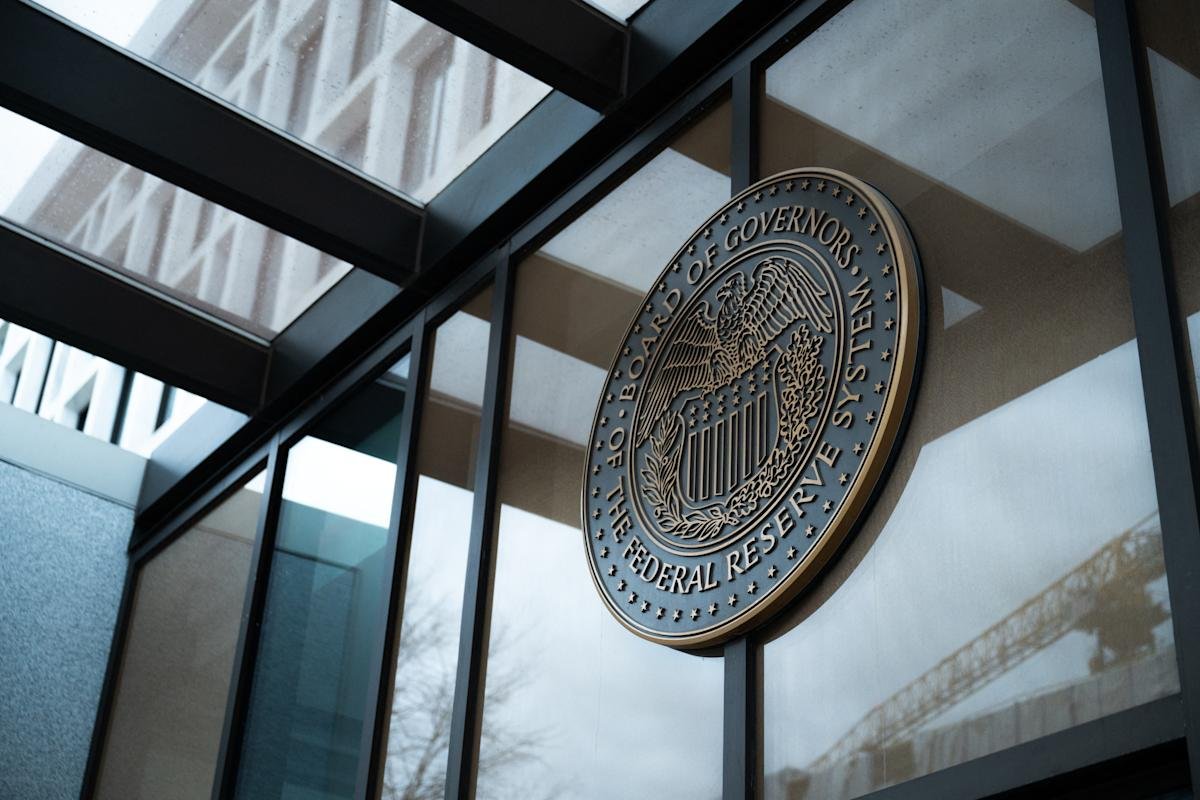
US stocks sank to session lows on Wednesday after the Federal Reserve voted to hold rates steady, while Chair Jerome Powell expressed concerns over progress over inflation.
The Dow Jones Industrial Average (^DJI) lost roughly 1.5%, or more than 600 points, following a second winning day in a row for Wall Street stocks. The S&P 500 (^GSPC) and tech-focused Nasdaq Composite (^IXIC) each fell over 1.1% and 1.2%, respectively.
The Fed decision following a two-day policy meeting received one dissent from Fed governor Stephen Miran, who favored a rate reduction. Officials kept their rate cut forecast steady for 2026.
Losses accelerated as Powell spoke on Wednesday and investor worries grew that the central bank could push out rate cuts in anticipation of higher inflation amid surging oil prices.
Stock had already been in decline on Wednesday after government data showed wholesale inflation accelerated 0.7% month-over-month in February, before the effects of the Middle East conflict gripped markets this month.
On Wednesday, Brent crude futures (BZ=F) rose to $104 a barrel, continuing their recent surge after Iran said some of its energy facilities had come under attack. West Texas Intermediate crude futures (CL=F) also turned higher, trading near $98.
LIVE 22 updates
-
Powell won’t leave board until DOJ investigation is over
Fed Chair Jerome Powell said he will not leave the board until the Department of Justice investigation on him is done.
“I have no intention of leaving the board until the investigation is well and truly over with transparency and finality,” said Powell on Wednesday.
Regarding whether he will continue as Fed governor after his term as Chair ends and the investigation is over, Powell said he has not yet made a decision.
-
Losses accelerate as Fed says progress on inflation not as ‘hoped’
Stock market losses accelerated after Fed Chair Jerome Powell suggested policy makers foresee inflation progressing this year, but not as much as anticipated.
“The forecast is that we will be making progress on inflation, not as much as we had hoped, but some progress on inflation,” said Powell on Wednesday afternoon during a press conference.
Right now, officials foresee one rate cut this year. Policy makers have been clear that inflation needs to be under control in order to cut.
“If we don’t see that progress then you won’t see the rate cut,” Powell told reporters.
Investors fear Fed officials may hold off on cuts if inflation surges as oil prices have topped $100 recently amid the Middle East war.
-
Fed holds rates steady, as expected
Yahoo Finance’s Jennifer Schonberger reports:
Read more here.
-

Food stocks are losing their defensive bid
At the end of February, Consumer Staples (XLP) was the third-best performing sector in the S&P 500 this year, up 15%.
But today’s intraday heat map of the food industry is red across the board.
General Mills (GIS) is one clear downside catalyst after reaffirming guidance into still-soft demand, while Unilever (UL) is under pressure as investors weigh a possible separation of its food business.
But this looks bigger than a few headlines. Kraft Heinz (KHC), Mondelez (MDLZ), Coca-Cola (KO), and PepsiCo (PEP) are all lower too, which says the whole food trade is getting marked down. The month-to-date heat map shows this is an ongoing trend.
That fits the broader setup. Staples had become an expensive hiding place, and now investors are backing away as earnings pressure, weak volumes, and private-label competition creep back into focus.
-
European natural gas prices jump as South Pars gas field is struck by Israel
Natural gas prices in Europe surged on Wednesday after Israel confirmed it had struck Iran’s South Pars gas field, taking a major source of gas that would typically flow to the Asian and European markets offline.
Futures on the European gas market (TTF=F) jumped roughly 8%, adding to the more than 80% jump in prices on the Dutch exchange over the past month. Futures on US Henry Hub natural gas (NG=F) gained roughly 4%, though the US market is much less exposed to Middle Eastern supply.
Iran’s South Pars gas field accounts for roughly a third of the world’s largest natural gas formation. Iran shares access to the formation with Qatar, which refers to its portion of the field as the “North Dome.” Though more than 90% of the gas Iran produces is used domestically, Qatar’s gas supplies much of the European and Asian markets via LNG exports.
Early Wednesday morning, Iran said the site had been subject to airstrikes, and Israel later confirmed the move. Iran’s Asaluyeh oil facilities were also targeted, according to regional media reports.
In retaliation, Iran published a list of potential targets it could move to strike throughout the Gulf, including the Ras Laffan refinery in Qatar, which has already declared force majeure after earlier attacks; the Samref oil refinery in Saudi Arabia; and the Al Hosn gasfield in the UAE, among other targets.
Iran’s semi-official news agency Fars said the country had taken several sites within the South Pars field offline, and Iraq’s electricity ministry said on Wednesday that shipments of natural gas it typically receives from Iran had stopped, taking roughly 3,100 megawatts of power offline, according to regional state media.
Iran issued an evacuation warning for several energy infrastructure sites throughout Saudi Arabia, the UAE, and Qatar on Wednesday, saying the sites could be targeted “in the coming hours.”
The Fars news agency reported a statement from Iran’s military operational command saying, “We consider the targeting of the source country’s fuel, energy, and gas infrastructure to be a legitimate cause for us, and at the first opportunity, we will retaliate with utmost severity.”
-
Swarmer stock soars another 80%, dwarfing IPO price
Shares of Swarmer (SWMR) surged 82% a day after the company’s eye-popping initial public offering. It was the top trending ticker on Yahoo Finance on Wednesday afternoon.
The stock closed its first day of trading on Tuesday at $31, valuing the company at $350 million. Tuesday’s gain represented a roughly 520% increase from its indicated price of $5 per share and a 148% increase from its opening price of $12.50 per share.
Swarmer is based in Austin, Texas, and develops software for autonomous drones that allows one operator to control hundreds of drones. Its technology has been tested in combat in Ukraine, though the company is currently unprofitable, bringing in about $310,000 in revenue in 2025.
-
Gold loses its $5,000 floor
Gold (GC=F) just lost the $5,000 price level, which had held for the past month.
The tape shows a stop run down to $4,850 — well below the 50-day moving average at $4,953, which has held since last August. Prices are now trying to stabilize after the flush.
This puts gold on track for its worst day in two weeks.
-
The market isn’t crashing, and that’s one reason why it’s not crashing
Paging Matt Levine.
As Nomura’s Charlie McElligott lays it out, investors bought downside protection for the kind of fast, ugly sell-off that makes put options suddenly very valuable. Instead, stocks have mostly churned, leaked lower, and bounced around in a way that feels bad without quite tipping into panic.
Crash hedges work best in an actual crash. In a slow bleed, they don’t pay enough, time decay starts to bite, and investors begin unwinding them.
Then the loop kicks in. When those hedges come off, that can create buying flows — or at least take away some selling pressure. High volatility adds a second twist by forcing funds to cut positions, which also means they need less protection.
So the bearish setup starts to undermine itself: Stocks do not fall fast enough for the protection trade to really work, and the failure of that trade helps keep stocks from falling fast.
-
Today’s new highs are crowded with energy names
Energy is still doing most of the heavy lifting at the top of the tape.
The 52-week highs list for US-listed stocks worth at least $1 billion is loaded with oil and gas names — from ConocoPhillips (COP) and Canadian Natural Resources (CNQ) to Equinor (EQNR), EOG Resources (EOG), Valero (VLO), and Marathon Petroleum (MPC). Most are up 30% to nearly 60% this year already.
The smaller energy names look even hotter. Liberty Energy (LBRT) is up over 70% in 2026 and has more than tripled from the low on April 8, 2025, while Solaris Energy Infrastructure (SEI) has more than quadrupled from that same point.
There are pockets outside energy, but they are just that.
Cloud company DigitalOcean (DOCN) is up over 70% this year, electrical equipment maker nVent (NVT) is up over 15% in 2026, and infrastructure play Quanta Services (PWR) keeps grinding higher, up over 35% on that time frame.
As far as fresh highs go, today still looks like a commodity-and-infrastructure tape — not a broad market free-for-all.
-
Chip stocks rise after Nvidia gives $1 trillion forecast
Shares of AI chipmakers were on the move in morning trading amid a flurry of news out of the sector.
Nvidia (NVDA) stock bounced 0.3% higher after starting the session lower. At the company’s annual developer conference, underway through Thursday, CEO Jensen Huang stated that the chipmaker received purchase orders for China-bound AI chips and that it was ramping up its production network to meet demand.
Huang also disclosed that the company expects AI chip sales to surpass $1 trillion by 2027, not including its latest products unveiled Monday.
Meanwhile, Advanced Micro Devices (AMD) stock gained 1.2% after the company reached a memorandum of understanding with Samsung Electronics (005930.KS) to expand their strategic partnership for memory chip supplies. In addition to working on a long-term advanced memory supply agreement, the companies will discuss partnering to create a foundry. Samsung stock jumped 7%.
Micron (MU), up 0.2% in early trading, was also in focus ahead of its earnings report after the closing bell. The company is facing high expectations going into its report as a memory chip supply crunch has sent prices soaring — and sent the stock soaring too. Year to date, Micron has rocketed 62% higher.
-
White House waives Jones Act in a bid to tame rising domestic energy prices
President Trump issued a temporary waiver for the Jones Act on Wednesday, according to Bloomberg, making the transport of seaborne cargo around the US cheaper as the administration attempts to combat the domestic effects of quickly surging energy prices.
The Jones Act, formally the Merchant Marine Act of 1920, requires that ships transporting cargo between US ports be American-built, American-flagged, American-owned, and American-crewed — costly requirements that raise the expense of domestic seaborne goods flows.
The president’s waiver allows foreign-flagged vessels to transport cargo around the US for 60 days.
In the oil markets, this has the biggest impact on the shipment of refined products such as gasoline from the refinery complexes along the Gulf Coast to the more isolated East Coast. While the waiver doesn’t apply to all products, it covers a range of energy commodities, including crude oil, refined oil products such as diesel and gasoline, natural gas, coal, fertilizer, and other energy-derived products, Bloomberg reported.
“President Trump’s decision to issue a 60-day Jones Act waiver is just another step to mitigate the short-term disruptions to the oil market as the U.S. military continues meeting the objectives of Operation Epic Fury,” White House press secretary Karoline Leavitt said in a statement posted on X. “The Administration remains committed to continuing to strengthen our critical supply chains.”
-
Why the dollar is today’s real Fed trade
Happy Fed Day to all who celebrate.
Today’s FOMC meeting lands on top of a crowded global bet.
BofA’s March Global Fund Manager Survey shows that big institutional investors are the most overweight on emerging market stocks since February 2021 and commodities since April 2022, while still underweight on the US dollar.
That puts the greenback at the center of today’s decision. Powell does not have to move rates to move markets.
If he sounds hawkish and the US dollar index (DX-Y.NYB) pushes back above 100, that could pressure the trades investors have piled into abroad. A softer tone would ease that pressure and give emerging markets stocks and commodities more room.
The level to watch is 100 on the dollar index. A clean break above it tightens the screws. Another rejection keeps the global risk trade alive.
-
Stocks fall at the open after hot wholesale inflation print
US stocks opened lower ahead of the Federal Reserve rate decision, which is expected to keep rates unchanged.
The Dow Jones Industrial Average (^DJI) dropped 0.4%, while the S&P 500 (^GSPC) and tech-focused Nasdaq Composite (^IXIC) lost 0.3%.
Ahead of the open, futures turned lower after a February reading of wholesale inflation came in hotter than expected. The Producer Price Index rose 0.7% in February over the previous month, an increase from January’s 0.5% rise.
Concerns about rising inflation have complicated the Fed’s path amid an oil supply shock stemming from the war in the Middle East. WTI crude oil (CL=F) traded at $97 a barrel at the open, while Brent crude (BZ=F) traded at $108.
Treasury yields rose at the open, with the 10-year yield (^TNX) climbing 2 basis points to 4.22%.
-
US producer prices rose more than twice as fast as expected in February
US producer prices rose more than twice as fast as expected in February, according to data released Wednesday by the Bureau of Labor Statistics.
Prices rose 0.7% in February over the previous month, up from January’s 0.5% and more than double economists’ expectations for an increase of 0.3%.
Excluding the more volatile food and energy costs, producer prices advanced by 0.5% over the previous month, outpacing the 0.3% growth economists had predicted but below the previous month’s gain of 0.8%.
On a year-on-year basis, headline prices rose by 3.4%, above estimates of 3% and the previous month’s 2.9% year-on-year increase. Prices ex-food and energy gained 3.9% year-on-year, hotter than estimates of 3.7% and the previous month’s 3.6%.
“Intermediate” prices for the inputs businesses buy to produce other goods and services underpinned the headline gains, led by energy goods and energy materials, which rose 5.5% and 6% over the previous month, respectively.
The Bureau of Labor Statistics noted that “nearly 30 percent of the February rise in the index for processed goods for intermediate demand can be traced to prices for diesel fuel, which increased 13.9 percent.”
Headline final demand prices — the closest producer-side measure to consumer prices — were led by food and energy prices, up 2.4% and 2.3%, respectively, over the previous month.
The index for processed goods for intermediate demand, up 1.6% in February, marked the largest monthly increase since gaining 2% in August 2023, the BLS said. The agency also noted that “sixty percent of the February advance is attributable to a 5.5-percent jump in prices for processed energy goods.”
-
Oil prices tick up as conflict remains hot in Middle East, Iraq resumes Kirkuk-Ceyhan exports
Oil prices ticked up in early morning trading on Wednesday as a bevy of headlines and attacks in the Middle East reinforced the risk facing energy markets.
Futures on Brent crude (BZ=F) picked up 3%, or roughly $3 per barrel, in the hours since 12 a.m. ET, while those on West Texas Intermediate (CL=F) gained 2%, or around $1.50.
On Wednesday morning, Iran confirmed the killing of Supreme National Security Council secretary Ali Larijani, a key leader for the regime, but said its leadership remains strong and committed to keeping the Strait of Hormuz closed.
The Iranian regime also said the US and Israel struck the massive offshore South Pars gas field, which Iran shares with Qatar — but Iran did not elaborate past saying the field was hit by airstrikes. Such a development would likely mark the first time since the outbreak of conflict in February that the US and Israel have targeted Iran’s energy infrastructure.
Axios reported around 8 a.m. ET Wednesday morning that the Israeli military had struck a gas facility inside Iran with the approval of the US, citing a senior Israeli official.
At the same time, upward price action is likely muted by the news that Iraq and the semi-autonomous Kurdistan region have reached an agreement to restart Iraqi crude exports through the Kirkuk-Ceyhan pipeline to the Turkish Mediterranean port of Ceyhan. However, the pipeline is only expected to have a capacity of roughly 250,000 barrels per day.
In the physical market, spot prices for Dubai and Oman oil grades are trading around $158 per barrel, or roughly $55 above the benchmark Brent futures contract, according to Bloomberg data, suggesting that the futures market could be significantly lagging reality.
-
Premarket trending tickers: Lumentum, Coherent Corp, Boston Beer, and Micron
Lumentum (LITE) and Coherent Corp (COHR) stocks rose 7% and 6% before the bell on Wednesday as investors weighed the latest comments from Nvidia (NVDA) about the role of optical networking. Lumentum, which is the market leader and manufacturer of optical and photonic products, saw its stock price swing on Tuesday after Nvidia said it would use both copper and optical networking during its GTC conference.
Boston Beer’s (SAM) stock fell 2% during premarket hours today. The beer company announced on Monday it will repurchase up to $25 million of its stock through a 10b5-1 plan.
Micron (MU) stock rose 2% before the bell on Tuesday. The digital memory and storage provider announced plans to build a second chip manufacturing facility in Taiwan on Monday and will report its earnings after the close today.
-
Macy’s earnings beats Wall Street’s low expectations, gives conservative outlook
Macy’s (M) posted better-than-expected fourth quarter earnings results as the department store chain heads into the third year of its turnaround strategy, called Bold New Chapter.
Adjusted earnings per share for the holiday quarter came in at $1.84, above the $1.54 the Street estimated, according to Bloomberg. Revenue came in at $7.6 billion, just above the $7.5 billion the Street was looking for.
The stock rose nearly 7% in premarket trading
Overall, same-store sales increased 1.8%, compared to 0.12% decline the Street forecast. Comparable sales grew by 2% for stores that Macy’s plans to keep open — those it invested in with new merchandise and more staff.
Same-store sales for its luxury business, Bloomingdale’s, grew nearly 10% during the quarter, which CEO Tony Spring said “underscores its ability to elevate the customer experience and capture demand across premium contemporary to luxury businesses” in the release. Wall Street analysts only expected a 2.5% pop.
Spring added, “At Macy’s, we are offering more relevant brands, stronger storytelling and investing in our colleagues so we can better serve the customer … looking to 2026 and beyond, we are ready to build on our progress.”
The company beat all key metrics, including earnings, revenue, and same-store sales growth, for its fiscal 2025 results.
For the upcoming fiscal year, it expects adjusted earnings to be in the range of $1.90 to $2.10, below the $2.21 the Street expected. That’s alongside revenue of $21.4 billion to $21.65 billion, which was above Wall Street’s predicted outlook of $21.1 billion.
Meanwhile, same-store sales are expected to range from a 0.5% decline to a 0.5% increase. The Street was looking for a 0.5% increase for this year.
-
Hormuz reopening looks unlikely without a truce in Iran war
From Bloomberg:
US President Donald Trump is desperate to reopen the Strait of Hormuz to ease a growing global energy crisis. He won’t achieve that easily without a ceasefire in the war on Iran.
… Trump has been pressing allies to send warships to help reopen the strait, proposing a multinational naval effort to escort commercial ships.
European and Asian partners are reluctant, with governments from Berlin to Tokyo questioning whether a handful of ships would make any difference against Iran’s ability to threaten vessels. Officials say additional navies would add little beyond the substantial US presence already in the region — and still fall far short of what’s needed to meaningfully unblock the strait.
“It could take several weeks to secure the Strait of Hormuz,” said Bob McNally, president of Rapidan Energy Group and a former White House official. “Until we’ve neutralized Iran’s layered, asymmetric capabilities — mines, fast attack craft, submarines and drones — we won’t want to put commercial or even escort ships through.”
-
NFE stock rises after announcing debt deal
New Fortress Energy (NFE) shares jumped 10% before the bell on Wednesday after announcing a massive debt restructuring deal. The plan cuts their debt from $5.7 billion down to $527.5 million and splits the company into two.
MT Newswires reports:
-
Gold steady near $5,000 as investors weigh Fed rate-cut path
Gold futures traded near $5,000 an ounce on Wednesday as investors weighed the Federal Reserve’s rate-cut path against inflationary risks from the war in the Middle East.
Bloomberg News reports: