The stock market is sending two messages at the same time, and that is exactly why it looks stronger — and stranger — than it probably should.
That is the straightforward part of the story. When supply risk rises and crude jumps, investors reach for the companies most directly positioned to benefit.
Nvidia, AI Brigade Defy The Oil Shock
The other message is coming from technology, and it should be pulling in the opposite direction. Higher oil usually feeds inflation anxiety, pushes out rate-cut expectations, and makes investors less willing to pay up for long-duration growth.
But that is not what March has looked like.
‘Under-The-Radar Support’
LPL Financial underscored this peculiar market pattern in a recent piece of market commentary.
“Energy stocks led the S&P 500 again this week, while technology provided notable under-the-radar support. Semiconductor shares were second only to energy among sub-industry groups thanks to well-received earnings from Oracle,” analysts at the independent broker-dealer and retail wealth management platform wrote.
Put those two signals together and you get a market with a split personality.
Exxon, Nvidia Tell Two Different Market Stories
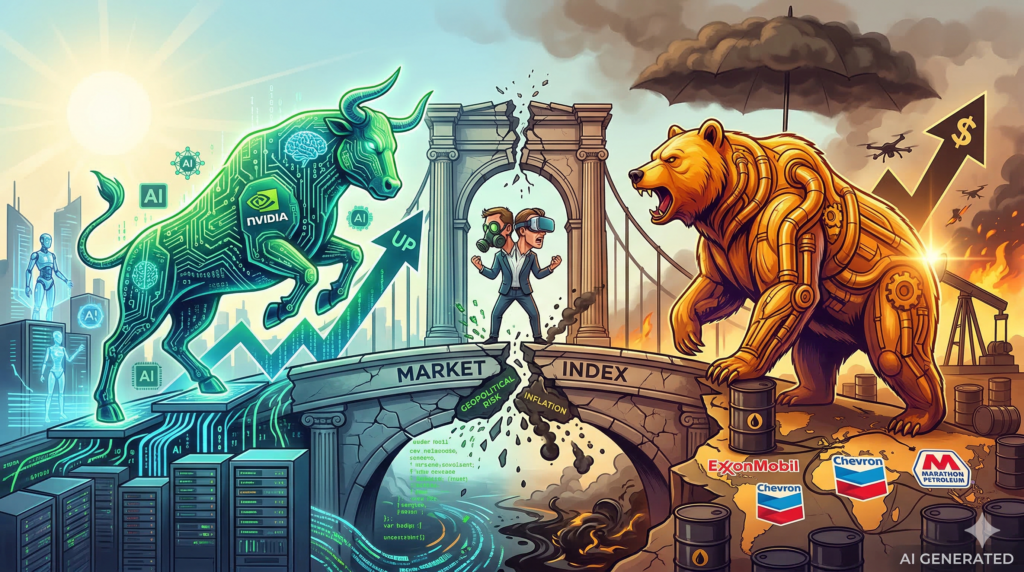
Exxon-type leadership says investors are pricing scarcity, inflation pressure, and geopolitical risk. Nvidia-type leadership says investors are still willing to pay for scale, earnings power, and the AI buildout despite all of that. That makes the index look more coherent than it really is.
The market is not expressing one clean macro view. It is expressing a truce between two competing stories: one defensive and commodity-driven, the other growth-hungry and still willing to believe the biggest AI winners can outgrow the macro noise.
That matters because the bullish case for tech has not disappeared.
BlackRock Still Loves AI, U.S. Stocks
It helps explain why the market keeps finding its way back to the same giant companies even when the macro backdrop turns uglier. But it also means the market’s resilience is leaning on a narrower and more conditional foundation than a headline index move might suggest. Big Tech is still being bought, but increasingly on a stock-by-stock basis rather than as one giant, frictionless trade.
Split Personality = Structural Tension
But that is also a more demanding standard than before. The market is no longer simply cheering “AI” as a category. It is starting to ask which companies can fund the spending, which ones can monetize it, and which ones are being priced for a level of perfection that gets harder to maintain as oil rises and rates stay sticky.
This is why the “split-personality” label is not just colorful phrasing. It captures a real structural tension in the tape. Energy leadership says investors are preparing for a world with scarcer supply, higher inflation pressure, and fatter profits for commodity producers.
Semiconductor and selective Big Tech leadership says investors are still betting that the AI buildout remains important enough to overpower those headwinds. Those two ideas can coexist for a while. In fact, March shows they already are coexisting. But they do not point to the same economic future, and that is the part investors should be taking more seriously.
Image created using artificial intelligence via Gemini.
This content was partially produced with the help of AI tools and was reviewed and published by Benzinga editors.
Market News and Data brought to you by Benzinga APIs
© 2026 Benzinga.com. Benzinga does not provide investment advice. All rights reserved.
To add Benzinga News as your preferred source on Google, click here.