Key Points
-
With recession fears ramping up, it’s wise to start preparing your portfolio.
-
Staying invested right now can reduce risk and increase long-term earning potential.
-
Investing in the right stocks is key to surviving a recession.
Stock prices have been sliding, and major indexes recently reached new lows for the year. The S&P 500 (SNPINDEX: ^GSPC)is down by nearly 6% from its peak, as of this writing, with the Nasdaq Composite (NASDAQINDEX: ^IXIC)falling by around 9% after recently entering correction territory.
This doesn’t constitute a market crash, and the U.S. is not in a recession right now. But if the economy worsens and stock prices fall further, three investing moves can help protect your portfolio.
Will AI create the world’s first trillionaire? Our team just released a report on the one little-known company, called an “Indispensable Monopoly” providing the critical technology Nvidia and Intel both need. Continue »

Image source: Getty Images.
1. Avoid panic selling
It can be tempting to sell off your investments when stock prices are in freefall. After all, if the market continues this downward slide, there’s a good chance your portfolio might lose even more value.
The challenge in selling your stocks right now, though, is that nobody knows what the market will do in the coming months. If you sell after prices have already sunk but then the market quickly rebounds, you may end up selling at a loss and missing out on future gains.
It’s not unheard of for the market to unexpectedly rebound. At the beginning of the COVID-19 pandemic, the S&P 500 lost roughly one-third of its value in less than a month. Almost immediately, though, it bounced back and went on to set new record highs.
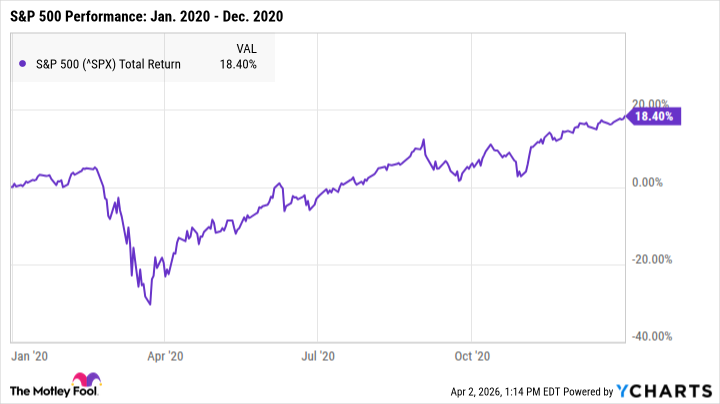
Again, we don’t know for certain whether the market will experience a similar recovery this time around, and there’s always a chance stock prices will sink deeper. But that uncertainty is what makes it risky to sell your investments now.
2. Stay invested for the long haul
Fortunately, with a long-term outlook, it doesn’t matter as much what the market does in the near term. Even if prices have much further to fall, it’s incredibly likely that major indexes will be setting new records in the next decade or so.
The average S&P 500 bear market since 1929 has only lasted around nine months, according to analysis from Bespoke Investment Group. Meanwhile, the average bull market lasted close to three years. While recessions and bear markets are tough to stomach, the good times have historically outweighed the bad.
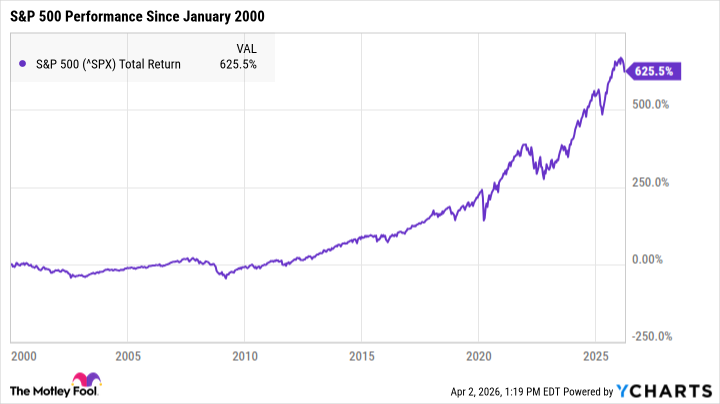
In the last two decades alone, we’ve experienced historic volatility. Yet if you’d invested in an S&P 500 index fund in January 2000 and held it through all the rough patches, you’d have earned total returns of around 625% by today.
3. Only invest in high-quality stocks
High-quality stocks from healthy companies are far more likely to withstand volatility and deliver positive long-term returns. The more of these stocks you own, the better your portfolio’s chances of pulling through even the worst recession or bear market.
Healthy stocks have robust foundations. They should be on strong financial footing to survive tough economic times, for example, but they’ll also ideally have a competitive advantage over peers, a competent leadership team, and potential for growth in their industry.
Weak companies can appear to thrive when the market is surging and investors are eager to buy, but these stocks may crash hard during a recession. By checking that all your stocks have strong underlying fundamentals and holding those stocks for at least a few years, you’ll be far more prepared for whatever the market may throw at you.
Where to invest $1,000 right now
When our analyst team has a stock tip, it can pay to listen. After all, Stock Advisor’s total average return is 926%* — a market-crushing outperformance compared to 185% for the S&P 500.
They just revealed what they believe are the 10 best stocks for investors to buy right now, available when you joinStock Advisor.
*Stock Advisor returns as of April 4, 2026.
Katie Brockman has no position in any of the stocks mentioned. The Motley Fool has no position in any of the stocks mentioned. The Motley Fool has a disclosure policy.
This article contains syndicated content. We have not reviewed, approved, or endorsed the content, and may receive compensation for placement of the content on this site. For more information please view the Barchart Disclosure Policy here.