Uber (UBER) reported rising revenue and trips as well as upbeat guidance before the bell on Wednesday, as the ride-hailing giant performs in a tough macroeconomic environment.
Uber’s first quarter gross bookings came in at $53.72 billion vs. $52.9 billion expected, up 25% year over year and better than Uber’s guidance range of $52 billion to $53.5 billion.
Uber said trips grew 20% year over year to 3.6 billion, with monthly active platform consumers (MAPCs) up 17% year over year to 199 million.
Uber stock jumped over 7% in early trading.
Uber reported Q1 revenue of $13.20 billion vs. $13.33 billion, per Bloomberg consensus, up 14% from a year ago. The company posted adjusted earnings per share (EPS) of $0. 72 vs $0.71 expected, with adjusted EBITDA of $2.48 billion vs $2.44 billion estimated, up 33%.
“Uber is off to an exceptional start in 2026, with gross bookings and non-GAAP EPS at or above the high end of our guidance, despite a complex macro backdrop marked by weather disruptions, geopolitical tensions, and gas price volatility,” CEO Dara Khosrowshahi said in his prepared remarks.
Investors were also buoyed by Uber’s second quarter guidance. For Q2 2026, Uber projects:
-
Gross bookings of $56.25 billion to $57.75 billion, up 18% year over year.
-
Adjusted earnings per share of $0.78 to $0.82, up 31% to 38% year over year.
-
Adjusted EBITDA of $2.7 billion to $2.8 billion.
Uber is also one of many companies in the travel and mobility space catering to higher-end consumers, who are spending more and are less susceptible to economic conditions.
“We’re already seeing strong momentum in premium, with Uber for Business (U4B) growing more than twice as fast as Mobility overall, as we continue to lead in corporate travel globally. Building on this, we introduced Uber Elite, our most elevated ride experience to date, designed for executives and frequent travelers,” Khosrowshahi said.
The slew of recent moves by the company builds on the focus on premium
The company unveiled Uber Autonomous Solutions, a new business unit designed to help partners build and commercialize AV fleets globally on Uber’s network.
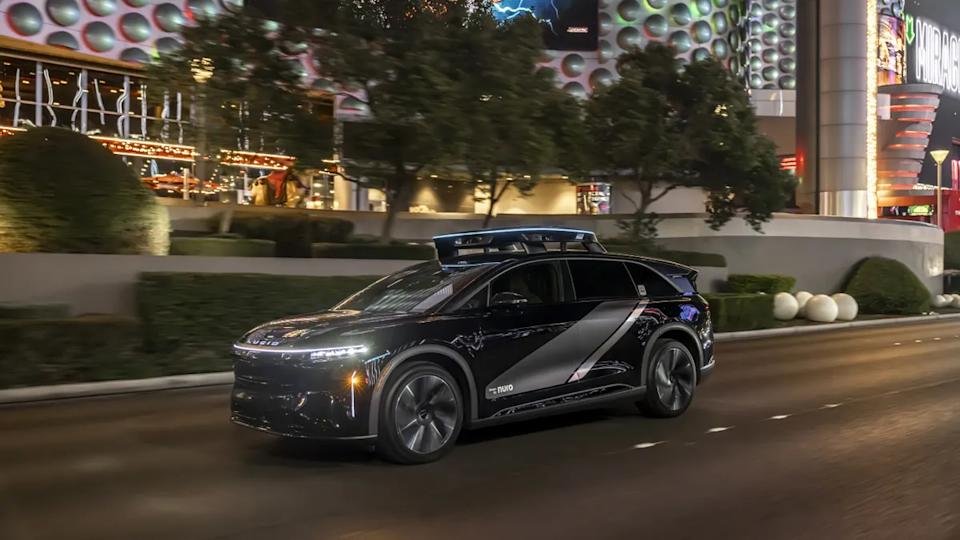
Uber upped its commitment to the partnership with Lucid (LCID) to $500 million in April and now owns more than 11% of Lucid Motors. Uber’s robotaxi network will use Lucid electric vehicles and Nuro Level 4 autonomous software, with both using Uber’s demand-matching platform.
Uber and its fleet partners will also purchase 10,000 Rivian (RIVN) R2 robotaxis, with an option to purchase an additional 40,000 in 2030. Initial deployments will start in San Francisco and Miami in 2028, with plans to scale to 25 cities by 2031.