Published: 11 May. 2026, 16:20
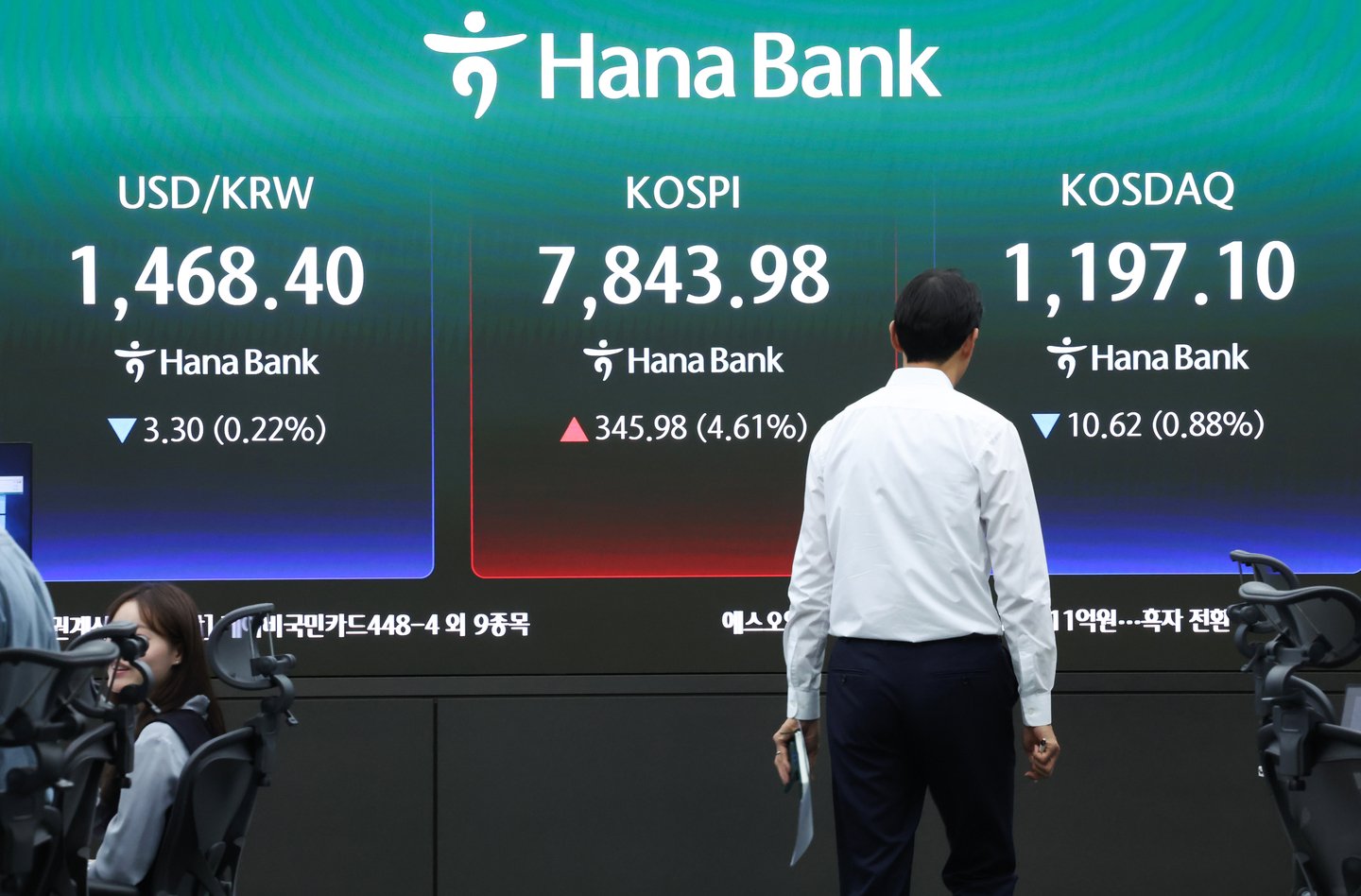
![A man walks by a display of the Kospi and Kosdaq benchmarks at the main trading room of Hana Bank in Jung District, central Seoul, on May 11. [NEWS1]](https://10xwealthreport.com/wp-content/uploads/2026/05/echo/c0ba385a-51d4-4495-83ba-734642331ce8.jpg)
A man walks by a display of the Kospi and Kosdaq benchmarks at the main trading room of Hana Bank in Jung District, central Seoul, on May 11. [NEWS1]
A Financial Supervisory Service (FSS) official said Monday that the watchdog does not believe the recent stock market to be overheated despite the benchmark Kospi surging past the 7,800 mark, citing ample market liquidity, strong trading activity and manageable levels of leveraged investing.
Hwang Seon-oh, the FSS senior deputy governor who oversees capital markets, said the recent rally remains supported by fundamentals even amid persistent geopolitical uncertainties during a monthly briefing at the agency’s headquarters in Yeouido, western Seoul.
“Korea’s stock market has continued a strong upward trajectory, surpassing the 7,000-point level on the Kospi, helped by capital market normalization policies and improving corporate earnings despite continued external uncertainties such as the war in the Middle East,” Hwang said.
The remarks come as the benchmark Kospi has extended its sharp gains in recent weeks, recently climbing above the 7,800 threshold for the first time intraday.
Hwang said the regulator considers market liquidity and trading activity to remain sufficiently strong. Funds parked on the sidelines — including investor deposits and balances in cash management accounts (CMAs) — currently total about 243.4 trillion won ($165 billion), according to the FSS.
Daily average trading value on the Kospi has also more than doubled, rising 139 percent to 29.6 trillion won this year from 12.4 trillion won last year.
Hwang also said leveraged stock investing remains broadly manageable, citing an 8.4 trillion won increase in margin loan balances to 35.7 trillion won at the end of April, up from 27.3 trillion won at the end of last year. This accounted for just 0.58 percent of total market capitalization — the lowest level in the past five years.
However, the FSS has warned that sharp market declines could amplify investor losses through forced liquidations.
On March 5, shortly after the outbreak of the Middle East conflict, forced sales triggered by margin calls totaled 108.4 billion won, roughly 22 times higher than last year’s daily average of 4.8 billion won.
Hwang expressed greater concern over money flowing disproportionately into high-risk investment products and the spread of ultrashort-term trading.
Turnover in exchange-traded funds reached a record 21.58 percent this year, while turnover in leveraged and inverse exchange-traded funds (ETFs) climbed as high as 70 percent.
“There is clearly concentration in leveraged ETFs,” Hwang said. “But the movement of investor funds is not an area that supervisory authorities should mechanically control. It is more appropriate to guide sound investment behavior through financial education.”
Separately, the FSS plans to sharply shorten accounting review cycles for listed companies to accelerate the removal of poorly performing firms from public markets.
The regulator said it will establish a road map this year to inspect Kospi-listed firms every 10 years and Kosdaq-listed companies every five years, down from the current average review cycle of about 20 years.
The stricter 10-year cycle will be immediately applied to companies included in the Kospi 200 index.
The FSS plans to impose a liquidity coverage ratio above 100 percent on major investment banks to mitigate liquidity risks arising from maturity mismatches as they expand short-term note issuance and integrated management accounts.
This article was originally written in Korean and translated by a bilingual reporter with the help of generative AI tools. It was then edited by a native English-speaking editor. All AI-assisted translations are reviewed and refined by our newsroom.
BY KIM DA-YOUNG [[email protected]]