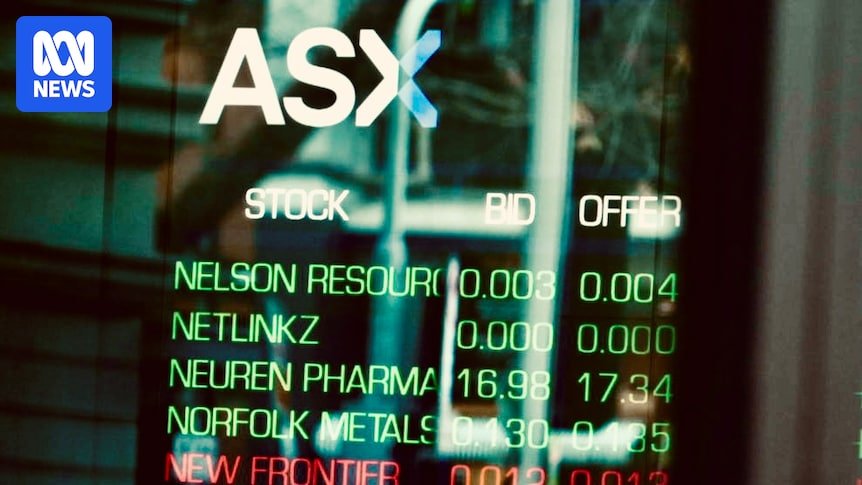
As the nation digests last night’s budget, Australian shares are in negative territory, with the ASX 200 sharply down at the opening today before recovering some of its losses.
It comes after a mixed night on Wall Street, with the Dow Jones rising 0.1 per cent, the Nasdaq falling 0.7 per cent, and the S&P 500 dropping 0.15 per cent.
The US markets were spooked by the consumer price index (CPI), which rose by 3.8 per cent in the 12 months to April, the worst numbers since May 2023.
Follow the day’s financial news and insights from our specialist business reporters on our live blog.
Disclaimer: this blog is not intended as investment advice.
Market snapshot
- ASX 200: -0.2% to 8,653 points
- Australian dollar: +0.1% to 72.42 US cents
- Wall Street: S&P500 -0.2%, Dow +0.1%
- Europe: FTSE -0.1%
- Spot gold: -0.2% to $US4,704/ounce
- Spot silver: +2.2% to $US87.43/ounce
- Oil: Brent futures -0.96% to $US107.07/barrel, WTI futures -0.5% to $U101.67/barrel
- Iron ore: -0.3% to $US111.11/tonne
- Bitcoin: +0.7% to $US81,005
Prices current at around 12.10pm AEST
Live updates on the major ASX indices:
Financials biggest laggard in ASX
The Financials sector has lost 3.1%, with Commonwealth Bank the worst performing, down 8.9% to $155.95 per share.
Looking at the rest of the big four banks, Westpac also fell 2.5%, followed by NAB and ANZ, down 1% and 0.6%, respectively.
Trump Tower won’t go ahead
Plans for a $1.5 billion Trump Tower on the Gold Coast have been scrapped less than three months after the deal was made.
The 91-storey, branded tower was announced on social media in late February by Eric Trump, US President Donald Trump’s second son.
The Trump Organization has removed the project from its website, while the developer says the brand is “toxic”.
Read more here:
Biofuels door opens a crack wider
The biofuels industry has had a problem.
We’ve got the feedstock (ingredients).
(So much so that we send 70% of our canola overseas to be turned into biofuels, a situation the Resources Minister Catherine King calls “nuts”.)
We’ve got the land.
We’ve got the refineries. They’re not operating at capacity – even in the middle of a ‘fuel crisis’ and much of what they make they export.
What it hasn’t had is consistent demand. Most of the industry has wanted a ‘demand side’ mechanism so it would have the certainty to invest and grow.
Without it, the prices work now – when global oil prices are elevated and there are concerns about supply – but not if the conflict in the Strait of Hormuz is sorted out and importing becomes cheap again.
So a significant move in the budget, but with no dollars attached.
Here’s what it says:
“We are continuing to develop a domestic low carbon liquid fuel industry, along with a green fuel bunkering strategy.
“Working with industry, we will introduce a demand measure that provides certainty for new Australian low carbon liquid fuel production and stimulates investment in new, clean fuel refining capacity. This will reduce our reliance on imported fuels, improving the resilience of our domestic transport industry.”
To me, that sounds like they will introduce a demand measure.
The scale of it, the ambition, will define how many billions get locked into building new refineries and pipelines.
🎧What the budget means for petrol prices
We all feel the pinch at the bowser, but what does last night’s federal budget mean for petrol prices?
In this episode, Carrington Clarke and Alan Kohler help you stay on top of the numbers behind the ongoing energy crisis on Fuelcast on ABC Business Daily.
You can have a listen here.
Post budget: how will the proposed tax changes affect you?
Hello, Lin from the business team here.
Post budget, we’re examining the real-life impact of the federal government’s key changes to capital gains tax and negative gearing.
I’m particularly interested in hearing from people who invest outside the property market, including those who hold shares, ETFs, crypto or other alternative assets, and have question/concerns about how the changes could affect their long-term plans.
We’d also like to hear from rentvestors, people who rent where they want to live, while investing elsewhere , and whether the changes could affect the way you build wealth, save for a home, or plan for early retirement.
Are you affected? You can share your story in the comments below, and include your contact details if you’re happy for an ABC journalist to get in touch.
Or you can email me directly at lin.lin@abc.net.au.
Biofuels backer readies to spend billions
You don’t hear a lot of ‘set you on your arse’ moments when you’re doing interviews about infrastructure, but when I sat down with IFM Investors Global Head of Asset Management Danny Elia to talk about biofuels I should have known someone with US$266 billion in assets under management would have a bit to say.
I asked him about what would happen if the government brought in a mandate – enforcing the blending of fuel made from organic material with our largely imported refined fuels.
Here’s what he said, before the budget:
“Well if we got a mandate today, I would turn up to my investment committee tomorrow, asking for ($3 billion) support to invest in what would be our first plant, which would produce 8% equivalent of the country’s aviation fuel.
“That’s the importance of a demand signal, so that certainty, that mandate is really important. We think this country’s got the ability to produce, by around 2030, 2032, about a billion litres of low carbon liquid fuel. And grow exponentially from there. So we’re looking for those kinds of signals.”
It’s not as simple as that, but the government has committed to working with industry to bring in a mandate.
Here’s a statement Danny released a short while ago, speaking on behalf of IFM Investors, which is the investment arm of the industry superannuation funds:
“We welcome the Government’s commitment to introduce a demand measure that provides certainty for new Australian low carbon liquid fuel production and stimulates investment in new, clean fuel refining capacity.
“Developing a domestic low carbon liquid fuels industry will strengthen Australia’s long-term fuel security and sovereign production capability at a time of ongoing global uncertainty.
“Clear demand signals will unlock investment, providing the certainty needed to accelerate projects and establish a competitive Australian market for sustainable aviation fuel and renewable diesel.
“IFM Investors, alongside Ampol and GrainCorp, are working to deliver 750 million litres of new Australian-made lower carbon diesel or jet fuel – that’s enough to fuel eight per cent of all flights out of Australian airports.
“This is an important step towards establishing an industry that has the potential to improve fuel security, create new jobs – and at the same time, deliver for the long-term retirement savings of working people.”
Australia’s outlook ‘shaped by risks from slowing growth’
Moody’s, the global financial risk assessment and analytics firm, has weighed in on the federal budget.
It says Jim Chalmers has delivered a plan that targets “significant improvements” but warns of “slowing growth.
“The federal government budget addresses a range of objectives in a challenging environment, targeting significant improvements in the fiscal and debt outlook, predominantly through cost savings driven by large reductions around disability insurance (NDIS),” said Singapore-based Anushka Shah, Vice President and Senior Credit Officer, Moody’s Ratings.
“Going forward, the fiscal outlook will also be shaped by risks from slowing growth, owing to supply chain disruptions due to the Middle East conflict, as well as slowing productivity. Structural costs on defense, healthcare, and climate change will further complicate these challenges.”
Moody’s added that “implementation will be key to achieving these outcomes, particularly given the current environment of rising inflation and weaker growth”.
Wednesday woes so far
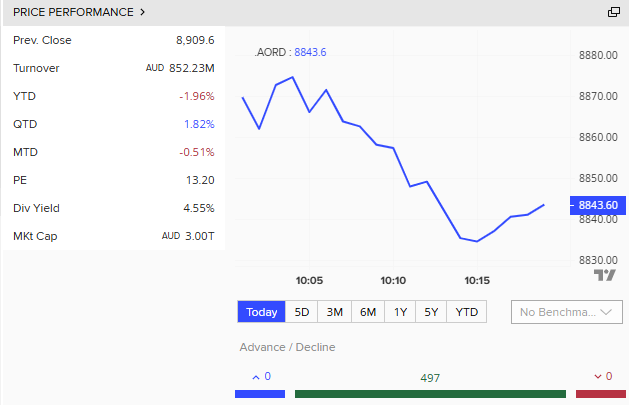
The ASX 200 and the All Ordinaries have both started the day in negative territory and are continuing to slide.
Within the first 20 minutes of Wednesday’s trading, the ASX had shed more than 0.7% or 62 points.
The All Ords was also down sharply.
This comes after a mixed night on Wall Street.
ASX 200 opens lower
Australian shares are sharply down in early Wednesday trading in the first session since Tuesday night’s budget.
The ASX 200 has dropped 46 points or 0.6% to sit at 8,622.3
On Tuesday, we saw the ASX record its 15th decline in the past 19 sessions.
At the moment, that run is likely to be extended to 16 out of the last 20 trading days.
Tax cut calculator
Treasurer Jim Chalmers mentioned a string of “tax cuts” in his federal budget speech, talking up how the measures could put more money into the pockets of working Australians.
How much could the 2026 federal budget measures save you?
Try out tax cut calculator here.

‘We are going to kneecap young Australians’
The Coalition has declared it will fight moves to restrict negative gearing and amend the capital gains tax discount.
It says the government’s tax reform package will increase the cost of rent, result in fewer homes, and make it harder for young people to get into the housing market.
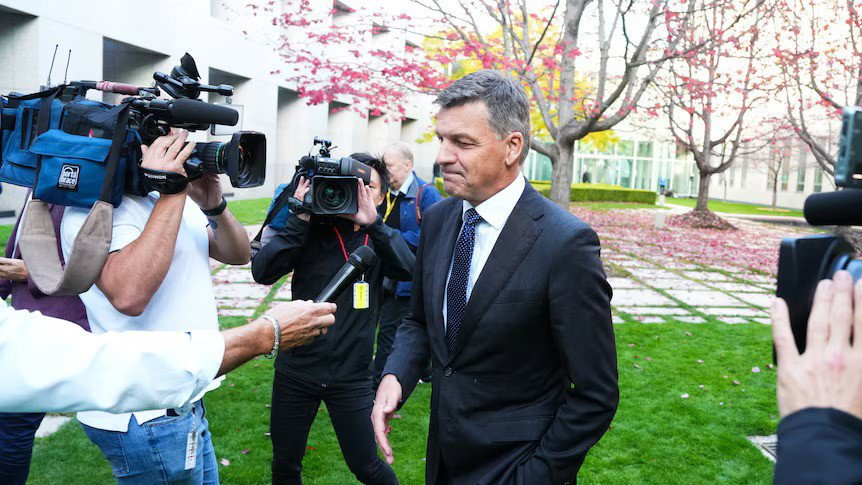
Ahead of the budget reply speech by Opposition Leader Angus Taylor on Thursday, Shadow Treasurer Tim Wilson said the changes could have the opposite effect to what the government hoped.
“What the government has done is turned around and said we’re going to protect the existing arrangements for those who’ve accumulated wealth, but we are going to kneecap young Australians in their chance to get ahead,” Mr Wilson told RN Breakfast.
Read more here.
Brazil’s Lula scraps taxes on international purchases ahead of re-election bid
There’s nothing like dangling the removal of taxes before an election.
Brazil President Luiz Inacio Lula da Silva on Tuesday signed an executive order to eliminate federal taxes on all international purchases worth up to $US50 ($69).
Lula had previously imposed the highly unpopular levy in 2024, but reversed course as he gears up to seek re-election in October.
Discretionary trusts dead by ‘default’ from 2028
Understandably, negative gearing and capital gains tax dominated discussion last night.
Less discussed were changes to discretionary trusts, a way of structuring that tends to reduce tax and tends to be only used by rich people (due to the cost of setting them up and running them).
Dhanushka Jayawardena, a partner at large national law firmHolding Redlich,had this to say about the implications:
“The government has just done what 25 years of tax reform reviews recommended and neutralised the tax advantage of discretionary trusts over companies.
“With both vehicles now sitting at or around 30%, and small business companies sitting below that at 25%, the case for a discretionary trust collapses to non-tax considerations.
“Asset protection and succession planning remain valid reasons to choose a trust. Tax efficiency is no longer one of them.
“We expect a meaningful migration into corporate structures over the three-year rollover window, and a near-universal default to companies for new structures from 2026 onwards.
“While the changes don’t kick in until 2028, those looking to set up new structures from this year onwards should consider the changes.”
Meta employees protest against mouse-tracking tech at US offices
Things aren’t exactly happy at Meta’s US offices.
It’s bad enough with Meta set to lay off 10% of its workforce in a week’s time.
Now Meta employees are protesting against the company’s recent installation of mouse-tracking software on their computers.
They’ve distributed flyers encouraging staffers to sign an online petition against the move.
The flyers, which appear in meeting rooms, on vending machines and atop toilet paper dispensers, ask “Don’t want to work at the Employee Data Extraction Factory?”
Some employees are furious about the company’s plans to reshape its workforce around AI into labour-organising efforts.
For months, Meta staff have seethed on internal platforms and online forums over the company’s plans for deep layoffs this year — which it confirmed to staffers more than a month after it was first reported — and the introduction of mouse-tracking software that many employees see as tantamount to helping design their own bot replacements.
But Meta spokesperson Andy Stone defended the move.
“If we’re building agents to help people complete everyday tasks using computers, our models need real examples of how people actually use them — things like mouse movements, clicking buttons, and navigating dropdown menus,” he said.
With reporting by Reuters
‘Really significant’ tax changes will be welcomed by RBA, says former assistant governor
Westpac’s chief economist Luci Ellis says the government “has really bit the bullet” on key changes to negative gearing and capital gains tax.
“The tax changes on negative gearing and capital gains are really significant,” she told Sally Sara on Radio National Breakfast.
“These are changes that everybody thought was politically impossible.”
The former Reserve Bank assistant governor (economic) said the RBA had long argued that the interaction of the 50% capital gains tax discount with negative gearing was contributing to housing unaffordability.
“The Reserve Bank every couple of years has done a submission, there’s been another inquiry whether in parliament or elsewhere about housing affordability, and the RBA dutifully puts in a submission,” she commented.
“And often they’ll say, ‘It’s not negative gearing on its own, it’s the way it interacts with concessional capital gains tax’, and suddenly a government has actually dealt with that, so it’s an intergenerational issue they’re addressing.”
Ellis said the RBA was also concerned about the increased debt that the tax policies prompted investors to take on.
“It’s also a financial stability issue,” she observed.
“If you go back to all those submissions that the RBA’s made, that was what was concerning them — that the tax system did overly encourage leveraged investment in property.”
There’s a fair chance Ellis authored or oversaw many of those submissions in her lengthy stint at the RBA, so she knows what she’s talking about.
You can listen to the full interview here:
Australians are still buying petrol-guzzling cars
Sales of large utility vehicles have been minimally impacted by rising fuel costs in March and April.
According to data from the Federal Chamber of Automotive Industries (FCAI), sales of 4X4 utes have decreased to 13,251 compared to 15,672 in April last year.
However, 4X2 sales have slightly increased to 1,775 in April this year from 1,719 in April last year.
Electric vehicles now make up 16 per cent of the total market share.
Read more here:

🎙️ A big budget all about housing
Treasurer Jim Chalmers unveiled his highly anticipated fifth budget, claiming it’s the “most ambitious and important in decades”.
Housing tax reform was the centrepiece, with changes to negative gearing and the capital gains tax discount announced.
Labor says the reforms will allow 75,000 people to afford their first home, but does the move go far enough to address intergenerational inequity? Will voters reward them for taking a risk, or punish them for “breaking a promise”?
And as inflation continues to surge, how healthy is the budget bottom line?
Carrington Clarke and Patricia Karvelas break it all down from the budget lock-up on this ABC Business Daily x Politics Now special episode:
‘Seek forgiveness, not permission’
ABC News business editor Michael Janda has referenced former opposition leaders Bill Shorten and John Hewson as he dissects changes to negative gearing and the capital gains tax discount in last night’s federal budget.
They promise to make a significant impact on Australia’s housing market.
Hewson’s overly ambitious economic reforms saw him lose to Paul Keating in 1993. But Shorten’s “too much, too soon” approach scuppered his PM hopes a mere seven years ago.
And Michael explores whether the changes will make housing more affordable to first-home buyers.
Read the full analysis:
US inflation at 3.8 per cent
You’ll remember Australia’s inflation rate spiking to 4.6% in the 12 months to March — the highest since September 2023.
Well, the US has released its worst numbers in almost three years overnight.
A surge in the cost of petrol and groceries pushed America’s CPI to 3.8% in the 12 months to April.
That’s the highest since inflation touched 4% three years ago under former president Joe Biden.
The CPI increased 0.6% last month after surging 0.9% in March, the Labor Department’s Bureau of Labor Statistics said.
With no end in sight to the US-Iran war, economists warned prices would continue to push higher and broaden in the months ahead.
US President Donald Trump on Monday proposed reducing the 18.4-cent federal gasoline tax to lower surging prices at the pump.
“Prices are going up everywhere you look and families everywhere are struggling to keep up,” said Janelle Jones, a visiting senior fellow at the Century Foundation.
“Measures like suspending the gas tax will provide short-term relief, but it’s robbing Peter to pay Paul. What families really need is an end to this war and leaders that are committed to ending the affordability crisis.”
A 3.8% increase in energy prices accounted for more than 40% of the rise in the CPI last month.
That followed a 10.9% jump in March. Gasoline prices rose 5.4% after a record 21.2% surge in March. Other motor fuels, which include diesel, increased 17.0%. Consumers also paid higher prices for electricity amid strong demand from data centres to power artificial intelligence.
Food prices accelerated 0.5% after being unchanged in March. Grocery store inflation shot up 0.7%, the largest increase since August 2022. Beef prices increased 2.7%, the most since November 2024. Coffee prices rose 2.0%. Fruits and vegetable prices climbed 1.8% while nonalcoholic beverages cost 1.1% more. There were also strong increases in the prices of dairy and eggs.
Fertilizer shortages are expected to drive food prices higher. In the 12 months through April, the CPI advanced 3.8%. That was the biggest year-on-year increase since May 2023 and followed a 3.3% rise in March.
With reporting by Reuters