The S&P 500 (^GSPC 0.16%) fell sharply in March when the Iran conflict pushed oil prices above $100 per barrel for the first time since 2022. The index has already recovered its losses, but the rebound may have been premature.
Geopolitical tensions are still elevated, energy prices are still increasing, and no one knows when the situation will improve. Federal Reserve Chair Jerome Powell said as much during a recent press conference: “The economic outlook remains highly uncertain and the conflict in the Middle East has added to this uncertainty.”
Meanwhile, Fed officials recently warned that inflationary pressure could lead to interest rate hikes, and the S&P 500 just sounded an alarm last witnessed during the dot-com crash. Here’s what investors need to know about the current market environment.

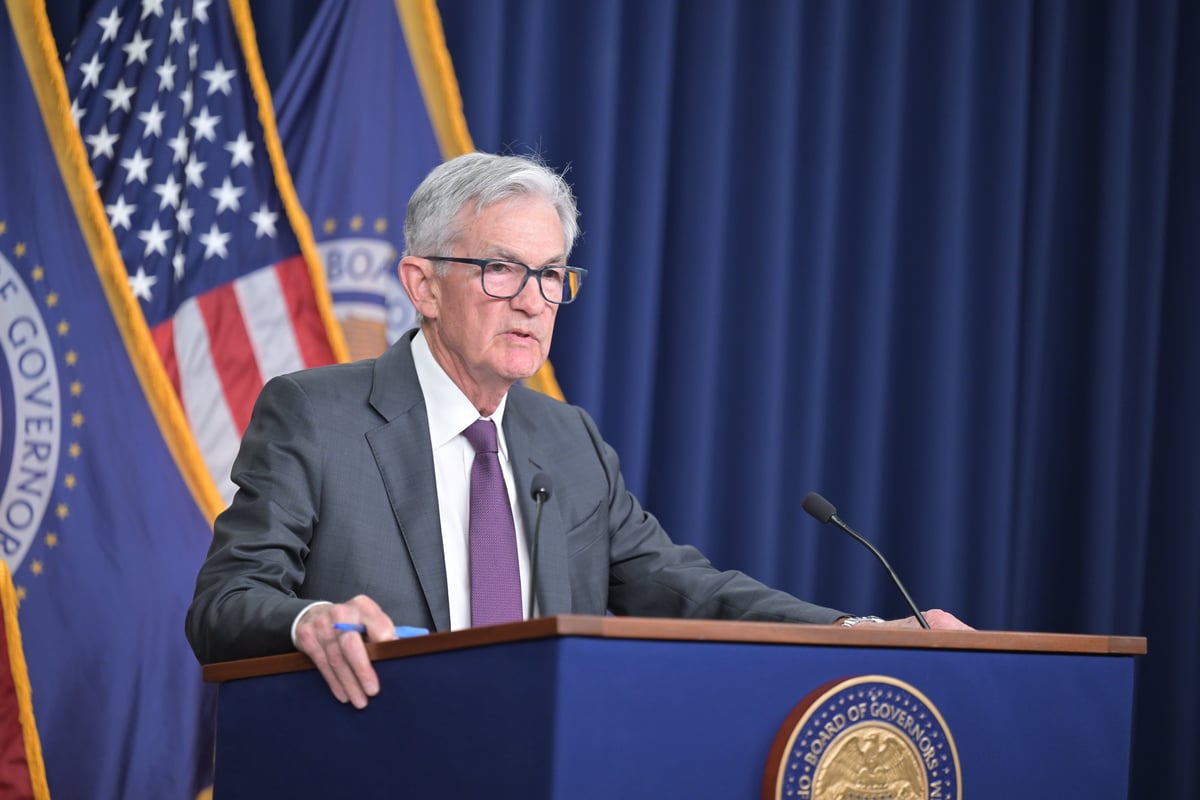
Federal Reserve Chair Jerome Powell addresses reporters at a press conference. Image source: Official Federal Reserve Photo.
The Federal Reserve says inflationary pressure could lead to interest rate hikes
The Federal Reserve’s biannual financial stability report identifies and assesses risks to the U.S. financial system. The latest report was released in May 2026, and it ranked geopolitical tension and elevated oil prices as the most pressing concerns.
“Inflationary pressure from an energy shock could force central banks to tighten monetary policy even if economic growth were to weaken,” warned the Fed Board of Governors. That could be particularly bad in the current environment because stocks already trade at very rich valuations by historical standards.
Under normal circumstances, the Fed would cut rates to stimulate a weak economy. But inflation accelerated substantially in March due to soaring energy prices caused by the Iran conflict, and inflation may continue climbing as the oil shock drives up manufacturing and transportation costs. In that scenario, the Fed may be forced to raise its benchmark rate.
That could sink the stock market in several ways. Higher interest rates would hurt corporate earnings, both directly by increasing interest expense and indirectly by reducing consumer demand. Higher interest rates would also make bonds more attractive, which could cause investors to sell stocks.
Historical context is valuable here. The Federal Reserve’s last rate-hike cycle started on March 17, 2022, and the S&P 500 fell 17% in the next three months. In fact, the Fed has initiated four rate-hike cycles since 1999, and the S&P 500 has always declined over the next three months, with an average drawdown of 7%.
The stock market sounds an alarm last seen during the dot-com crash
The cyclically adjusted price-to-earnings (CAPE) ratio, sometimes called the Shiller PE, is a valuation metric used to evaluate entire stock market indexes. As of early May, the S&P 500 had a CAPE ratio of 39.6. Excluding the last few months, the index has not traded at such a high valuation since the dot-com crash in September 2000.
In fact, the S&P 500’s average CAPE ratio has only exceeded 39 during 27 months since its creation in 1957. In other words, the S&P 500 (a benchmark for the U.S. stock market) has only been this expensive about 3% of the time in the last 70 years, and such rich valuations have historically correlated with dismal future returns.
The chart below shows the S&P 500’s average return over different time periods following a monthly CAPE reading above 39.
|
Time Period |
S&P 500’s Average Return |
|---|---|
|
1 year |
(4%) |
|
2 years |
(20%) |
|
3 years |
(30%) |
Data source: Robert Shiller.
Here is what the chart above suggests about the future: If the S&P 500’s returns match the historical average, the index will fall 4% by May 2027. It will drop 20% by May 2028. And it will plummet 30% by May 2029.
Should investors sell their stocks right now? No. Past performance is never a guarantee of future results. The CAPE ratio is based on the S&P 500’s average inflation-adjusted earnings from the past 10 years. And earnings could grow faster in the future as artificial intelligence boosts productivity. In that case, the S&P 500 may keep moving higher while its CAPE ratio falls to something more reasonable.
However, while it doesn’t make sense to exit the stock market simply because the S&P 500’s CAPE ratio is near the upper end of its historical range, it would be equally foolish to dismiss the stock market’s rich valuation. In the current environment, investors should only buy high-conviction stocks they would be comfortable holding through a steep downturn, and only if shares trade at reasonable prices.
I’ll end with advice from Warren Buffett. “Your goal as an investor should simply be to purchase, at a rational price, a part interest in an easily understandable business whose earnings are virtually certain to be materially higher five, 10, and 20 years from now.”