
A version of this article first appeared on TKer.co
Market skeptics and commenters on social media will watch a single variable move in what they consider an unfavorable way, and then jump to the conclusion that the stock market is in trouble.
Maybe the market eventually moves as they predicted. Sometimes that happens.
But markets are complicated, and they’ll often move in counterintuitive ways.
Consider the recent rally in long-term interest rates. That’s gotta be bad news for the stock market, right? Not necessarily .
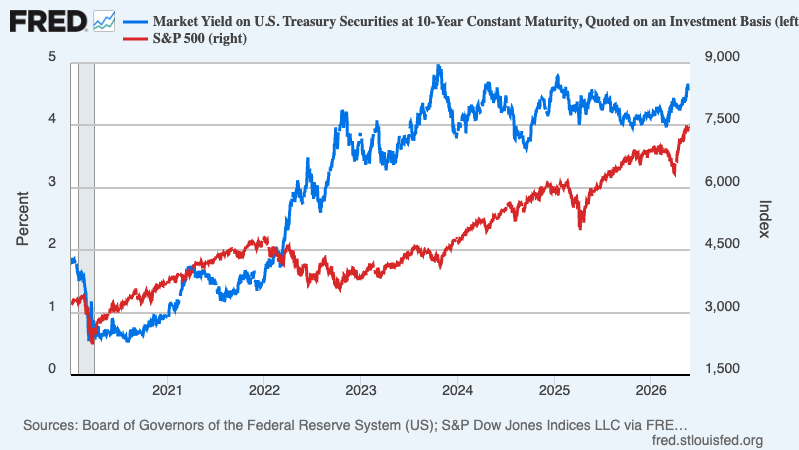
In his note to clients on Wednesday, Nick Colas, co-founder of DataTrek Research, challenged the idea that rising rates automatically mean lower stock market valuations. From his note: “You have probably heard this sequence of statements many times: Long-term interest rates are increasing. This means that the present value of future cash flows is declining. Therefore, equity valuations should drop as well.“
TKer subscribers aren’t strangers to this theory.
Colas dismantled this oversimplification, flagging two big problems with the shoddy argument he just summarized.
“The first is that it doesn’t work in real life,” he wrote.
He pointed at 2015 to 2019, when the 10-year U.S. Treasury note yielded an average 2.27%. During that period, the S&P 500’s forward price-to-earnings (P/E) ratio was between 15x and 18x earnings.
He then noted that as of Wednesday, the 10-year yield is now much higher at 4.49%, and yet the forward P/E is also much higher at 21x earnings.
In short, the market didn’t do what some skeptics might’ve assumed.

But does this mean the stock market is irrational ? No.
“The second reason that yields and equity valuations move independently of each other comes down to discounted cash flow math,” Colas wrote.
Instead of quoting too much of his work here, I’ll recommend you sign up for his and his colleague Jessica Rabe’s work at DataTrekResearch.com .
But the takeaway from his analysis is that an increase in interest rates is theoretically bad for valuations if you don’t consider earnings growth.
“If interest rates go up 2 percentage points (as they have since 2020) but earnings growth expectations increase by 3 percent, then equity valuations actually increase,” he wrote.
It’s such a refreshingly simple observation that speaks to a massive mistake some short-sighted market prognosticators keep making. And that mistake is adjusting one variable in a complex formula while holding all other variables constant.
In the real world, all other variables are never constant . With the passage of time , a lot of things change. This includes earnings, which we’ve seen trend higher for decades.