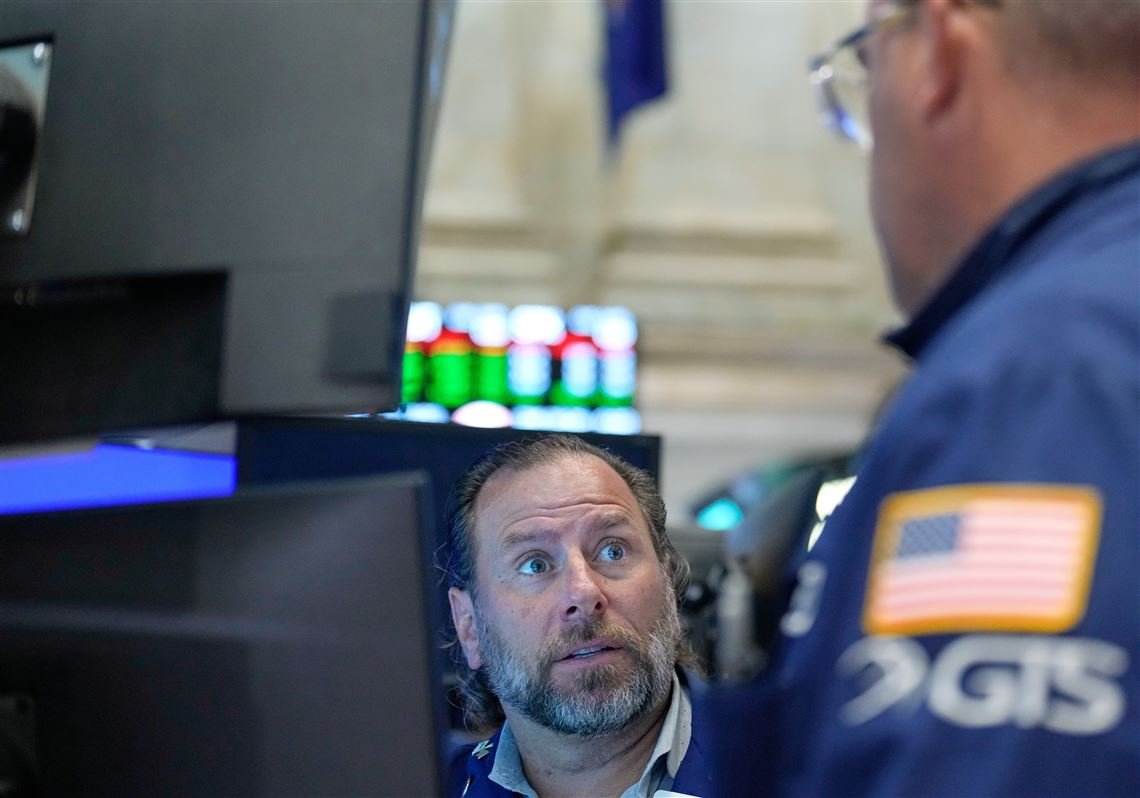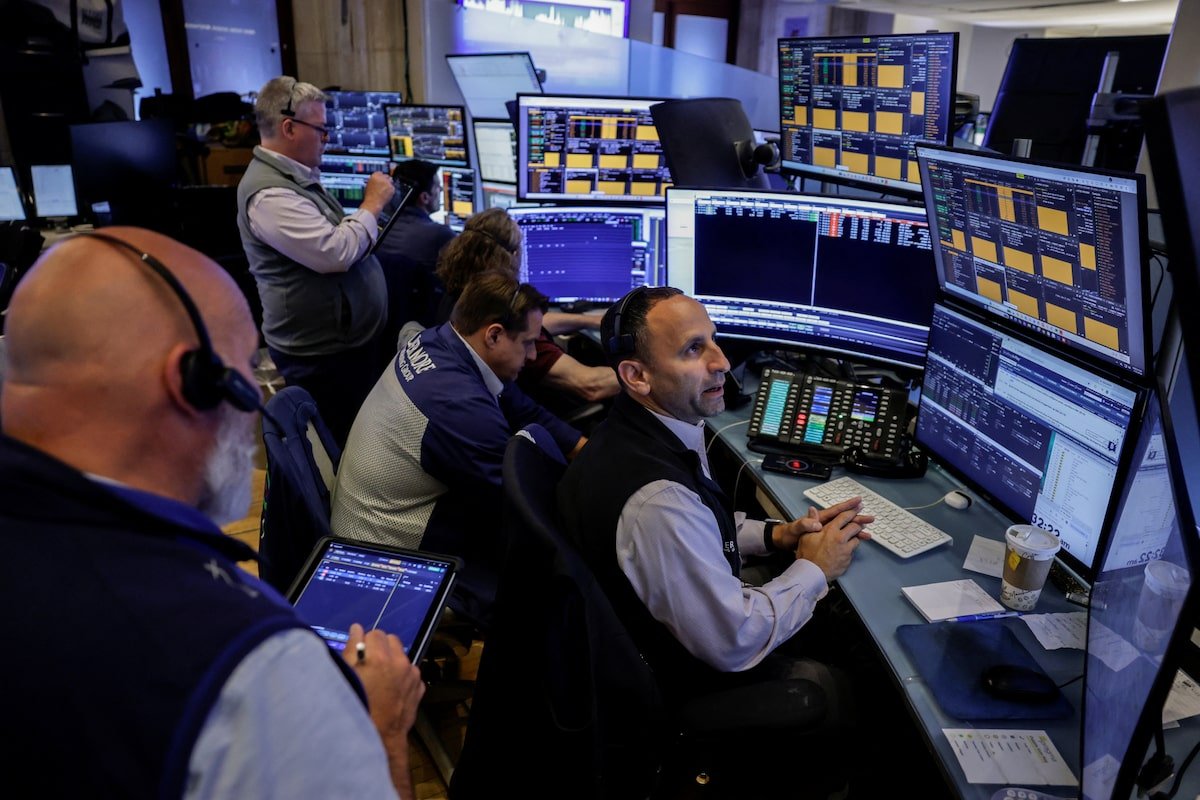

Traders work on the floor of the New York Stock Exchange on Friday. Though the biggest companies are swinging madly, the stock market itself is not, writes Tim Shufelt.Jeenah Moon/Reuters
It’s odd to see the largest companies ever assembled being tossed around like ragdolls.
Apple Inc. just had its worst post-earnings drop in 12 years, down 7 per cent on Friday. Meanwhile, Amazon.com Inc. had its best day in 14 years, up 15 per cent.
The day before, Microsoft Corp. added US$450-billion in market capitalization, the largest one-day gain ever for an American company. On the losing side, Meta Platforms Inc. shares dropped 8 per cent after its financial results showed the company’s free cash flow was nearly wiped out last quarter.
That was all in two trading days. These are the kinds of moves you would expect from penny stocks and speculative growth names. Not the multi-trillion-dollar concerns leading humanity into a brave new world of artificial intelligence.
These are nerve-racking times for investors with money riding on these companies – which is basically everyone.
But here’s the twist – though the biggest names are swinging madly, the stock market itself is not. The S&P 500 ended the week about where it started. Same with the TSX.
Much of what investors have spent the past couple of years worrying about has recently come to pass. The AI trade faltered. Big Tech stopped trading as a unified bloc. Microchip stocks took a nosedive. Momentum fizzled.
And still, the stock market was unfazed. Participation broadened out. Non-AI stocks picked up the slack.
Investors spend a lot more time anticipating the death of a bull market than they do imagining how it might evolve.
Boom times such as these pose a dilemma. How do you seize the opportunity without risking too much?
Either you toss your money into a bubble or stand back and risk missing out on a stock market golden age. The job of every investor is to stake out the right middle ground between those extremes.
In a market that largely hinges on the fortunes of AI, a reasonable first step might be figuring out just how much AI one holds.
It’s not as easy as it sounds. It’s not like, say, gold. A company either gouges yellow rocks out of the ground or it does not.
These may be early days in the AI revolution, but the technology is already creeping into every corner of the economy, said Spencer Morgan, director of portfolio strategy at Purpose Investments in Toronto.
“The market has quietly made AI exposure a default setting, and there’s no line item on a statement that says so,” Mr. Morgan said in a report.
Beyond the hyperscalers, such as Amazon.com and Microsoft, as well as chip and memory manufacturers, the data-centre buildout is a big factor for utilities stocks, power suppliers, storage and backup power, construction and engineering, industrials and more.
Mr. Morgan devised a framework that scores companies based on their AI exposure. From there, he calculated how much of a specific stock market’s value is tied to AI.
No surprise, the U.S. is highest at nearly 50 per cent exposure. Emerging markets rank unexpectedly high, by virtue of large chip manufacturers in China and South Korea. Canada scores lowest at just 8 per cent, most of that coming from application software companies such as Shopify Inc. and Constellation Software Inc.
If you can approximate your own AI exposure, you can figure out how to diversify it.
As far as advice goes, diversification is about as exciting as “floss daily” or “keep your receipts.” It still works, though. Look at 2026 so far.
While bonds have not performed well, they have at least dislodged from equity prices, meaning they have helped offset risk. At times when the stock market buckled, bond holdings helped limit the losses.
For all the hype around American stocks, non-U.S. stocks have shone this year. That includes Canada, whose benchmark S&P/TSX Composite Index is up by 11 per cent year to date.
There is a problem with bank stocks. They’re doing too well
Small-cap stocks have also had a moment as the investing masses came to question the mega-cap names at the vanguard of the bull market. Plus, non-AI sectors, like financials and energy, have stepped up, helping paper over what has been mini tech correction over the past six weeks.
Chip stocks have been hardest hit in that time, with the PHLX Semiconductor Sector Index dropping by nearly 30 per cent from peak to trough. An unsettled feeling crept into the market as doubts resurfaced as the sustainability of the data centre buildout and the profitability of AI.
“Are the wheels falling off the AI stock market train?” John Higgins, chief economic adviser for financial markets at Capital Economics, asked in a research note. Ultimately, a selloff driven by fear, rather than any sign that big-tech earnings were starting to falter, would likely fizzle out, he said. Toward the end of the week, there were signs that was exactly what was happening.
Through it all, the stock market held steady as the ground shifted beneath it, seemingly less reliant on the biggest stocks moving in the same direction at the same time. It would be a healthy thing if that stuck. We’ll likely have another stress test soon enough to know.
Until then, investors should focus on reaping the benefits of these boom times without putting too much at stake.