Updated 1 min read
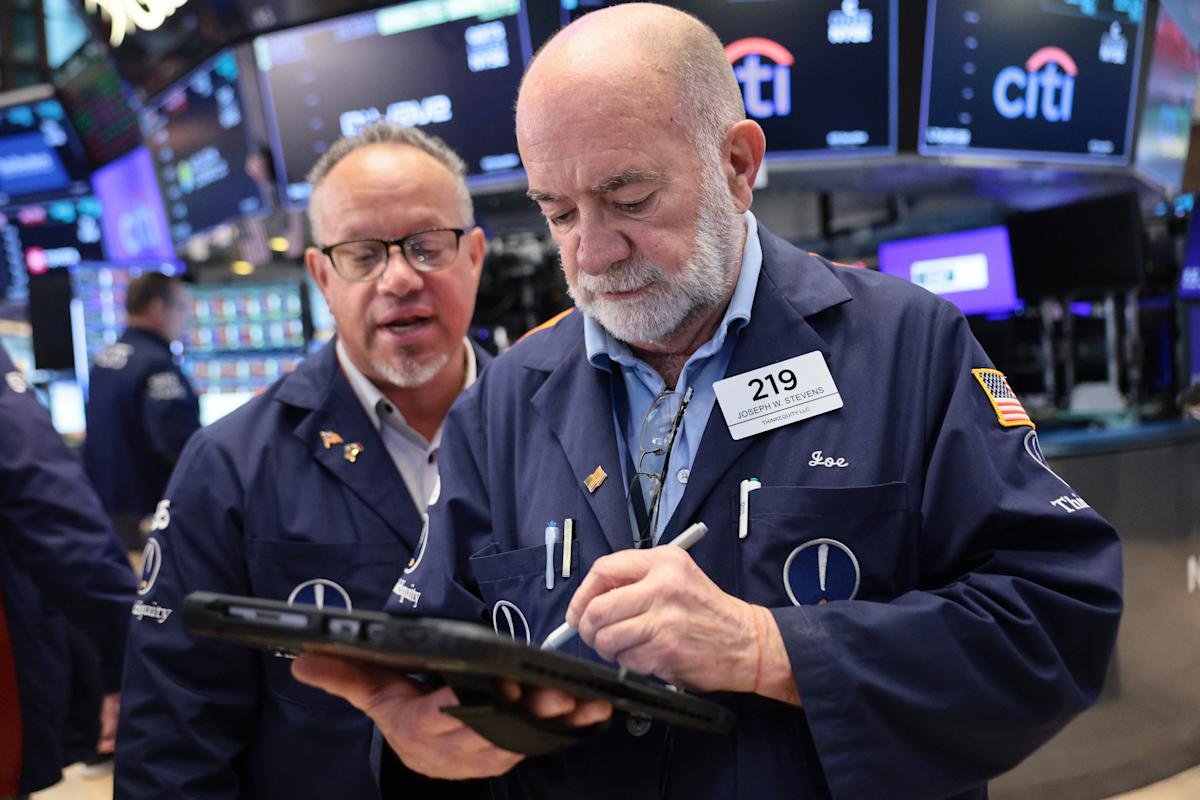
US stocks recovered from their lows on Tuesday morning, as a sell-off in memory chipmakers continued on Wall Street, spurring doubts about the AI trade.
The tech-exposed Nasdaq Composite (^IXIC) sank around 2% at last check, bouncing back from a nearly 3% plunge. Meanwhile, the S&P 500 (^GSPC) lost 1.2%, while the Dow Jones Industrial Average (^DJI), which includes fewer tech names, hovered near the flat line.
The Nasdaq took another hammering on Tuesday after Monday saw Big Tech players take a hit as SpaceX (SPCX) notched its third day of losses in a row. Shares in Elon Musk’s space company seesawed on Tuesday, briefly wiping out all of its post-IPO gains at one point.
Piling on the pressure, a sell-off in memory chip giants SK Hynix (000660.KS) and Samsung Electronics (005930.KS, SSNLF) in South Korea underscored growing questions about overstretched AI valuations. Both saw their shares sink over 12%, to drag the benchmark Kospi Composite (^KS11) stock index to a 10% loss.
The rout turns up the focus on Micron (MU) earnings due for release on Wednesday, watched for a read on how strong the demand for memory remains. Shares in the chipmaker dropped by as much as 12%, after surging to a record close on Monday.
Meanwhile, ongoing peace and nuclear negotiations between the US and Iran showed signs of progress. Brent (BZ=F) and WTI (CL=F) crude futures both fell roughly 1.5% after the US issued a 60-day waiver on oil sanctions on its adversary and satellite data showed an uptick in crossings through the Strait of Hormuz.
LIVE 12 updates
-
Americans are warming up to homebuying for the first time in 3 years
Yahoo Finance’s Claire Boston reports:
For the first time since 2023, most Americans think it’s a better idea to buy a home than rent or move in with relatives.
Fifty-three percent of respondents surveyed by Bank of America said it was better to buy a home now, up from 48% last year and 47% in 2024. Other measures of attitudes toward homeownership, such as the percentage of respondents who say a home is a valuable investment and provides stability, also improved.
The finding underscores how perceptions of homeownership are changing as housing becomes slightly more affordable. While it’s still far more difficult to afford a home now than it was pre-pandemic, home price appreciation in much of the country has dropped below inflation and wage growth, and mortgage rates are slightly lower now than during the past three summers.
As of May, the median home in the US was listed for $429,500, according to Realtor.com. That’s down slightly from $440,000 last year, but 34% higher than May 2019, when the median was $319,500.
-
July 4 weekend travel spending looks strong, Marriott CEO says
Yahoo Finance’s Brian Sozzi reports from Cannes, France:
A dip in gas prices from the highs of the Iran war appears to be prompting people to stay in hotels for the July 4 holiday weekend.
“We feel good about forward bookings on the Fourth of July. And even here in Europe, we see pretty solid bookings of inbound international,” Marriott CEO Anthony Capuano told Yahoo Finance at the Cannes Lions Festival of Creativity on Tuesday. “So we expect the summer to be strong.”
Capuano said demand trends in the Middle East have only marginally improved amid the US deal with Iran.
“We expect RevPAR will be down in 2Q plus or minus 50% [in the Middle East],” Capuano added. “But I was just in London with our Middle East general managers two weeks ago, and in talking to them — this is certainly anecdotal — but their view is as soon as travelers both in the region and internally have a sense that the tensions have in fact settled, they expect a very steep recovery.”
-
US business activity grows slightly in June, per S&P Global
US business activity in June slightly outperformed expectations, according to preliminary data released by S&P Global on Tuesday.
S&P’s US manufacturing purchasing managers’ index (PMI), which measures business conditions in the manufacturing sector, including production, new orders, employment, and inventories, came in at 55.7 — a more than 4-year high —against estimates of 54.6.
The manufacturing reading also grew from May’s 55.1 reading. Readings above 50 signal growth, while those below 50 signal contraction.
Looking at the other side of the economy, S&P’s US services PMI came in at 51.3 — a four-month high — exceeding estimates of 51.1 and the previous month’s 50.7. Totaling up activity across both manufacturing and services, S&P ‘s US composite PMI read at 52.2 — a five-month high — against estimates of 52.1 and a previous reading of 51.5.
Taken together, the readings mark the third month in a row of growth for US business economic activity, per S&P’s data, even as the rate of growth remains weaker than the start of the year before the war in Iran began.
The numbers, S&P noted, once more show an “unbalanced economy, as sluggish demand for services contrasted with historically strong growth in demand for manufacturing goods” — though the latter category was supported by stock building and supply issues.
“Brighter news out of the Middle East has helped restore some confidence among US businesses in June, though the overall rate of economic growth signalled by the flash PMI survey remains relatively sluggish compared to that seen earlier in the year in the lead up to the conflict,” said Chris Williamson, Chief Business Economist at S&P Global Market Intelligence.
“The survey signals that current output levels are consistent with the economy struggling to grow much faster than a 1% annualized rate in the second quarter.”
-
US stock market drops as tech rout continues
US stocks turned sharply red early Tuesday as a sell-off in the tech sector pushed the broader market further into a downturn that began on Monday.
The tech-heavy Nasdaq Composite (^IXIC) fell around 2.2%, while the S&P 500 (^GSPC) lost 1.5%. The Dow Jones Industrial Average (^DJI), which includes fewer tech names, slid 0.7%.
As the global tech rout picks up speed, in focus for investors on Tuesday will be earnings from Cerebras Systems (CBRS) after the bell, leading up to tomorrow’s Micron (MU) earnings — both set to give investors a strong read on the state of the chip market.
FedEx (FDX) reports earnings after the bell on Tuesday, as well.
Statements from President Trump on Tuesday that the Strait of Hormuz is fully open were met with drops of less than 1% in Brent crude (BZ=F) and US WTI crude (CL=F) as the US issued a 60-day waiver on Iranian oil sales.
-
Global stocks sell off, leading US market lower
US equities — especially the tech sector — spent Monday’s trading session and Tuesday morning selling off deeply into the red. The sell-off isn’t contained to the US market.
Leading much of the move in tech is a 10% sell-off on Tuesday in South Korea’s benchmark Kospi Composite index (^KS11), which includes major semiconductor and tech names such as SK Hynix and Samsung Electronics. In Japan and Hong Kong, the Nikkei 225 (^N225) and Hang Seng (^HSI) indexes dropped 3.6% and 1.8%, respectively.
Given that the Asian market opens roughly 13 hours ahead of the US market, moves to the upside or downside in that market often weigh on US performance in the morning.
The European open on Tuesday morning at 3 a.m. ET, several hours after Asia, saw more red. The FTSE 100 (^FTSE), Britain’s benchmark index, shed 0.4%, while the eurozone benchmark Euro STOXX 50 (^STOXX50E) lost a deeper 1.1%.
When US premarket trading began an hour later at 4 a.m., futures on all three major indexes fell to the downside. Contracts on the S&P 500 (^GSPC) and Dow Jones Industrial Average (^DJI) had lost 1.4% and 0.5% each by 9 a.m. ET, while those on the tech-exposed Nasdaq Composite (^IXIC) fell by an even deeper 3%.
-
Walmart signs first nuclear power deal with Constellation Energy
Walmart (WMT) has signed an agreement to buy nuclear power from Constellation Energy (CEG), the two companies announced Tuesday morning, marking the big box retailer’s first purchase of nuclear energy.
Shares in Constellation shed roughly 3.1% in premarket trading on Tuesday, while Walmart picked up roughly 1%.
Constellation, the largest US supplier of nuclear energy, will sell Walmart 176 megawatts of power from its Dresden nuclear plant, including 30 MW of new capacity.
The deal will see Walmart purchase energy and capacity through two 15-year terms beginning in 2029 and 2030, the companies announced Tuesday. The 176 MW of power will be enough to power a “high-tech” perishable distribution center under construction in Belvidere, Illinois, Walmart said.
“Walmart’s commitment enables meaningful investment in the Dresden Clean Energy Center — bolstering reliability, sustaining local jobs and economic activity, and putting more dependable, emissions-free energy onto the Illinois power grid,” said Jim McHugh, senior executive vice president and chief commercial officer at Constellation.
-
SpaceX stock searches for gains after massive post-IPO rout
SpaceX (SPCX) turned slightly higher in premarket trading on Monday after falling 16% the day before.
At its current level of around $156 per share, Elon Musk’s company has retained its $2 trillion valuation, bucking a broader sell-off in tech stocks.
As the stock settles in less than a week from its IPO, those who invested in the company right when it went public have seen nearly all their gains erased.
-
Stock futures barely budge as Trump says Strait of Hormuz is ‘OPEN’
Dow Jones Industrial Average futures slightly recovered after President Trump posted on Truth Social that US talks with Iran were “going well.” But stocks were still on track for an open well into the red.
However, the two sides offered mixed messaging on major concessions. Trump stated that Iran has agreed to the “highest level Nuclear inspections,” but that came just hours after an Iranian spokesperson Esmail Baghaei said that Iran had not given that concession, which Trump called “Fake News.”
Oil prices remained generally unchanged from the day before, with Brent trading around $78 per barrel and WTI crude trading around $74, as Trump said the Strait of Hormuz was open. Though he acknowledged the military could quickly close it again.
“I have agreed to allow the Hormuz Strait to remain OPEN, with no further Naval Blockade,” Trump also stated. “However, all ships are remaining in place should it be necessary to reinstitute the Blockade, which seems, at this point, highly unlikely.”
According to the New York Times, 39 vessels passed through the Strait of Hormuz on Monday, which puts traffic through the strait at its busiest levels since the war began.
-
SpaceX rout set to push its market value below $2 trillion
SpaceX (SPCX) shares extended declines in premarket trading, a day after the company saw the second-largest single-session drop in market value on record.
Bloomberg reports:
The stock fell as much as 5% to about $147, below its first-day opening price of $150 and putting the Elon Musk-led rocket, satellite and artificial intelligence company on track to slip below $2 trillion in market capitalization. The decline came as a sell-off in technology stocks dragged Nasdaq 100 futures (NQ=F) lower.
After falling for three straight sessions, SpaceX has shed more than $600 billion in value. Monday alone erased about $400 billion, marking the second-largest one-day loss on record after Nvidia’s (NVDA) roughly $590 billion plunge last year.
-
Korea’s Kospi tanks 10% to lead tech-fuelled Asia rout
South Korea’s Kospi Composite (^KS11) index in Seoul collapsed 10% on Tuesday in an Asian stock market rout that followed a tech-led sell-off on Wall Street.
The sell-off came as investors again question a long-running AI-fuelled boom, while oil extended losses amid optimism for US-Iran peace talks.
From AFP:
Tech firms — the main driver of a surge across world markets as investors pile into all things AI — took a painful hit in Asia.
South Korean chip giants SK Hynix (000660.KS) and Samsung Electronics (005930.KS, SSNLF) tumbled more than 12 percent each to drag the Kospi index down 10%, after it finished Monday at a record high.
“The scale of the decline … appears excessive. More importantly, the sell-off could signal that investors are beginning a broader process of reducing their positions. In other words, there may still be considerable selling pressure waiting in the wings,” Joo Won, head of the economic research division at Hyundai Research Institute, told AFP.
-
Bloomberg reports:
Oil steadied after falling more than 3% in the previous session following early progress in peace talks over the Iran war, which included a US waiver allowing some sales from the Islamic Republic.
Brent (BZ=F) crude traded near $78 a barrel after the biggest decline in almost a week on Monday, while West Texas Intermediate (CL=F) was above $74. The 60-day license permits the sale of some Iranian oil and petroleum products, citing “productive talks” in Switzerland, offering Tehran a crucial economic lifeline.
US and Iranian officials both cited progress in the first round of talks toward a lasting agreement to end the conflict that started at the end of February, but some discrepancies have emerged. Vice President JD Vance said Iran agreed to allow nuclear inspectors into the country, a claim disputed by Tehran.
The waiver permits almost anyone to purchase and pay for Iranian oil, including US refineries, although some might be unwilling to take on the risk. Supply from the Persian Gulf has ticked up recently, with producers such as Kuwait and the United Arab Emirates finding workarounds to get energy out. Iran has also shipped more more than 30 million barrels over the past week.