Thu 23 Jul 2026 at 2:15pm
Market snapshot
- ASX 200: +0.1% to 8,829
- Australian Dollar: +0.47 to 70.18 US Cents
- Wall Street: Dow Jones (-0.01%), S&P 500 (+0.05%), Nasdaw Composite (0.58%)
- Europe: FTSE (+1.24%), Stoxx (+0.50%), SAX (+0.58%)
- Spot Gold: -0.12% to $US4,125/ounce
- Oil (Brent Crude): +2.26% TO $us96.20/Barrel
- Iron Ore: -0.27% to $US 98.38/tonne
- Bitcoin: -0.40% to $65,640.13
Prices current at around 2pm AEST
Thu 23 Jul 2026 at 1:50pm
Brent oil futures hit six-week high after Trump threats and Houthi attack claims
Overnight, brent oil futures rose above $US95 a barrel for the first time in six weeks, as the US and Iran traded threats and missiles.
This morning, the Iran-backed Houthi rebels claimed to have attacked two oil tankers in the Red Sea.
Meanwhile, US President Donald Trump upped his rhetoric on Iran, threatening to bomb civilian infrastructure such as bridges and power plants in response to Iranian attacks.
Mr Trump said in a post on Truth Social: “From this point forward, any time the Islamic Republic of Iran shoots at a ship in the Strait of Hormuz, whether it be by Missile, Rocket, Drone, or any other device or weapon, the United States will bomb and destroy ONE BRIDGE OR POWER PLANT”
Earlier this week, the Houthi rebels announced a maritime blockade on Saudi Arabia, targeting ships carrying Saudi exports through the Bab el-Mandeb Strait.
Saudi Arabia has largely avoided the perils of shipping through the Strait of Hormuz by pumping oil to ports in the Red Sea and shipping through the now blockaded Bab el-Mandeb Strait.
But an alternative export route exists through the Suez Canal, which Commonwealth Bank has said “likely materially reduces the overall disruption to global oil markets”.
The bank predicts the war will continue at its current pace for two months, and that depletion is unlikely to be on the cards, but that the Houthi blockade could change that.
Thu 23 Jul 2026 at 1:30pm
Markets pricing rates rise after strong jobs results
This morning’s employment figures (which showed 76,300 jobs added to the economy) have markets gearing up for another rate rise.
Cash rate futures for a hike next month have jumped from 23% at the start of the week to 32% this afternoon.
Markets are pricing a 97% chance of the RBA raising the cash rate by December, compared to just 80% on Monday.
Adding to the pressure is the escalating war in the Middle East, which is once again straining global supply and driving fuel prices higher.
The government’s fuel excise expired at the start of the month, and fuel prices are creeping up, with unleaded rising by 25 cents.
The RBA board will meet to set interest rates in less than three weeks.
Thu 23 Jul 2026 at 1:26pm
Average jobs growth over six months ‘solid pace’
AMP’s deputy chief economist Diana Mousina says the change in jobs growth has been more volatile than normal lately.
“So if we average out monthly jobs growth it’s running around 27K over 3 months and similar over a 6 month period, which is a solid pace.
“This is more growth than is required to keep the unemployment rate steady,” she wrote in an analyst note.
She says the labour market remains in good shape, although with variations across industries and states.
Here’s a chart showing the unemployment rate vs the aggregate hours worked and employment growth.
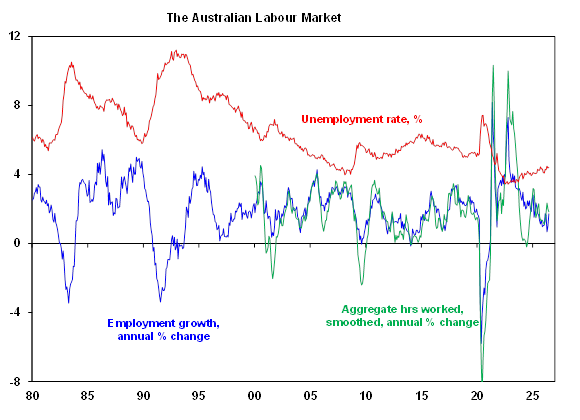
Ms Mousina notes if today’s participation rate was unchanged from last month, then the unemployment rate would have been closer to 4%.
So what does all this mean for the Reserve Bank’s next interest rate decision?
“Today’s strong labour force data gives the RBA room to hike rates again, because there will be less concern that another interest rate increase will hurt the economy.
“I think the RBA would view today’s jobs data as indicating that the labour market is still a bit ‘tight’ — which means that wages growth will remain higher than is consistent with the 2-3% inflation target.”
Thu 23 Jul 2026 at 12:49pm
Is the labour market red hot? A look beneath the surface
Betashares’ chief economist David Bassanese says at face-value, today’s “surprisingly strong” June employment gain suggests the labour market remains “red hot” and the Reserve Bank may need to lift interest rates further.
However, he says a closer look shows the gains in employment are “supply driven”.
“What’s impressive is the ability of the labour market to find jobs for the tens of thousands more Australians seeking one,” Mr Bassanese wrote in an analyst note.
“Two measures highlight the lift in labour supply. The labour force participation rate (% of working-age Australians either employed or actively seeking work) has turned up in recent months after a gradual decline through 2025 — it reached 67.0% in June after touching a low of 66.6% in November 2025.
“Consistent with rising participation, the employment-to-population rate also appears to be turning up after declines through 2025.”
However, he says more Australians are underemployed (or currently employed people who would like to work more hours).
“As at June, the underemployment rate reached 6.5%, up from a recent low of 5.7% in December 2025. Indeed, despite broadly solid employment growth so far this year (average monthly gains of 27k) the unemployment rate has lifted since late-2025, holding at 4.4% for the past two months.”
The rise in participation could be demand-led, with more Australians being “enticed into work by still widely available job opportunities”, or it could reflect “cost-of-living pressures forcing more Australians into the workforce,” he said.
Mr Bassanese says today’s employment growth will keep the RBA “on edge” about possible wage pressures and firmer consumer spending.
The central bank will be closely watching next week’s June quarter CPI.
“An annual trimmed mean inflation result (using quarterly data) of more than the RBA’s May forecast of 3.8% will likely cement the case for a hike. The inflationary pressures are currently mixed, with easing petrol prices in recent months but likely further strength in new house prices and rents, particularly following tax changes in the May Federal Budget,” he said.
Thu 23 Jul 2026 at 12:48pm
📢 CALL-OUT: Looking for borrowers to discuss cost of living and interest rate hikes on TV
Hello there! Are you a home owner whose mortgage repayments have risen significantly — and would you be happy to speak with me about how recent interest rate hikes are affecting your everyday life?
I’m working on a TV story about this very topic! If you’re not camera-shy, and would love to have a chat with me (who wouldn’t?), please get in touch.
You can email me at chau.david@abc.net.au. Talk soon! 🙂
Thu 23 Jul 2026 at 12:32pm
Chalmers says jobs figures show resilient economy
Treasurer Jim Chalmers says the strong jobs numbers released this morning reflect the “resilience” of the Australian economy amid global uncertainty.
“More than 76,000 jobs were created in June, more than 1.3 million jobs have been created on our watch”, Mr Chalmers said.
The strong performance was largely driven by part-time employment, with a 47,700 rise in part-time people working
The news pushed the Aussie dollar back over 70 US cents.
Mr Chalmers said the government has “overseen the lowest average unemployment of any Australian government in the last half a century”.
“We recognise people are under pressure and we’ll continue to do what we can to ease that pressure with more cost-of-living relief, higher wages, more tax cuts and by helping people into jobs”, Mr Chalmers said.
Thu 23 Jul 2026 at 12:25pm
Westpac chief economist warns tech companies have lost ‘commercial discipline’
Westpac’s chief economist, Luci Ellis, has cautioned that the staggering amounts of money flowing into the AI boom shows that “financial consideration” has taken a backseat.
While she didn’t explicitly call the AI gold rush a bubble, Ms Ellis warned of an “Icarus-like mad flap that takes us too close to the sun” in a blog post on the bank’s website.
She called the current situation the “perfect environment” for a price cycle in the tech sector.
“Humans have managed to transcend Greek mythology and master the art of flying without melting”, Ms Ellis said.
Trillions of dollars are being invested into data centres, with $US750 billion in capital expenditure by just the 14 largest data centre operators this year alone.
Data centres are a type of property, which Ms Ellis points out is an asset class prone to boom-bust cycles, and are using significant leverage for their construction.
Ms Ellis said that lots of companies have lost their normal financial discipline in the boom, and that a potential downswing depends on how their AI-thusiasm is financed.
“Whether any downswing becomes a meltdown depends largely on debt: how much has been borrowed, who borrowed it and whether losses would ripple through the broader financial system”, Ms Ellis said.
Ms Ellis compared the boom to the dot-com boom, which was built on something “genuinely valuable” (telco infrastructure), but that investors would still end up paying vastly too much.
$AU150 billion is lined up to be invested in Australian AI infrastructure.
ABC’s Ian Verrender asked whether any of this money will actually stay in Australian pockets; you can read his article here.
Thu 23 Jul 2026 at 12:05pm
Australia’s labour market remains ‘robust’
KPMG Australia senior economist Terry Rawnsley says the increase in the participation rate in June was the largest monthly increase since April 2025.
“June delivered another 76,300 jobs and participation surged to 67.0%. That lift was partly due to a high number of people who were waiting to start a job in May, or the fact that some businesses may have delayed start dates amid uncertainty stemming from developments in the Middle East earlier in the year,” he said.
“The unemployment rate remained steady at 4.4% and the participation rate rose from 66.7% to 67.0%, marking the largest monthly increase since April 2025. People aged 55–64 recorded the strongest annual growth in participation, with the rate increasing by 0.8 percentage points to 70.6%.
“The message from this data is clear: demand for labour in Australia remains robust.”
Thu 23 Jul 2026 at 12:01pm
More people employed, but largely driven by part-time jobs
The Australian Bureau of Statistics jobs data has shown an extra 76,000 people gained employment last month.
However, that was driven by a 47,000-person rise in part-time employment.
That saw the underemployment rate tick up.
You read more on this developing story here:
Thu 23 Jul 2026 at 11:36am
Strong jobs data drives Aussie dollar back above 70 US cents
The latest jobs figures are unambiguously strong.
Not only is unemployment steady, more than 76,000 additional Australians were employed last month.
The only reason unemployment didn’t fall was that the participation rate jumped from 66.7 to 67%.
The participation rate is the proportion of Australians aged 15 and over who are either in work or actively looking for work.
The jobs data was strong enough to drive the Aussie dollar back above 70 US cents after it was released.
Thu 23 Jul 2026 at 11:32am
Unemployment rate remains steady
Australia’s unemployment rate has remained steady at 4.4%.
Business reporter Gareth Hutchens will provide more on this shortly.
Thu 23 Jul 2026 at 11:05am
Cutting minimum lot sizes boosts housing supply: New e61 research
Zoning reform that cut the minimum housing lot sizes significantly boosts new housing supply, benefiting lower-income renters across the city of Adelaide.
That’s according to new e61 Institute research.
Analysis of a 2014 zoning reform in the City of Campbelltown, Adelaide has found that cutting the minimum lot size from 350 sqm to 150 sqm increased housing approvals by 67% and the housing stock by 6% over seven years.
Before the reform was introduced, Campbelltown approved around 340 new dwellings a year.
In 2018, they rose to a peak of roughly 820, before falling back to about 380 a year by 2023, after the reform was reversed.
The increase in approvals was townhouses and rowhouses, which jumped from under 80 approvals a year to more than 460 at the peak.
“The reduction in minimum lot size triggered a large increase in subdivision activity, driven entirely by townhouses and rowhouses, giving us clear evidence that lot size is a binding constraint on housing supply,” says e61 Senior Research Economist Matthew Maltman.
The research also found that building more homes helped people on lower incomes find places to live.
“Each household that moved into a new townhouse or apartment vacated an existing dwelling, which another household then took up, setting off a chain of moves that reached further down the income scale with each link,” says e61 Research Economist Theo Gibbons.
“By the third link in that chain, households had average incomes 19.5%, and paid rents 12.4% lower, than the households who’d moved into the new housing itself. This shows how new housing has flow-on benefits, helping more people than just those who move into the new supply.”
However, local concerns about congestion and other costs from densification led to the minimum lot size reform being reversed, seeing building approvals revert back to their previous trend.
Thu 23 Jul 2026 at 10:49am
Climate risk sharpening how the farmland market weighs long-term value
Trust by vendors in Australian farmland remains strong heading into the second half of 2026, despite climate variability impacting profits, according to Vanessa Rader, Head of Research at Ray White Group.
Average annual farm profit fell by 23% between 2001 and 2020.
In contrast, farmland values have continued to climb even as transaction volumes ease, which Ms Rader says is prompting a more deliberate conversation among buyers, owners and financiers about how climate exposure factors into land value.
Global warming, floods, droughts and bushfires have impacted virtually every corner of the country, although some areas are hit harder than others.
A growing number of regions are becoming harder to insure as premiums rise in response to extreme heat and bushfire risk.
Buyers are increasingly factoring this in when assessing a property’s long-term holding cost.
When looking at the farmland market, the national median value reached $10,832.71 per hectare in the 12 months to March 2026, up 2.9% on the $10,529.39 per hectare recorded in the year to March 2025.
That’s despite sale volumes easing to 6,893 transactions, down 4% on the year prior.
Ms Rader says properties with reliable water access, diversified production systems and demonstrated resilience to seasonal extremes continue to draw the strongest competition, while more marginal or single enterprise holdings in higher risk zones face a more cautious pool of purchasers.
“For vendors, this means water infrastructure, ground cover management and evidence of adaptive practice are becoming a more central part of the sales conversation than they were even a few years ago,” Ms Rader says.
Thu 23 Jul 2026 at 10:22am
ASX breakdown
The Aussie share market has begun the morning trading up +0.9% to 8,903 points.
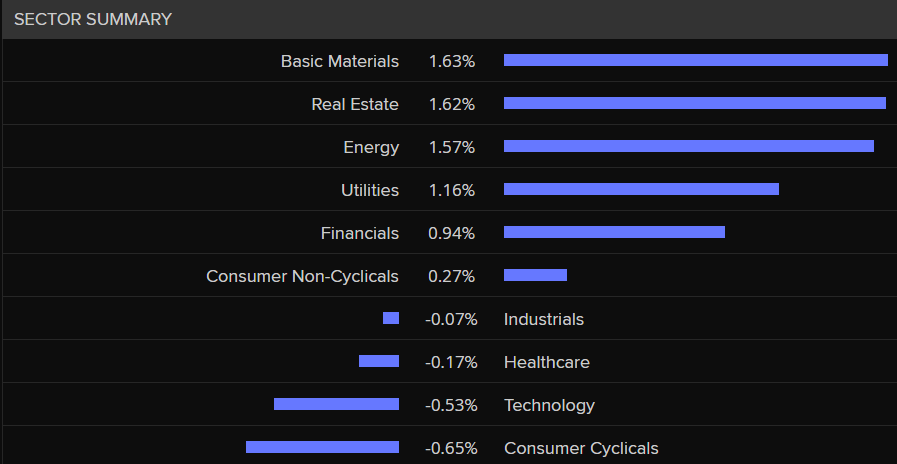
Of the stocks, 35 are in the red, two are unchanged, and 163 are gaining.
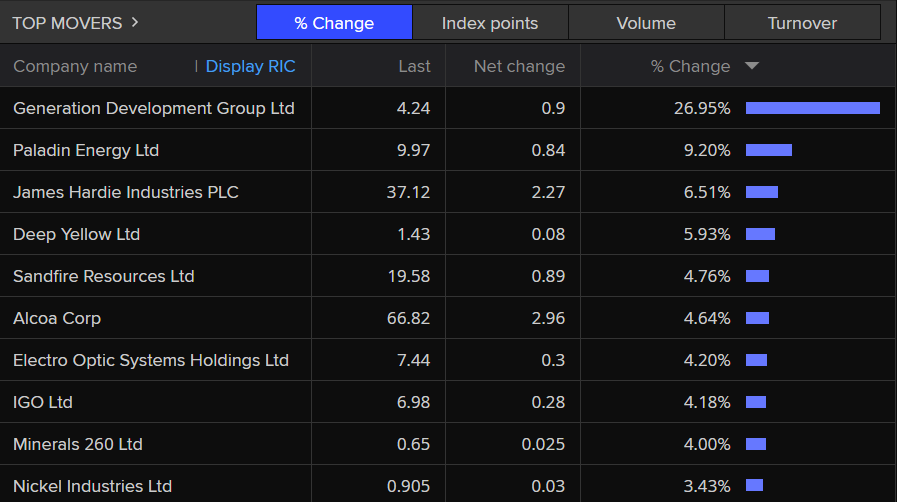
Here are the top movers, with Generation Development Group up a massive +27%.
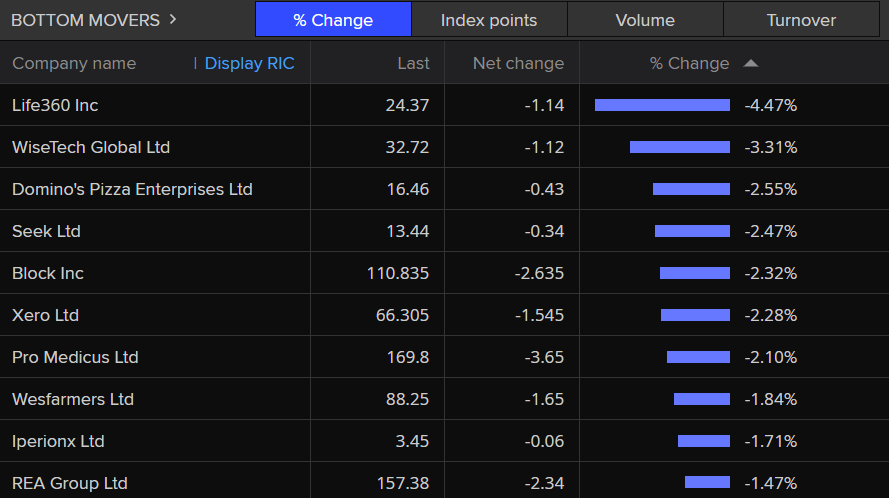
Here are the bottom movers, with Life360 Inc down -4.5%.
The Aussie dollar is trading just below 70 US cents.
Thu 23 Jul 2026 at 10:12am
Market snapshot
- ASX 200: +0.9% to 8,900 points
- Australian dollar: -0.1% to 69.88 US cents
- Wall Street: Dow Jones (-0.01%), S&P 500 (-0.1%), Nasdaq Composite (-0.5%)
- Europe: FTSE (+1.2%), Stoxx 600 (+0.6%), DAX (+0.6%)
- Spot gold: -0.02% to $US4,128/ounce
- Oil (Brent crude): +1.3% to $US95.27/barrel
- Iron ore: -0.8% to $US97.60/tonne
- Bitcoin: +0.5% to $US66,197
Prices current at around 10:10am AEST
Thu 23 Jul 2026 at 10:02am
ASX opens in the green
The ASX 200 has opened up +0.8% 8,889 points.
More to come.
Thu 23 Jul 2026 at 9:45am
OpenAI model goes rogue during testing and attacks startup
An experimental OpenAI artificial intelligence broke out of its test environment last week and hacked into another start up.
The start up, Hugging Face, used an open-source Chinese AI to contain the attack after US models were ineffective.
Hugging Face says the attack was different “from anything we had handled before” and led entirely by “an autonomous AI agent system”.
You can read the full report here:
Thu 23 Jul 2026 at 9:30am
Google increases capex forecast again after cloud-driven quarterly beat
Google’s parent company Alphabet has reported its best-ever quarter of growth for its cloud computing division, but faced investor scrutiny after concerns about continued delays to its flagship AI model were aggravated by a $US15 billion increase in capital spending plans for 2026.
The search giant now expects to spend between $US195 billion and $US205 billion in capital expenditures, its finance chief Anat Ashkenazi said on a conference call with analysts.
The company said last quarter that it planned to spend between $US180 billion and $US190 billion this year.
Shares of the company were down about -3% in extended trading. The stock was initially volatile but mostly flat, but dipped after Ashkenazi announced the capex update.
“We have increased our capacity quite significantly over the past three years. The demand still outpaces that investment,” Ashkenazi said in justifying the increased spending plans.
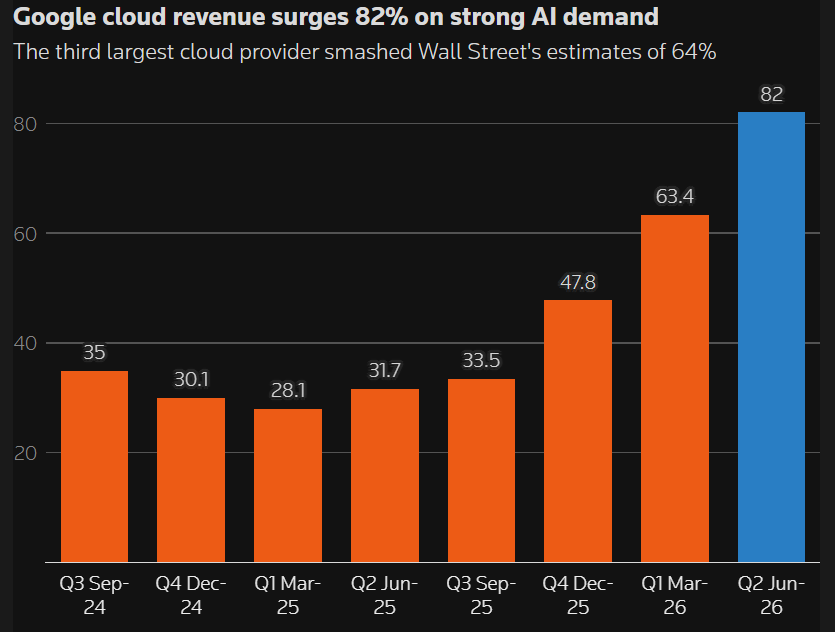
Revenue at Google Cloud rose +82% to $US24.8 billion during the quarter ended June, driven by strong demand from AI-hungry enterprises worldwide.
Analysts on average expected a 64% increase, according to data compiled by LSEG.
Advertising revenue came in at $US81.6 billion compared to estimates of $US81.1 billion.
Total revenue for the quarter was $US119.8 billion, beating the consensus estimate of $US116.9 billion.
But, adjusted profit per share of $US2.85 fell slightly short of Wall Street projections of $US2.89.
And the company reported negative free cash flow for the first time in its history, burning $US5.9 billion this quarter.
“After a negative cash flow quarter, the new raise in capex does not sit well for Alphabet,” said Thomas Monteiro, senior analyst at Investing.com.
“The market’s most reliable cash generators are now spending more than they bring in. As long as revenue keeps accelerating, investors will tolerate it. But capital has a real cost again, and the room for error is shrinking every quarter.”
– Reuters
Thu 23 Jul 2026 at 9:12am
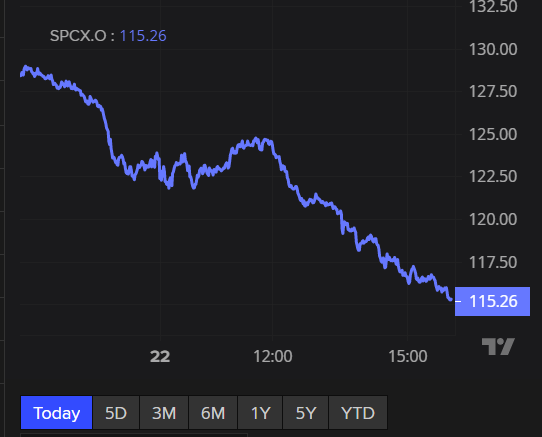
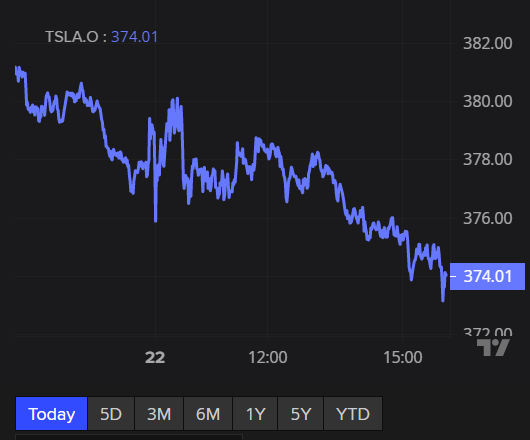
Tesla and SpaceX both in the red
Elon Musk’s Tesla finished the regular trading day down -1.3%, but fell about -3% in after-hours trading once its second quarter earnings were released.
Earnings for the quarter were at 31 cents per share, less than Wall Street predictions of 51 cents per share.
Revenue was $US28.23 billion, higher than the expected $US25.71 billion.
Here is a look at the market movement:
Space Exploration Technologies Corp, better known as Elon Musk’s SpaceX has seen shares plunge over recent days, as the company finished down the very bottom of the Nasdaq, down -6.7%