Fri 24 Jul 2026 at 12:20pm
The perfect storm that could push the RBA into another rate rise next month — analysis
As noted previously on the blog by David Chau, the odds of a Reserve Bank rate increase in August have risen markedly over the past couple of days.
Yesterday, it was much stronger than expected jobs numbers, with an additional 76,000 Australians employed over June, that saw rate hike bets increase.
This week, five consecutive daily increases in global oil prices have compounded the risk, especially as the Houthis backed up their blockade threat by actually firing on Saudi tankers.
That looks set to close off the southern exit from the Red Sea, through which the Saudis have been exporting a large share of the 5 million barrels a day of oil that they’ve piped overland to avoid the closed Strait of Hormuz.
If the Iran-backed Houthi rebels in Yemen have succeeded in making the Bab el-Mandeb Strait commercially impassable for Saudi oil, the only outlet left open is the Suez Canal to the north.
But there are severe practical constraints to what can be exported via that route.
As reported by Al Jazeera, fully laden very large crude carriers (VLCCs) cannot transit the Suez Canal, meaning smaller or partially laden vessels must be used, adding to cost and reducing volumes.
To get that oil to the big refineries in Asia, those tankers must then sail through the Mediterranean, down the West Coast off Africa and across the Cape of Good Hope before they even get to the Indian Ocean, where they would have been if they could transit Bab el-Mandeb.
That’s weeks of extra time at sea, fuel costs, insurance costs and delay.
It’s no wonder Brent crude oil prices are back above $US100 a barrel, especially given US president Donald Trump’s threat of retaliation both on the Houthis and Iran directly for any Saudi shipping that is attacked.
Throw in a new means for Trump to impose 10-12.5% tariffs on America’s 60 key trading partners, and the clear signal is for further upwards, not downwards, pressure on inflation.
That is why the markets are pricing in a 36% chance the RBA will raise rates next month and a virtual certainty of at least one rate rise by year’s end, taking the cash rate to 4.6%.
That would be the highest cash rate since October 2011.
I had a good chat with Dan Ziffer about how the latest oil price surge and US tariff announcement are likely to shape the global and local economic outlook on a special ABC Business Daily podcast bonus episode today.
Fri 24 Jul 2026 at 12:09pm
Bond sell off points to imminent rate hike
The Australian fixed income has been caught up in a broader bond market sell-off.
Yields rise as bonds are sold.
In some circumstances, the selling of the bonds indicates the need to raise money and adds to the riskiness of the bond.
More broadly, bond prices move inversely to their yield.
The yield on an Australian 10-Year bond is up another 5 basis points (0.05%) to 5.06%.
The 3-Year bond is also up 0.07% to 4.69%.
This implies the bond markets are fully pricing in an August Reserve Bank interest rate hike.
Fri 24 Jul 2026 at 11:54am
RBA to hike in August: Betashares
The Bureau of Statistics will publish Australia’s second quarter inflation figures on Wednesday.
A hotter-than-expected number will put pressure on the Reserve Bank to hike interest rates in August.
That could be an underlying inflation figure of more than 3.8%.
Here’s the latest commentary on this from betashares chief economist David Bassanese:
As it stands, the RBA forecast annual trimmed mean inflation to reach 3.8% in the June quarter in the May Statement on Monetary Policy. To be achieved, this would require a 1.0% quarterly gain in trimmed mean inflation, compared with quarterly gains of 0.9% and 0.8% in the December and March quarters respectively.
To my mind, a bounce back in underlying inflation to a 1% quarterly pace should be enough to tip the RBA over the edge and raise rates at the August policy meeting. Indeed, the RBA would have no choice but to conclude that underlying inflation pressures just remain too firm and show little sign of meaningful deceleration.
The current market expectation (according to Bloomberg) is a 0.9% gain in quarterly trimmed mean inflation – which would leave the RBA’s August decision line ball.
My call is that trimmed mean quarterly inflation will hit 1%, reflecting ongoing persistent strength in market service prices – due to firm demand and the passing on of higher labour costs – and ongoing strength in new house prices and residential rents.
There will also be an element of pass through of higher energy costs more broadly through an array of CPI items.
Both new home prices and rents have significant CPI weights of 7.6% and 6.6% respectively.
The lift in the cost of new homes since mid-2025 alone accounts for 60% of the rise in annual trimmed mean inflation from 2.8% in June 2025 to 3.6% in May 2026.
Based on my forecasts of a 1% gain in quarterly trimmed mean inflation, my call is that the RBA will now likely raise rates at the August policy meeting, placing further downward pressure on economic growth and established house prices.
Fri 24 Jul 2026 at 11:43am
Minority of Australians confident about space investments: survey
Betashares is one of a number of investment platforms that offers exchange traded funds (ETFs) products.
It’s released the results from a recent ETFs survey.
Key findings include:
While 67% of Australians are excited about the future of space exploration and 49% believe it could become one of Australia’s next major growth industries, only 22% view the sector as a clear long-term investment opportunity.
The ASX recently published a note revealing a record increase in the number of news ETFs hitting the ASX boards.
ETFs can be marketed as being relatively safe investments, given their inherent asset diversity, but analysts warn not all ETFs are created equal.
As with any investment decision, it’s important to first seek professional advice on what it suited to your personal circumstances.
Fri 24 Jul 2026 at 11:25am
RBA is widely expected to lift interest rates again if oil remains above $US100 per barrel
If oil prices continue to surge above $US100 per barrel, or even if they remain at that level for some time, it will be bad news for people paying off a mortgage.
Inflation expectations have jumped as a result of Brent crude futures rising to their highest value since May 26.
If oil remains at these levels for a prolonged period, everything from petrol, diesel, fertiliser, shipping, delivery and grocery prices will become even more expensive — as businesses inevitably pass on their higher costs to consumers.
Once these ‘second-order’ effects from higher oil prices spread across the economy, the Reserve Bank may have little choice but to lift interest rates in an attempt to bring inflation down by making us feel poorer.
Financial markets are now ‘pricing in’ a:
- 38% chance of the RBA lifting rates at its next meeting on 10-11 August, according to Bloomberg data. So on balance, it’s expected to keep rates on hold next month.
- That probability rises to 96% by November, so it’s widely expected there will be another rate hike by the end of this year.
Looking overseas, it’s a similar story for the world’s largest central bank, the US Federal Reserve:
- Earlier this week, the likelihood of the Fed lifting American rates at its late-July meeting was 17%. But that has since jumped to 36%.
- Likewise, the odds of a September rate hike in the United States have risen from 72% to 100%. So at this stage, markets view this outcome as “guaranteed”, based on the current developments in the US-Iran War.
Fri 24 Jul 2026 at 11:12am
Worried about the fuel price near you?
You will have seen our posts about oil climbing up above $US100 a barrel today.
If the oil price stays that high, we could end up paying more at the pump.
Don’t forget Australia’s fuel excise is also due to end on August 2, which will also raise prices.
The ABC has updated its fuel price tracker (link below) if you want to check out the average price in your area.
Fri 24 Jul 2026 at 11:08am
Market Snapshot
- ASX 200: -0.4% at 8,804 points
- Australian dollar: +0.1 at 69.74 US cents
- Wall Street: Dow Jones (-0.97%), S&P 500 (-1.2%), Nasdaq Composite (-2.15%)
- Europe: FTSE (-0.7%), Stoxx 600 (-1.2%)
- Spot gold: -0.13% to $US4,042/ounce
- Oil (Brent futures): -0.14% to $US100.55/barrel
- Iron ore: +1.1% at $US98.10/tonne
- Bitcoin: -0.13% to $US65,027
Prices current at around 11 am AEST.
Fri 24 Jul 2026 at 11:05am
Oil and Origin
Morning All,
David Taylor signing in to take you through the rest of the day in the world of business and finance.
I’m going to keep across the oil price and anything new on the Origin Energy cyber hack.
DT
Fri 24 Jul 2026 at 10:56am
ASX sector breakdown
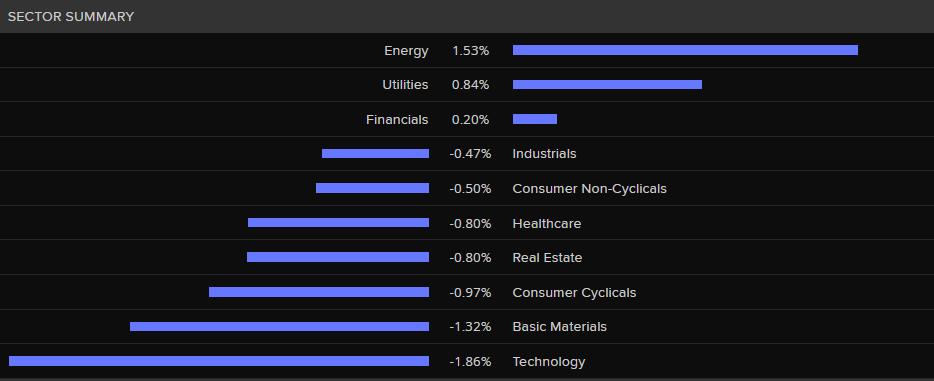
The majority of the market is under pressure this morning with 156 stocks on the ASX declining and 34 stocks higher. 10 remain unchanged.
Energy is the standout, up around 1.5%, as oil trades at around $US100 a barrel, boosting the outlook for producers.
But higher oil prices are also adding to inflation and interest-rate concerns, weighing on much of the rest of the market.
Fri 24 Jul 2026 at 10:39am
ASX 200 down as oil prices continue to climb higher
As we were anticipating, the ASX has fallen in early morning trade. It is down by 0.5% as of 10.30 AEST.
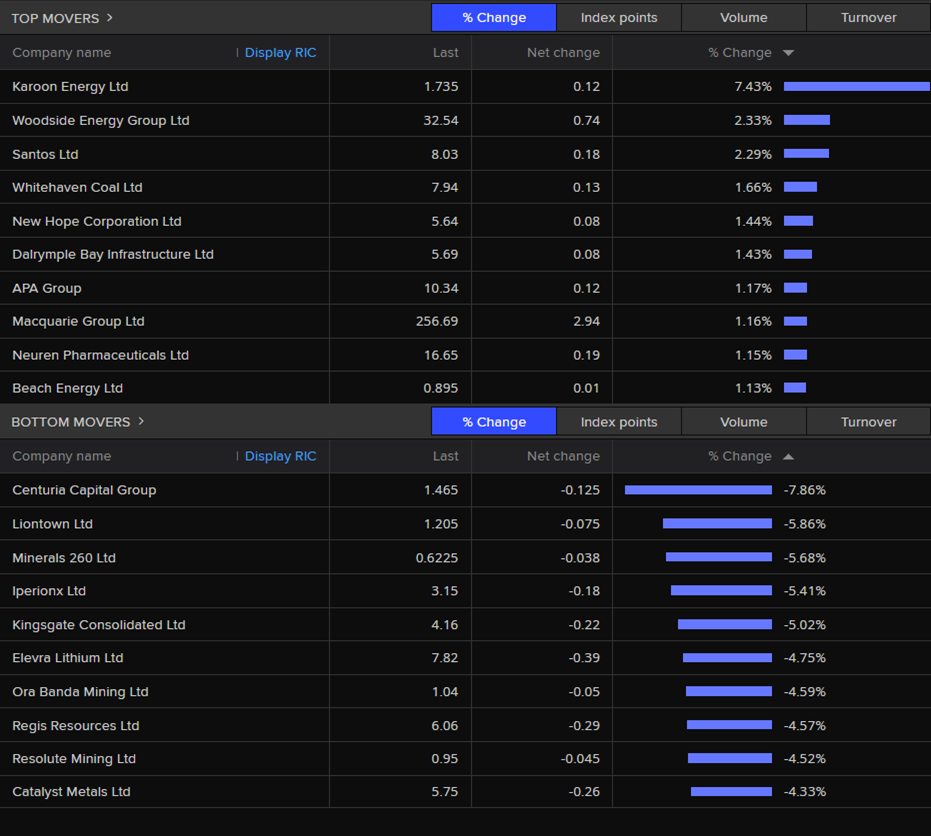
As oil prices rise for the fifth consecutive session and top $US100 dollars a barrel, energy stocks such as Karoon, Woodside and Santos have performed the best today, the sector higher overall by 1.5%.
Tech stocks though fell by 1.9%, tracking moves by the US overnight. Gold miners and resources also lower. Spot gold prices fell by about 2 per cent.
Take a look at the top and bottom movers so far this session.
Fri 24 Jul 2026 at 10:24am
Cochlear says it can continue to import into US duty-free
Hearing implant maker Cochlear has just put out an announcement regarding today’s US tariffs announcement.
The company says it will continue to be able to import its hearing implant systems into the US duty-free.
Dig Howitt, CEO and President of Cochlear, said, “We’re pleased that the US Government has recognised the importance of continued access for Americans who rely on the medical technology of cochlear implants to hear clearly, participate fully in life and deliver a substantial social and economic contribution to the US.”
Despite this, the company’s share price is lower this morning.
Fri 24 Jul 2026 at 10:13am
ASX falls 0.67% at the open
The Australian share market has begun its day down 0.66%, as higher oil prices amid escalating hostilities between US and Iran trigger a pullback in stocks.
The ASX 200 has fallen 0.66% to 8,780 points by about 10:10am AEST.
Fri 24 Jul 2026 at 9:55am
Oil analyst says crude prices will rise further as we max out the oil supply ‘credit card’
Brent crude climbed above US$100 a barrel overnight after Houthi forces attacked two oil tankers in the Red Sea, a route that has become increasingly important for crude shipments avoiding the Strait of Hormuz.
President Trump responded by threatening tougher strikes on Iran, telling Axios he was close to authorising a “massive attack” and blaming Tehran for any further action by the Yemen-based group.
Saul Kavonic from MST Financial told The Business on Thursday night that this is not a new oil shock, but oil shock “1.5, because this is a continuation of the same conflict that began in March. So we’ve been on a roller coaster since then.”
He said concerns don’t just stem from the renewed conflict activity, but that crude reserves are at a much lower starting point.
“We now have over a billion barrels of less oil and fuel stocks, which we’ve used up over the last few months.” He said.
The Brent crude oil price peaked above $US120 a barrel at the height of the conflict in April, Saul Kavonic says short of a de-escalation, the price is going one way.
“We’re living on the oil market credit card … We’re already at record low stocks… That’s going to max out in the next couple of months. And so I think we’re going to see oil head above $US100 a barrel the next few days.”
Take a watch.
Fri 24 Jul 2026 at 9:20am
How China won the auto wars with cheap EVs loaded with tech
China’s electric vehicle surge is rapidly reshaping Australia’s car market, as cheaper, technology packed models win over buyers and challenge the long dominance of Japanese brands.
In the first half of this year, BYD sales jumped 124 per cent, Chery rose 77 per cent and Geely surged 495 per cent. All were off a much smaller base, which exaggerates the percentage gain. But there’s no denying the trend.
Meanwhile, every major Japanese car maker except Honda recorded falling sales.
The shift is happening alongside a sharp rise in electric vehicles. According to Pitcher Partners’ Steve Bragg, the Iran war has helped shift the dial.
Chief business correspondent Ian Verrender looks at how decades of investment helped China seize the lead, and why some of the traditional giants of the global car industry are now scrambling to respond.
Fri 24 Jul 2026 at 9:00am
Wall Street takes a tumble
Surging oil prices weighed on stocks, as fresh concerns about AI spending also rattled investors.
Alphabet fell 7.1% after lifting its capital spending forecast for the year, while Tesla sank 15% after its free cash flow turned negative in the second quarter.
Those declines helped drag the Nasdaq down 2.2%.
The Dow Jones Industrial Average lost 507 points, or 1%, while the S&P 500 fell 1.2%.
Investors also got a fresh look at another major AI chip giant, with Intel reporting results after the closing bell.
The company’s turnaround effort showed further signs of progress, with second-quarter earnings coming in well above market expectations.
Intel also issued a stronger-than-expected revenue outlook for the current period, suggesting the boom in data-centre spending is helping drive its recovery. Intel’s shares jumped in after-hours trade.
Fri 24 Jul 2026 at 8:35am
Origin breach could fuel wave of AI-powered scams, cyber experts warn
We are continuing to track the latest from the Orgin Energy data breach.
Cyber experts this morning are warning personal information stolen in the Origin Energy data breach could be used for highly targeted scams, with AI making it easier to impersonate victims.
The exposed customer data may include names, dates of birth, phone numbers, addresses and email addresses, plus the last few digits of some credit cards and bank accounts.
Origin is still determining how many customers were affected.
Experts say scammers can combine that information with social media and previous data breaches to create convincing phishing messages, fake identities and even voice clones.
Customers are being urged to watch for unexpected calls and messages, particularly scammers pretending to be Origin, banks or other trusted organisations offering help.
Audrey Courty explains the risks.
Fri 24 Jul 2026 at 8:21am
Small business insolvency rates begin to rise
Australia’s small businesses are under growing pressure from higher fuel prices, interest rates and inflation, on top of rising wages and new regulatory costs.
Signs of stress are starting to emerge.
While starting from a low base, small business insolvency rates are starting to tick upward with a 13 per cent increase in the number of businesses going bust in the six months to May 2026 compared to the same period last year.
Credit agency Equifax says higher-risk businesses are increasingly shopping around for finance, a possible sign they are struggling to secure loans, while some businesses are pulling back on plans to expand.
Business reporter Alison Branley looks at how operators are coping, and why small business groups are calling for more government support as pressures mount.
Fri 24 Jul 2026 at 8:06am
Brent crude back above $US100 for the first time since May
Oil markets are again on edge over the outlook for global supplies.
Brent futures jumped $6.62, or 7%, to settle at $100.69 a barrel, highest close since May 22. Oil prices rose for a fifth consecutive session.
The global oil benchmark is now almost 40% higher than when the Iran war began in February, with most of that rise coming this month.
US West Texas Intermediate crude climbed $5.36, or 6.2%, to $92.19 a barrel, its highest close since June 4.
Yemen’s Houthis have opened another front in the Iran war by targeting vessels carrying Saudi oil through the Bab el-Mandeb Strait, after saying they would impose a naval blockade on Saudi shipments.
Analysts estimate the Strait of Hormuz and Bab el-Mandeb together carry the equivalent of around a quarter of the world’s oil supply.
The rise in crude is also adding to inflation concerns because sustained increases in oil prices can eventually flow through to petrol, diesel and other costs for households and businesses.
In Australia, motorists are still receiving some relief, with the government extending the reduced fuel excise for another month, although at a lower rate. That is set to end on August 2.
According to the ABC’s fuel tracker, as of 7am this morning, the average price of unleaded 91 is 185.2 cents a litre, while diesel is 226.1 cents.
You can check out more details here.
Fri 24 Jul 2026 at 7:37am
New US tariff for Australia to take effect later today
The Trump administration has confirmed a 12.5 per cent tariff will be placed on Australian exports to the US from later today (AEST).
The tariff was proposed last month, after a US trade investigation into forced labour.
The Australian Government and Business Council of Australia made formal submissions opposing the tariff during a consultation period, which ended earlier this month.
The US Trade Representative has just announced the proposed tariff will take effect from 12:01am Friday, local time.
A temporary 10 per cent “global tariff” on the US’s trading partners will expire at the same time.
Australia is not the only affected country. Tariffs between 10 and 12.5 per cent will be placed on imports from 59 other economies, which represent all of the US’s major trading partners.
Fri 24 Jul 2026 at 7:33am
Market Snapshot
- ASX futures: -0.6% at 8,750 points
- Australian dollar: flat at 69.69 US cents
- Wall Street: Dow Jones (-0.97%), S&P 500 (-1.2%), Nasdaq Composite (-2.15%)
- Europe: FTSE (-0.7%), Stoxx 600 (-1.2%)
- Spot gold: -2% to $US4,047/ounce
- Oil (Brent futures): +7% to $US100.7/barrel
- Oil (WTI futures): +6.4% to $US92.36/barrel
- Iron ore: +1.1% at $US98.10/tonne
- Bitcoin: -1.2% to $US65,066
Prices current at around 7:30am AEST