
Game board by Thomas Buchholz via Unsplash
Do you remember past financial contagions? Those periods of time that tend to occur just when “things can’t get any better than this.” 1987, 2000, 2008, and 2022 are the U.S. versions of those.
And, with the summer froth having convinced the broad market that nothing can go wrong, my risk-manager brain goes into overdrive. Because when fundamentals leave the building, as they have recently, it allows a lot of bugs to creep in. Such as leverage-induced selloffs. Like that we just saw unfolding in South Korea.
South Korea’s benchmark KOSPI index cratered 44% from its June peak — a collapse worse than the 2020 pandemic crash — before staging a record-breaking 18% single-day rebound on Friday. Is all well? Not likely.
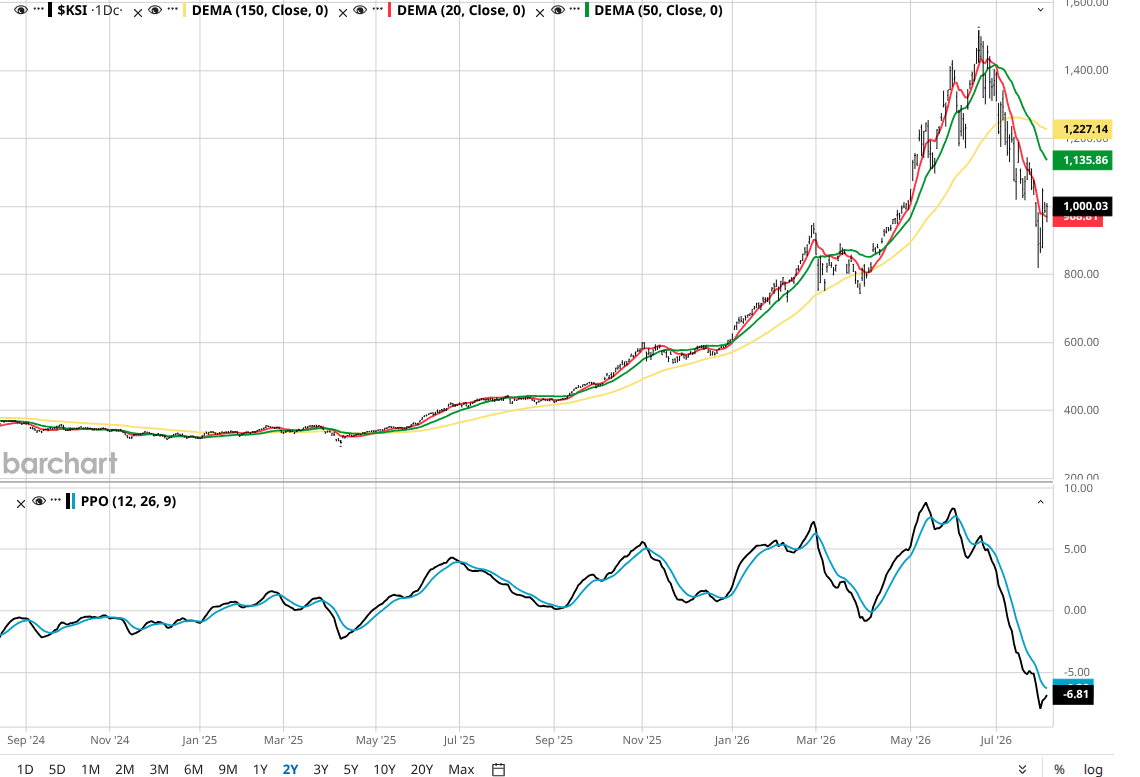
The primary catalyst wasn’t just fear over AI capital expenditure or tech debt. It was a hyper-leveraged feedback loop that trapped over a million retail investors and forced the government to issue a public apology.
At the center of the storm sit two tech giants—Samsung Electronics and SK hynix, which account for over half of the KOSPI’s weighting. When single-stock leveraged ETFs launched in South Korea this past May, retail investors jumped in aggressively. By July, these leveraged products and their underlying stocks represented 70% of total daily trading volume on the local exchange.
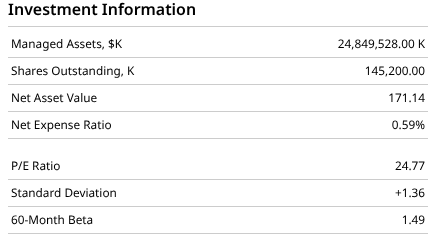
As we see here, South Korea’s stock market is no stranger to volatility. This table shows the iShares MSCI South Korea ETF (EWY), the main tracker ETF for the country’s stock market. That beta of nearly 1.5 over the past five years implies that this market is 50% more volatile than the S&P 500 Index.
Recently, when AI sentiment cooled, the unwinding for the Kospi was mechanical and merciless. Of course it was! Because leverage is a double-edged sword: it amplifies daily upside, but aggressively compounds downside risk. Because leveraged ETFs must rebalance their exposure daily, a declining stock forces the ETF issuer to sell more shares into a falling market.
Retail traders held 92% of these leveraged ETF positions, suffering an estimated $38 billion in cumulative losses. Incredibly, margin calls were delivered on more than 1.2 million South Koreans. That’s 3.4% of the adult population! By comparison, only 1% to 5% of U.S. retail accounts hit margin triggers during the entire 2008 global financial crisis. This seed was sowed in just a few weeks’ time, given the SK hynix (SKHY) IPO.
Outside Seoul’s National Assembly, funeral wreaths line the streets bearing protest signs. Regulators urgently established a debt-counseling hotline, suspended new single-stock leveraged ETF listings, and raised deposit minimums to 30 million won. National Assembly member Lee Jong-wook captured the public outrage during parliamentary hearings: “The country has turned into a casino.”
This crisis was created not only by greed, but by South Korea’s acute economic crisis. With real estate out of reach for young adults saving on average wages, high-leverage bets on Samsung and SK hynix became viewed as one of the few remaining tickets to social mobility. Sound familiar, U.S. investors?
American counterparts shouldn’t view this as a distant anomaly. In the U.S., leveraged ETF assets under management have surged 60% since March to a record $218 billion. While they make up just 1% of total ETF assets, they now generate 40% of all U.S. ETF trading volume.
As Charlie Munger famously warned, leverage strips away an investor’s most important asset: time. Unleveraged investors can comfortably ride out cyclical downturns; leveraged traders get liquidated at the absolute bottom, right before the recovery takes off.
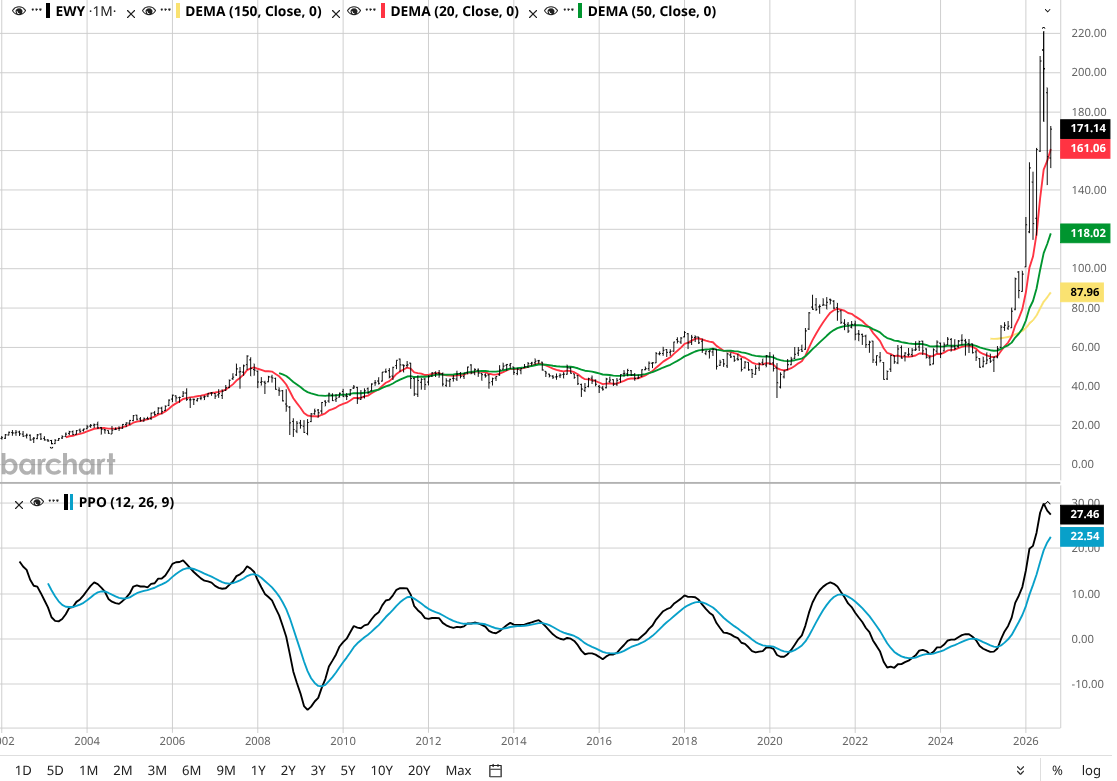
Finally, to show how “not surprised” I was by this event, look at that monthly chart of EWY above. The percentage price oscillator (PPO) indicator at bottom is way above where it has ever been. Just like many U.S. stocks look right now. Translation: overvalued, primed for a bruising. But as Mr. Munger said, time is the factor. I don’t know when the U.S. will suffer a similar fate. I just know we have reached the point where incorporating that possibility into your investment process and risk management approach is no longer an option. It’s a must.
Rob Isbitts is a semi-retired CIO, former fiduciary investment advisor, and Barchart columnist. Check out his other work at ETFYourself.com (featuring the Fresh Charts weekly trading post), and ROAR.PiTrade.com, helping investors to better-manage their own portfolios.
On the date of publication, Rob Isbitts did not have (either directly or indirectly) positions in any of the securities mentioned in this article. All information and data in this article is solely for informational purposes. For more information please view the Barchart Disclosure Policy here.