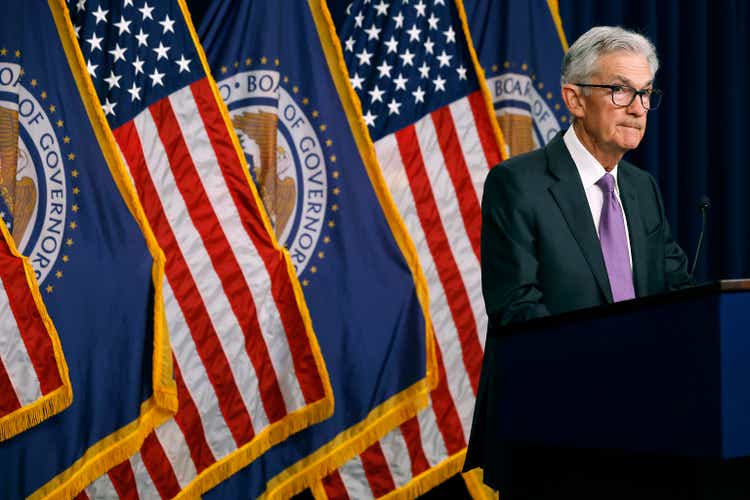
U.S. stocks on Wednesday moved slightly higher after the Federal Reserve kept its key policy rate unchanged as widely expected. Market participants will now be looking ahead to chair Jerome Powell’s press conference for clues on if rate cuts are still on the table this year.
Minutes after the release of the Fed decision, the tech-heavy Nasdaq Composite (COMP:IND) had reversed course and was now marginally up 0.05% to 15,665.13 points. The benchmark S&P 500 (SP500) cut some of its losses, last down 0.06% to 5,032.71 points. The blue-chip Dow (DJI) gained slightly by 0.42% to 37,976.52 points.
Of the 11 S&P sectors, seven were now in the green.
At the start of the year, inflation was on a downward trajectory and the economy was firing on all cylinders, leading Wall Street to price in at least seven 25 basis point rate cuts in 2024. However, hotter-than-expected economic data in April massively dented those expectations and led to the benchmark S&P 500 (SP500) posting its worst monthly loss since September 2023.
The Fed kept its key federal fund rate steady at a more than two decade high of 5.25%-5.50%. Moreover, the policy decision statement had a key change in wording: “In recent months, there has been a lack of further progress toward the (FOMC’s) 2 percent inflation objective.”
“The Fed marked to market its policy statement to acknowledge recent inflation setbacks, but didn’t change the guidance section,” the Wall Street Journal’s Fed watcher Nick Timiraos noted on X (formerly Twitter).
The Fed also said, beginning in June, it would slow the pace of decline of its securities holdings by reducing the monthly redemption cap on Treasury securities from $60B to $25B.
Earlier, Investors had plenty of earnings reports and economic data to wade through.
Technology slipped about 1% on the back of a post-earnings slide in Super Micro Computer (SMCI) and Advanced Micro Devices (AMD). Despite solid results and strong guidance from the maker of artificial intelligence servers and the semiconductor company, both stocks slumped and were among the top percentage losers on the Nasdaq (COMP:IND). It is worth noting that expectations were lofty coming into their results.
Amazon.com (AMZN) was a bright spot, gaining after a better-than-expected performance at its Amazon Web Services cloud cash cow offset a soft current quarter guidance.
Starbucks (SBUX) was another major drag on both the Nasdaq (COMP:IND) and the S&P (SP500). The world’s largest coffee chain dropped some bombshells on its earnings conference call with some disappointing guidance for revenue and U.S. comparable sales growth.
Turning to Wednesday’s economic calendar, there were multiple indicators on the labor market and manufacturing. The former was a mixed bag, with ADP’s jobs report showing strong gains in private employment and the latest Job Openings and Labor Turnover Survey pointing to cooling in the number of job openings in March. The latter was largely negative, with S&P Global and Institute for Supply Management data showing a setback in U.S. manufacturing activity in April.
Looking at the fixed-income markets, yields did not show much reaction to the Fed decision. They remained in the red after the Treasury Department earlier kept its quarterly debt sales mostly steady. The longer-end 30-year (US30Y) and 10-year yields (US10Y) were both down 4 basis points each to 4.74% and 4.64%, respectively. The shorter-end more rate-sensitive 2-year yield (US2Y) was also down 4 basis points to 5.01%.
See live data on how Treasury yields are doing across the curve at the Seeking Alpha bond page.