Earlier this week, an economist at the University of Helsinki predicted that the U.S. economy would enter a recession by 2027. As reported by Business Insider, the professor, an expert in financial crises, named high corporate debt as the trigger for a collapse in the economy. The result would be a global financial crisis, which would cause a U.S. stock market crash.
Personally, I don’t put a lot of faith in theories of this kind. There are simply too many moving parts in the economy to pinpoint a date and cause for a stock market crash.
Even so, I can understand the underlying anxiety. There have been several warning signs lately that the S&P 500 (^GSPC -0.36%) is expensive and approaching a correction or crash. I wouldn’t go so far as to put a date or year on it, but it seems likely a bear market is on the way. Here’s what we know.

Image source: Getty Images.
The stock market looks strongly overvalued by two popular measures
The current bull market is a bit of a freak. Against all odds — stubbornly high inflation, negative consumer sentiment, general apprehension and market skepticism — the S&P 500 has notched three straight years of double-digit gains, with a fourth underway. Most bull markets last on average 2.7 years. This one has lasted nearly four.
Another unusual feature of this bull market is its heavy concentration. For a long time, the index was driven by only a handful of megacap stocks, most notably the “Magnificent Seven” — the nickname Bank of America Chief Investment Strategist Michael Hartnett gave to seven dominant tech stocks. While lately the market has broadened, with energy, industrials, and healthcare contributing more, these market leaders were responsible for much of the S&P 500’s rise.
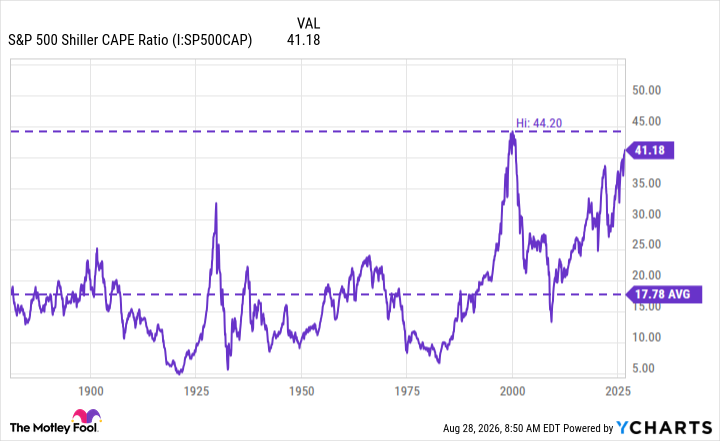
Those enormous gains have started showing up in another concerning way: valuation. By one measure, we have entered the second most expensive market in history, behind only the dot-com era. The CAPE ratio, which compares the S&P 500’s price today to the last decade of earnings, sits around 41. That’s more than twice its long-term average of about 17, and only a few points shy of its all-time high of roughly 44.
Data by YCharts
The Buffett indicator is flashing a similar warning. This metric, created by famed investor Warren Buffett, compares the total value of the stock market with GDP. The idea is that if the stock market is growing faster than the economy, a bubble might be forming. Any reading above 120% signals that the market is overvalued, with 200%-plus so hot it’s “playing with fire.” The current ratio is 244%.
A crash in 2027? Here’s what to do.
The CAPE and Buffett indicator measure the stock market’s valuation relative to history. They compare the present with the past, but they don’t predict the future. They tell us, in short, to invest with caution when the market is overvalued, but they don’t advise to give up on investing altogether.
That might seem counterintuitive. If the market is overvalued, why not pocket gains now? You’ll never regret taking a profit, but taking a loss could leave you remorseful.
If you want to reduce risk, I wouldn’t discourage from taking profits. You might want to diversify your portfolio, or you might be at the stage where less risk agrees more with your strategy. In that case, do what’s best for your long-term goals.
At the same time, I would caution against selling out of fear. The stock market might look expensive, but that doesn’t mean it’s going to crash next year. Many top banks, including Goldman Sachs, are predicting the opposite: strong growth in 2027, possibly another double-digit gain.
For most investors, the best thing to do is the least dramatic: nothing. If you’re confident in your investments, if you’ve picked high-quality stocks, hold them long-term. The stock market could crash in 2027 — or it might not — but profitable companies with durable earnings and competitive moats will weather the storm. Trust in your investments, and you could prevent yourself from making a common mistake: selling too soon and missing bigger gains later.
As Buffett once put it: “Our favorite holding period is forever.” The next bear market might test your patience, but just wait — another bull will be on the way.