![On the 18th, the KRW/Dealer exchange rate and the KOSPI closing price are displayed on the dealing room electronic board of Hana Bank's headquarters in Jung-gu. [Yonhap News]](https://10xwealthreport.com/wp-content/uploads/2026/09/echo/rcv.YNA.20260918.PYH2026091817700001300_P1.jpg6ab06ac5f092e.jpg)
The domestic stock market, which has digested major negative factors such as artificial intelligence (AI) speed control theory, the U.S. Federal Open Market Committee’s “hawkish” interest rate hike, and a surge in international oil prices, is expected to challenge the KOSPI 7,000 level again this week. This week, a large diplomatic event called the U.S.-China summit, the Chuseok holiday (closed on the 24th-25th), and the aftermath of the U.S. benchmark interest rate hike are expected to show volatility. NH Investment & Securities and Kiwoom Securities presented the range of “6400-7500” and “6500-7150,” respectively, as KOSPI forecast bands this week.
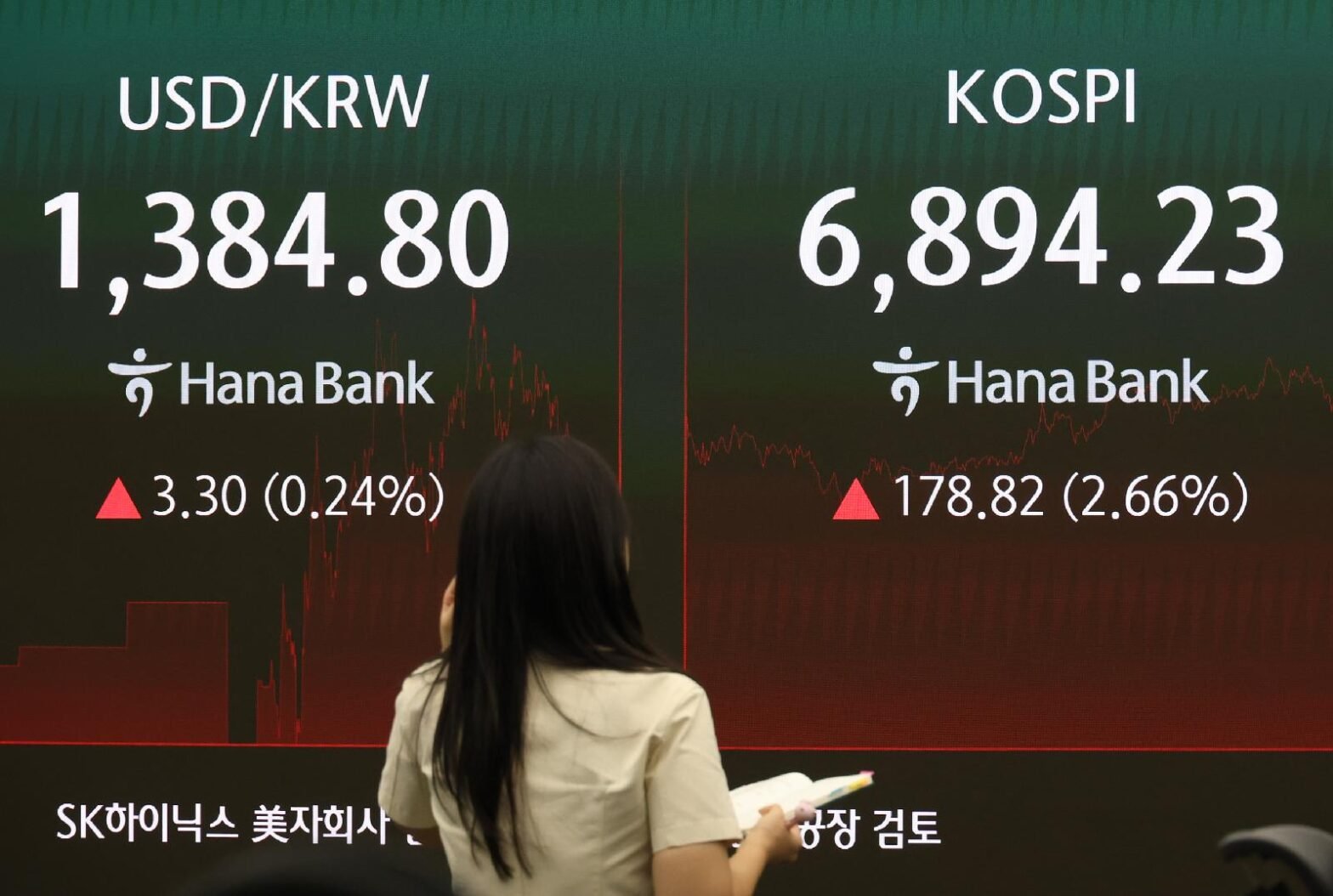
According to the Korea Exchange on the 21st, the KOSPI closed at 6894.23, down 15.68 points (0.23%) from the previous week (6909.91). Last week, the local stock market plunged more than 3 percent from the beginning, falling to the 6,600 level, before closing the fall with fluctuations.
The market’s attention this week is the U.S.-China summit to be held at the White House on the 24th (local time). U.S. President Donald Trump and Chinese President Xi Jinping will discuss pending issues such as AI, trade, and rare earths. From the perspective of the domestic stock market, the AI agenda, which is directly related to the control of semiconductors in China, is considered the core. In Korea, investor sentiment in semiconductor stocks such as Samsung Electronics and SK Hynix is expected to change depending on the direction of regulations on semiconductors in China.
Na Jung-hwan, a researcher at NH Investment & Securities, said, “The core of the domestic semiconductor perspective is the AI agenda, which is directly related to the control of semiconductors with China,” adding, “In a recent contribution, CEO Amodei demanded a ban on the sale of chips and equipment to China and blocking remote access, and AI-related issues have been formed.”
“If the discussion on open weight (weight open) and closed weight (closed) models mentioned by U.S. Treasury Secretary Scott Bessant is materialized as a ‘distillation’ crackdown, China’s low-cost AI development path will be narrowed, which is favorable to domestic semiconductors,” he added.
Lee Kyung-min, a researcher at Daishin Securities, said, “The average KOSPI yield for the past five trading days before and after the Chuseok holiday has been -0.42% and 0.68%, respectively. If the stock market is sluggish in the short term due to the aftermath of the hawkish FOMC and the gap in supply and demand before the holiday, the purchase strategy aimed at rebounding after the holiday is effective.”
Another variable is the level at which U.S. government bond rates will stabilize after FOMC. John Williams, president of the Federal Reserve Bank of New York, will speak on the 22nd and Beth Hammack, president of the Cleveland Fed, will speak on the 23rd. The market’s interest is the evaluation of the possibility of an additional rate hike within this year and the recent financial conditions. The U.S. Treasury Department’s 20-30-year long-term bond buyback scheduled for the 24th could also affect the direction of interest rates.
Industrial events that will affect stock prices by industry will also follow. On the 21st, ‘Battery Korea 2026’ will be held to check changes in technology across the industry such as battery materials, parts, and energy storage devices (ESS). Attention is focusing on whether there will be clues to gauge AI investment performance and return on investment (ROI) in the “Meta Connect” scheduled for the 23rd and 24th.
Han Ji-young, a researcher at Kiwoom Securities, said, “This week will be a section to reconfirm the resilience of stock prices while digesting existing macro and AI issues,” adding, “As the domestic stock market only opens for three trading days due to the Chuseok holiday, there is a possibility that there will be a “spread of perception -> decrease in transaction value -> thinner asking price and supply gap” during the three trading days.”
“However, it will only be a temporary phenomenon due to the holiday,” he said, adding, “It is necessary to avoid interpreting the volatility that may emerge in the short-term supply-demand gap as a full-fledged change in the market price.”
Seo Sang-young, managing director of Mirae Asset Securities, said, “In the end, the overall index is expected to change due to changes in related stocks as conferences, U.S.-China summits, and government bond rates are expected to affect technology stocks this week.” “The Korean stock market will be limited in supply and demand due to the Chuseok holiday, but the performance estimate is increasing again, so the 7,000p challenge is expected to continue.”
![[today’s-key-economic-and-crypto-events]-japan-stock-market-closed](https://10xwealthreport.com/wp-content/uploads/2026/09/237073-todays-key-economic-and-crypto-events-japan-stock-market-closed-1568x882.png)

![[good-morning-stock-market]-“kospi-to-remain-range-bound-this-week…-wait-and-see-until-micron-earnings-on-the-30th”](https://10xwealthreport.com/wp-content/uploads/2026/09/237079-good-morning-stock-market-kospi-to-remain-range-bound-this-week-wait-and-see-until-micron-earnings-on-the-30th.jpg)