With mere hours left on Election Night before polling closes across America, traders on prediction market platform Polymarket are forecasting an 89% chance (as of 7 p.m. ET) that Democrats sweep and retake both the House of Representatives and the Senate. For context, Republicans enter the midterms with 218 of 435 House seats and 53 of 100 Senate seats.
The potential implications of midterm elections on the Dow Jones Industrial Average (^DJI -0.38%), S&P 500 (^GSPC +0.36%), and Nasdaq Composite (^IXIC +0.83%) are massive. If a “blue wave” does unfold, things could get dicey, at least over the short run, for a historically expensive stock market.

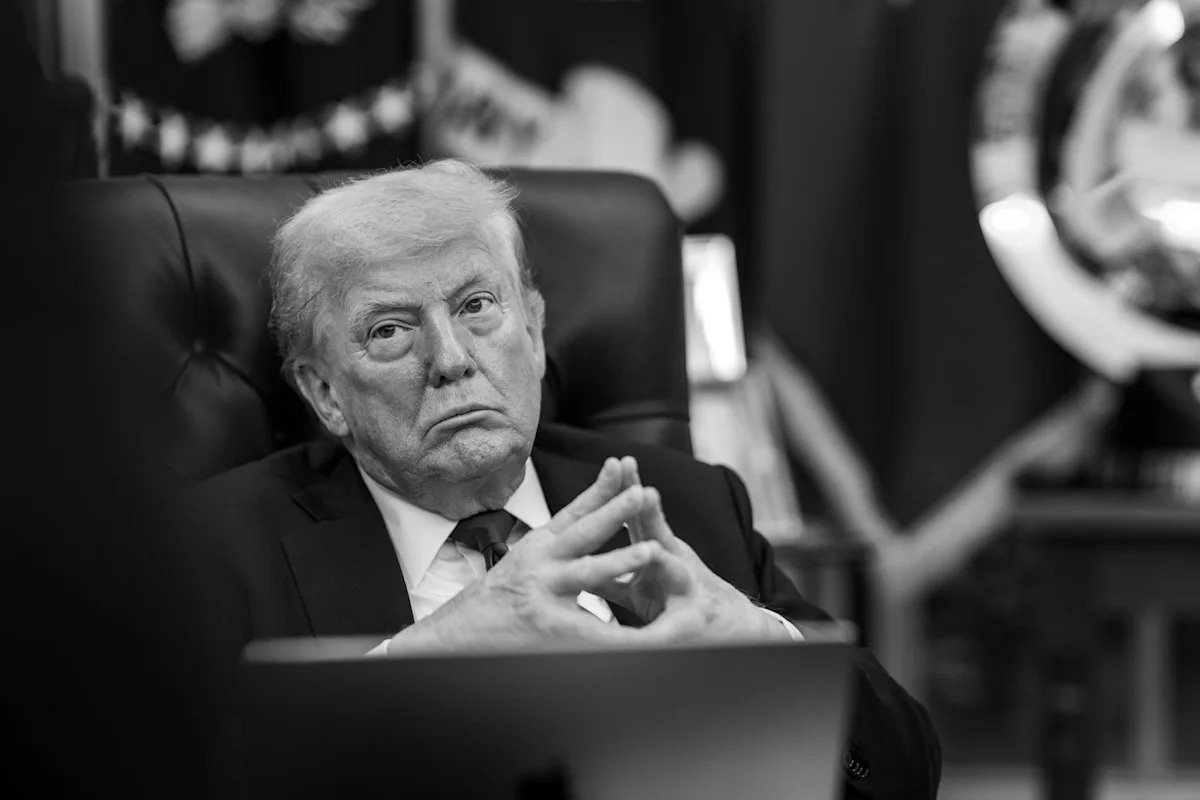
President Trump may soon be working with a divided government. Image source: Official White House Photo by Molly Riley.
President Trump vows to become “Mr. Veto” if Democrats win
President Donald Trump hasn’t been keen on the prospect of working with the opposition. In a recent Fox News interview, he proclaimed that “I guess I’ll become Mr. Veto” if a blue wave takes shape, and has previously gone on record as stating that he’d “veto everything” sent to him by a Democrat-led Congress.
On the one hand, the political gridlock that ensues from a divided Congress can, in some ways, be beneficial for the stock market. A split Congress effectively takes all major tax and spending legislation off the table, likely locking in historically low personal and corporate income tax rates through at least the end of Trump’s presidency in January 2029. Wall Street loves when things are predictable.
“I guess I’ll become Mr. Veto.” President Trump lays out his strategy for dealing with a potential Democratic-controlled Congress in an exclusive interview with Miranda Devine. Trump says he would veto legislation before eventually negotiating compromises, while expressing hope Republicans maintain control after Tuesday’s midterms.
— Fox News (@FoxNews) November 1, 2026
At the same time, a non-unified government can create friction points for the stock market. For example, a Democrat-controlled Congress could make debt-ceiling negotiations far more challenging. The debt ceiling is forecast to be reached in the first half of 2027. If Democrats take one or both houses of Congress, the odds of a lengthy government shutdown rise.
We’d likely also see friction between President Trump and Democrats over artificial intelligence (AI) regulation. Whereas Trump favors as little regulation as possible for Wall Street’s and the U.S. economy’s No. 1 catalyst, most Democratic lawmakers prefer to limit data center expansion and impose tougher restrictions on AI solutions, including large language models.
Even if President Trump successfully vetoes AI legislation from a Democrat-controlled Congress, simply putting AI regulations in the spotlight could be bad news for stocks.

Image source: Getty Images.
A worst-case scenario is still a green light for investors
From a statistical standpoint, no political scenario is less desirable for investors than a Republican president overseeing a divided Congress. According to Retirement Researcher, the S&P 500’s average annual return over 34 years is just 7.33% under this scenario, compared to 14.01% to 16.63% under the other political scenarios.
While this might sound less than ideal, a little historical perspective changes everything. For instance, the S&P 500 has been higher at the six- and 12-month mark following every midterm election over the last 75 years, with November up 100% of the time!
S&P 500 is higher 6 and 12 months after every midterm election over the last 75 years 📈🤑🥳 https://t.co/N1Eu0fZDie
— Barchart (@Barchart) November 1, 2026
Furthermore, a 7.33% average annual return, while notably lower than other political situations, is still markedly higher than the long-term annualized returns for real estate, commodities, and Treasury bonds. Even at their “worst,” stocks have continued to shine brightest for those willing to be patient.
Even if President Trump’s threats to “veto everything” perturb equities over the short term, history says that the Dow, S&P 500, and Nasdaq Composite are well-positioned for success, regardless of which political party is in power.