Alex Sirois
6 min read
Quick Read
-
Oracle’s $664 billion backlog fuels Wall Street’s bullish view, but negative free cash flow and heavy financing needs drove a 33% slide this year.
-
Oracle faces dilution and debt: it priced $20 billion of stock and notes while interest expense jumped 55%.
-
Microsoft and Amazon rose this year while Oracle fell alone, leaving Oracle with the largest analyst-implied upside but the weakest balance sheet.
-
Building a portfolio and living off one are two completely different skills, and almost nobody teaches the second. This problem is what The Definitive Guide to Retirement Income helps, and it is free today. Read more here. (Sponsor)
Oracle (NYSE:ORCL) is priced at $128.40, while Wall Street’s average price target sits at $235.77. That gap implies 83.6% upside.
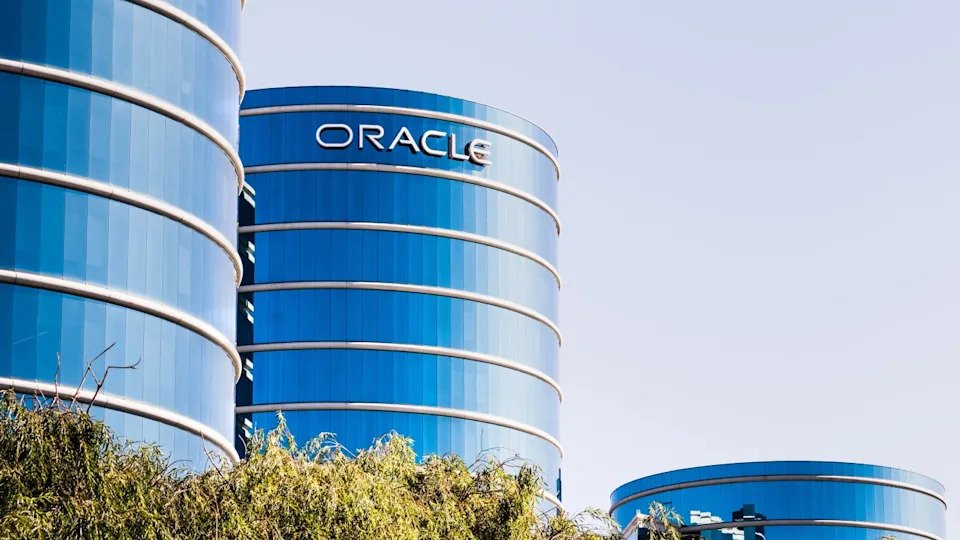
Oracle has turned its database franchise into one of the most aggressive AI cloud buildouts in tech. Oracle Cloud Infrastructure revenue grew 121% last quarter. The biggest bull is Guggenheim Securities, whose Street-high $400.00 target implies roughly 211.5% upside.
Oracle’s backlog and its cash flow statement point in opposite directions, explaining the gap. The stock’s direction depends on which one wins.
Oracle’s AI Building Spree Became a Cash Burn Problem
Negative free cash flow drove this selloff. Oracle posted free cash flow of -$23.686 billion for fiscal 2026 on $55.663 billion of capex. Last quarter added another -$5.396 billion, and management expects full-year capex of $90 billion to $95 billion.
Funding that expansion means dilution and debt. Oracle earlier flagged raising about $40 billion this fiscal year, recently priced $20 billion of common stock and senior notes, and saw interest expense climb 55% to $1.4 billion. Fears about its ties to OpenAI added pressure.
Shares are down 33.25% year to date and 44.9% over a year. The slide began when a 4.99% revenue miss in the fiscal second quarter of 2026 sent shares down about 13%.
——
Now Available: The Definitive Guide to Retirement Income
Many successful investors eventually reach the same moment. The saving is done, the portfolio is built, and the question quietly changes from how much can I grow this to how much can I take out? Get that second question wrong and decades of good investing can come apart in a handful of years.
That is exactly what The Definitive Guide to Retirement Income helps answer. It covers what your retirement could actually cost, which income sources are worth using, and the withdrawal math that decides whether the money lasts. It is free today from Fisher Investments. Read More Here ›