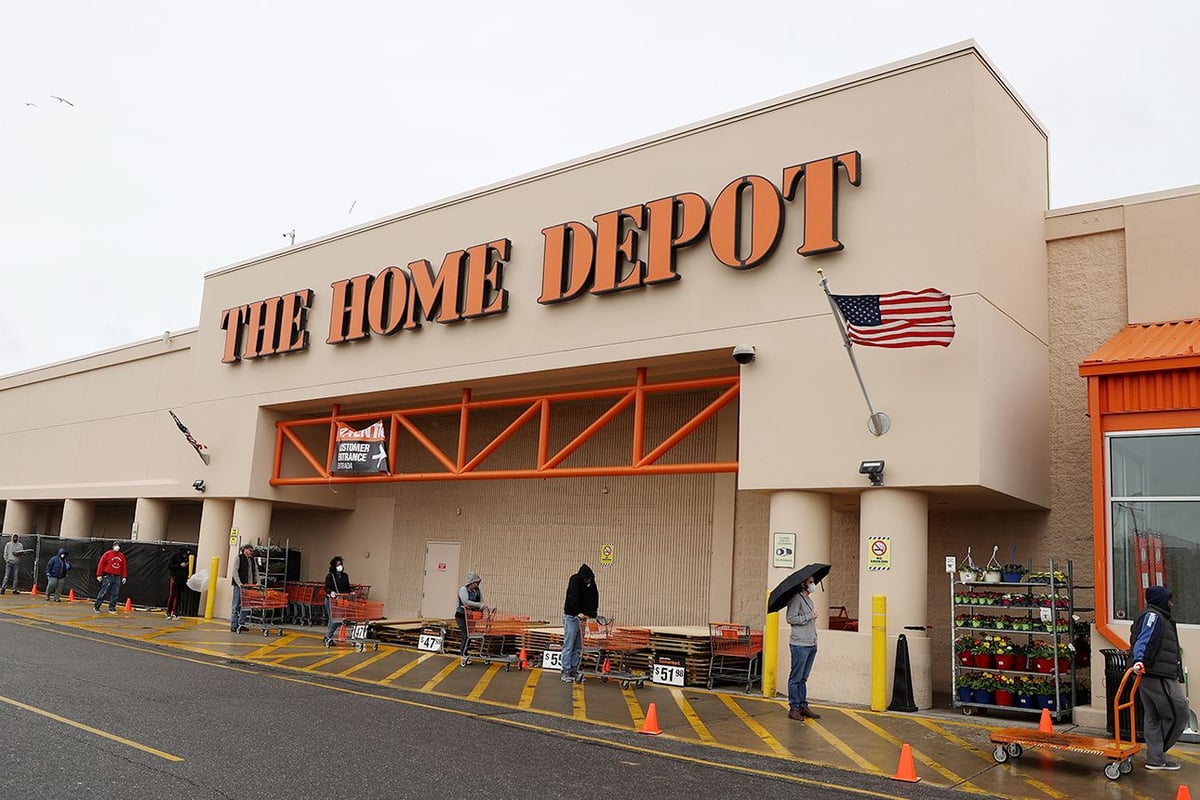
The housing market continues to be in a pinch. In the U.S., existing-home sales totaled a seasonally adjusted annual rate of 3.75 million units in October, down 8.8% from the same month last year.
That unit figure was the lowest since August 2010, when the country was fresh on the heels of the housing meltdown. It doesn’t help that the average 30-year fixed mortgage rate, near the highest level this century, is 7.11%. Higher borrowing costs, which lead to higher monthly payments, discourage people from purchasing homes.
This backdrop directly affects Home Depot (HD +0.12%) and Lowe’s (LOW +0.12%), the two giants in the home improvement market. When home transactions are under pressure, as they are now, a sign of low housing turnover, it translates to fewer big-ticket renovation projects. These retail stocks don’t benefit when they are forced to operate in a tighter environment.
Investors in these businesses must be extremely patient right now.

Image source: Getty Images.
Macroeconomic conditions matter enormously
Both Home Depot and Lowe’s faced a surge in demand after the COVID-19 pandemic affected the broader economy. These companies reported above-average revenue growth in fiscal 2020 and fiscal 2021. Credit should be given to the ultra-low-interest rate environment and unprecedented levels of government stimulus.
It’s been a slow grind in recent years, however. Inflationary pressures forced the Federal Reserve to raise interest rates. Higher prices across the economy remain a problem today. The market expects sticky inflation to persist, as shown by the 10-year Treasury yield rising 18% in the past 12 months to 4.86%. Lenders use this as a baseline to set mortgage rates.
During the second quarter, Home Depot’s same-store sales (SSS) increased by just 1.7%. Lowe’s fared worse, eking out a tiny 0.2% gain. The market is aware of the struggles these businesses face. Their share prices are down about 20% from their all-time records.
HD Home Depot
$348.69+$0.43 (+0.12%)
NYSE · As of 4:00 PM ET 11/13/26
Fundamental improvements won’t happen overnight
The industry heavyweights, which combined generated $74 billion in revenue last fiscal quarter, will present investors with their third-quarter financial results on Nov. 17 (Home Depot) and Nov. 18 (Lowe’s). Of course, investors will want to pay close attention to SSS trends. Home Depot projected full-year SSS to grow 1% at the midpoint, while Lowe’s expects it to be flat.
Understanding how customer transactions and ticket sizes move is also important. This will provide insight into customer demand. It might be more encouraging to see transaction counts rise, since this is a proxy for foot traffic coming to stores.
LOW Lowe’s Companies
$227.73+$0.27 (+0.12%)
NYSE · As of 4:00 PM ET 11/13/26
Listen to management’s commentary as well. In August, Home Depot chief financial officer (CFO) Richard McPhail said that “consumer uncertainty and housing affordability continue to pressure demand for larger home improvement projects.”
During his company’s Q2 2026 earnings call, Brandon Sink, Lowe’s CFO, said he and his team “continue to manage through a challenging home improvement backdrop and soft DIY demand.”
Investors definitely have low expectations. There’s no reason to believe that growth will pick up meaningfully if the economic backdrop hasn’t changed. In fact, with inflation where it is, the central bank could raise the benchmark rate again before the year ends. Higher borrowing costs are meant to pump the brakes on the economy, a headwind that’s precisely the opposite of what Home Depot and Lowe’s need to successfully increase their earnings power.
On a positive note, no one will argue about just how important these businesses are. They are critical to the U.S. housing market. They have strong brands, scale advantages, durable profits, and well-regarded management teams, and they return lots of capital to shareholders.
Each pays a dividend yield exceeding 2%. That’s a consolation prize for shareholders who will have to wait longer than anticipated for the fundamentals to improve.
Where to invest $1,000 right now
When our analyst team has a stock tip, it can pay to listen. After all, Stock Advisor’s total average return is 823%* — a market-crushing outperformance compared to 209% for the S&P 500.
They just revealed what they believe are the 10 best stocks for investors to buy right now, available when you join Stock Advisor.
*Stock Advisor returns as of November 15, 2026.