AMD (AMD +2.95%) has had an incredible year. It’s the ninth-best-performing S&P 500 (^GSPC +0.73%) stock, rising nearly 200% so far this year. That performance has pushed it to become a $1 trillion company. While Nvidia (NVDA +1.34%) is still ahead at a $5.5 trillion valuation, is this a sign that AMD is finally catching up?
Let’s take a look at both of these stocks and see if Nvidia investors have something to be worried about or if AMD has maximized its short-term returns.

Image source: The Motley Fool.
Nvidia is still the leader
Both companies are competing for market share in the AI arms race. They are primarily doing this in the graphics processing unit (GPU) sector, but there are also countless other companies that operate in data centers, which are major market opportunities. Nvidia took an early lead in 2023 because its products were flat-out better than AMD’s. Nvidia had leading GPUs and software to program them, so it naturally took a huge lead to start.

Today’s Change
Current Price
AMD is looking to close the gap and has released several promising GPUs alongside improving its programming software to compete with Nvidia’s CUDA. This is driving strong growth for AMD, as its data center revenue rose 107% year over year to $6.7 billion in the second quarter. Companywide, AMD’s revenue rose 50% to $11.5 billion. That’s a pretty strong performance from AMD, but the problem is, Nvidia’s is better.
Nvidia is both bigger and growing faster. In its data center division, it delivered 117% year-over-year growth to $89 billion. Nvidia has less exposure to consumer and original equipment manufacturers (OEMs) demand, so its overall growth rate was also faster, rising 106% to $96.2 billion.

Today’s Change
Current Price
Nvidia is growing faster and has a data center division that’s well over 10 times AMD’s. However, AMD is about a fifth the size of Nvidia, so what’s going on here?
I think this is a telling sign, as the market is highly valuing AMD’s stock while downplaying Nvidia’s. This could be a huge investment opportunity, and those who made a huge return on AMD stock can roll it into Nvidia’s for a huge gain in 2027.
AMD’s stock is very expensive compared to Nvidia’s
Not all of AMD’s stock success is genuine. Some of it has come from its business performance improving, but much of it has come from its valuation rising, which puts the stock on unstable ground. AMD trades at a very expensive 158 times trailing earnings and 81 times 2026 estimates. Even when 2027 projections are used, AMD’s stock trades at nearly 40 times forward earnings.
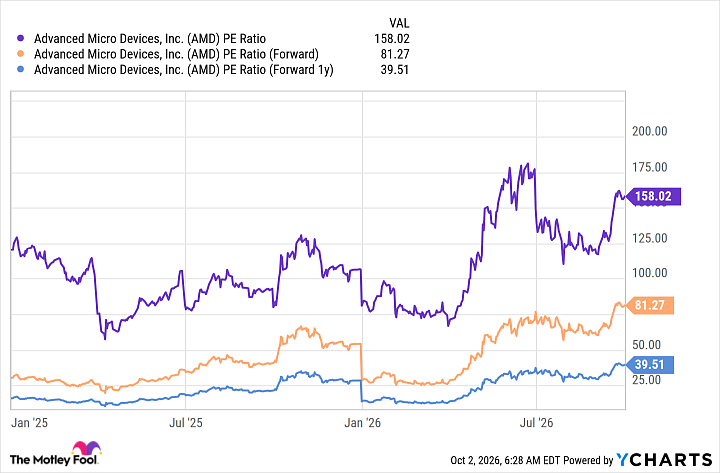
AMD PE Ratio data by YCharts.
Now, let’s contrast that with Nvidia’s price tag. Nvidia trades for less than 30 times trailing earnings. That’s right, Nvidia’s trailing earnings are less than AMD’s price tag when next year’s earnings projections are used.
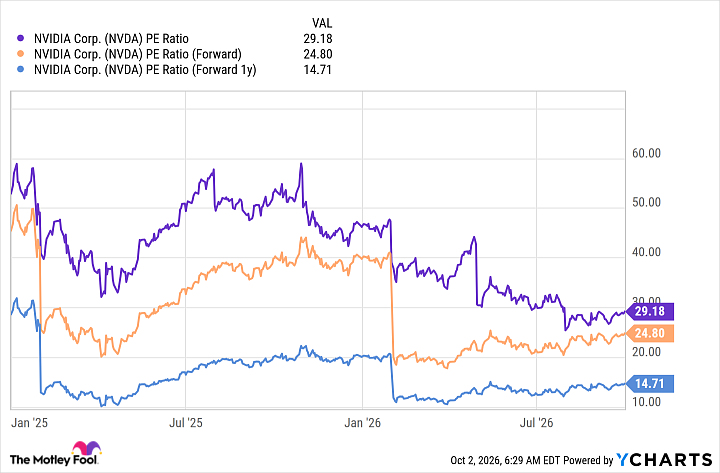
NVDA PE Ratio data by YCharts.
That’s a huge gap, and it shows just how expensive AMD’s stock is and how cheap Nvidia’s is. When next year’s forward earnings are used for Nvidia, it trades at a mere 14.7 times forward earnings. If Nvidia and AMD should trade for about 30 times trailing earnings, then AMD investors could expect about a 25% downside next year, while Nvidia investors would expect their stock to double.
Nvidia represents a compelling investment opportunity, while AMD is standing on a shaky foundation. AMD is still growing slower and smaller than Nvidia and hasn’t done anything to take market share from Nvidia quite yet. However, the market has priced AMD’s stock like it’s already won the battle. This mismatch won’t last forever, and I think Nvidia will be a far better stock to own as the market figures out what’s going on with these two.