A man looks at an electronic board displaying stock prices of the Nikkei 225 listed on the Tokyo Stock Exchange in Tokyo on April 30, 2024.
Kazuhiro Nogi | Afp | Getty Images
Asia-Pacific markets slid on Tuesday, tracking losses in the U.S. following anxiety over tariff policy and a potential recession in the world’s largest economy.
Japan’s Nikkei 225 fell 1.7%, paring steeper losses earlier in the session, while the broader Topix index fell 2%.
Significant losses in the Nikkei 225 were seen in telecommunications company Fujikura, which was down 7.43% and heavy-equipment manufacturer IHI Corp, which lost 6.51%.
Japan’s revised GDP for the fourth quarter came in at 2.2% on an annualized basis, below economists’ expectations and the previous estimate of 2.8% growth.
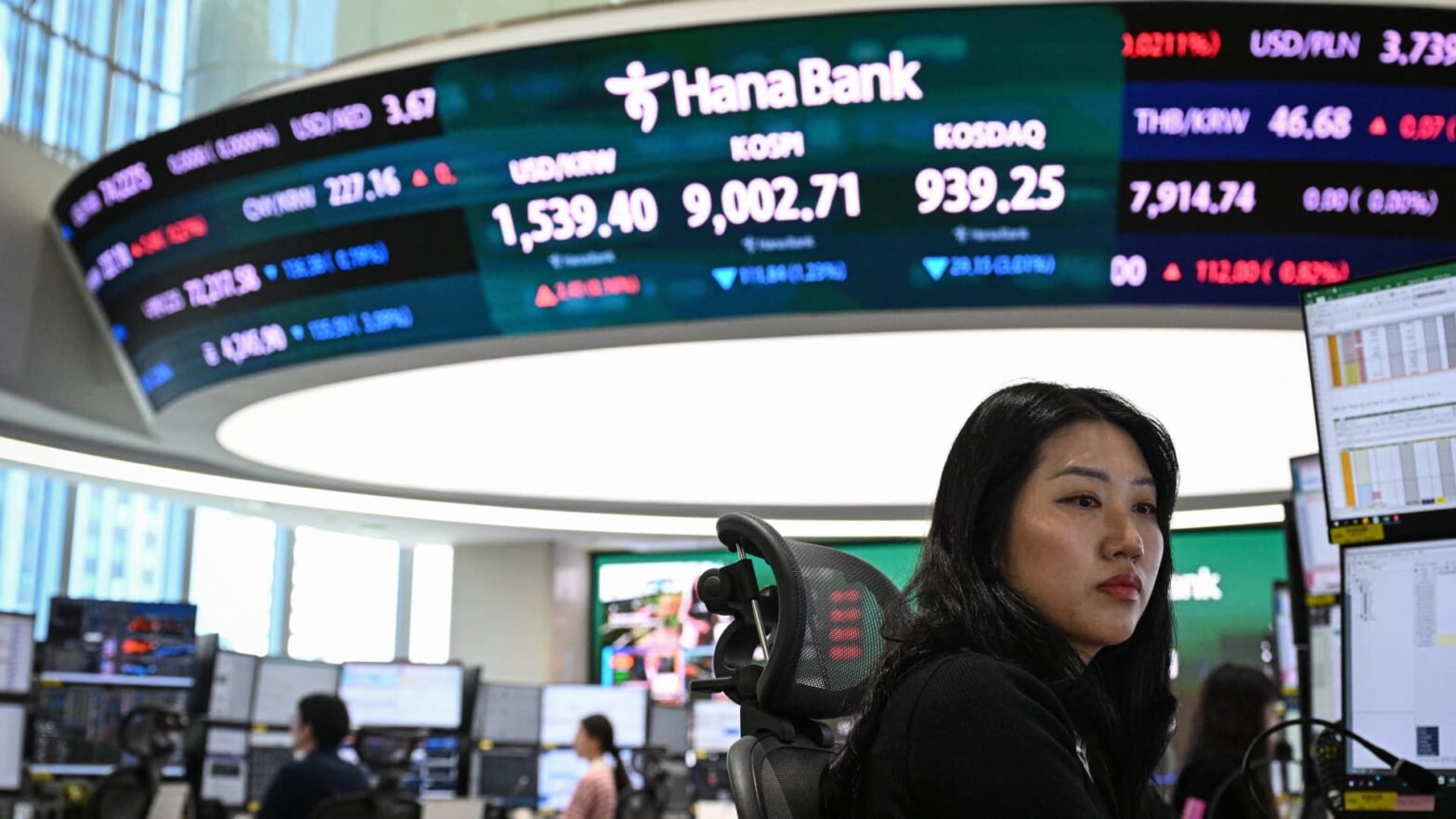
Over in South Korea, the Kospi was trading 1.53% lower, while the small-cap Kosdaq dipped 1.4%.
Hong Kong’s Hang Seng Index fell 0.9% in early trade, while Mainland China’s CSI 300 fell 0.2%.
Meanwhile, Taiwan’s Taiex index was down 1.84%, paring losses from an over 3% drop earlier in the session.
Elsewhere, Australia’s S&P/ASX 200 fell 0.9%, reversing course from gains in the previous session.
Overnight in the U.S., stocks slid amid fears that Trump’s tariff policy could push the U.S. into a recession.
The S&P 500 shed 2.7%, after touching its lowest level since September at one point. The tech-heavy Nasdaq Composite saw the sharpest decline, falling 4%, in its worst session since September 2022. The Dow Jones Industrial Average dropped 2.08%, ending at 41,911.71.
The S&P 500 is off 8.7% from its all-time high on Feb. 19, while the Nasdaq Composite is off nearly 14% from its recent high. A 10% decline is considered a correction on Wall Street.
The losses worsened as the day progressed, but the major averages came off their session lows just before the close.
— CNBC’s Lisa Kailai Han and Jesse Pound contributed to this report.
TSMC shares fall over 3% despite pick up in revenue in first two months of 2025
Shares in Taiwan Semiconductor Manufacturing Company dropped as much as 3.51% on Tuesday, despite a 39.2% year-on-year increase in its revenue for the first two months of the year.
The chipmaker – which is one of Nvidia’s biggest suppliers – posted a combined revenue of 553.3 billion New Taiwan dollars ($16.85 billion) for January and February.
Its latest growth rate is a marked improvement from the 34% rise it posted for the whole of last year and indicates resilient demand for Nvidia’s chips, TSMC announced on Monday.

TSMC Shares
— Amala Balakrishner
Japanese yen hits near five-month high after selloff in U.S. markets
The Japanese yen has notched near five-month highs after uncertainty on tariff policies weighed on U.S. stock markets and the dollar.
The yen was last down 0.48% to trade around 146.59 against the U.S. dollar.
Yen
Other moves in the currency market were more muted. The Australian dollar weakened marginally by 0.08% against the U.S. dollar to 0.6282, while the offshore Chinese yuan strengthened 0.08% against the U.S. dollar to 7.2564.
— Amala Balakrishner
Nikkei slides 2%
Japan’s Nikkei 225 index fell around 2% shortly after the open on Tuesday.
Nikkei 225
Japan revises fourth-quarter GDP lower, complicating BOJ’s interest rate outlook
Japan’s economic growth slowed to 2.2% on an annualized basis in the fourth quarter, complicating the central bank’s case for a further interest rate hike in the near term.
The revised data came in lower than economists’ median forecast and the initial estimate of 2.8% growth.
On a quarter-to-quarter basis, GDP expanded 0.6%, compared with a 0.7% growth in preliminary data released last month, the Cabinet Office’s revised data showed on Tuesday.
Read the full story, here.
— Anniek Bao
There’s irony in foreign markets outperforming U.S. equities, Oppenheimer says
Oppenheimer Asset Management believes investors may be disproportionately rewarding ex-U.S. assets in the wake of President Trump’s new tariffs.
“Ironically, since the beginning of the year, foreign markets around the world and particularly in Europe are outperforming the U.S. equity markets as the world frets over the potential effects of tariffs should they be broadly deployed by the Trump Administration,” wrote chief investment strategist John Stoltzfus. “We see some irony in the recent outperformance by foreign markets over the U.S. markets. In our view, foreign companies in Europe, Asia, and Latin America are likely to suffer even more from deployment of tariffs than companies in the U.S.”
— Lisa Kailai Han
Palantir declines 10% as investors dump onetime favorite
Palantir dropped more than 10% on Monday as the latest cult stock showed signs of sputtering out.
The defense tech stock is now within striking distance of its flatline for 2025. That marks a turn after shares surged more than 340% last year, making it the top S&P 500 performer.
Palantir, 1-day
Palantir has become a favorite of retail investors in recent months. Part of that optimism is tied to the quirky persona of CEO Alex Karp, who often directly addresses mom-and-pop traders.
The stock shot up following President Trump’s victory in November. Some pointed out that Peter Thiel, who co-founded of PayPal with billionaire entrepreneur Elon Musk, has chaired Palantir’s board for more than two decades.
— Alex Harring