HONG KONG (AP) — Asian shares declined Tuesday, following more drops for stocks in the artificial intelligence industry on Wall Street ahead of Nvidia’s earnings results.
U.S. futures were mixed and oil prices edged lower.
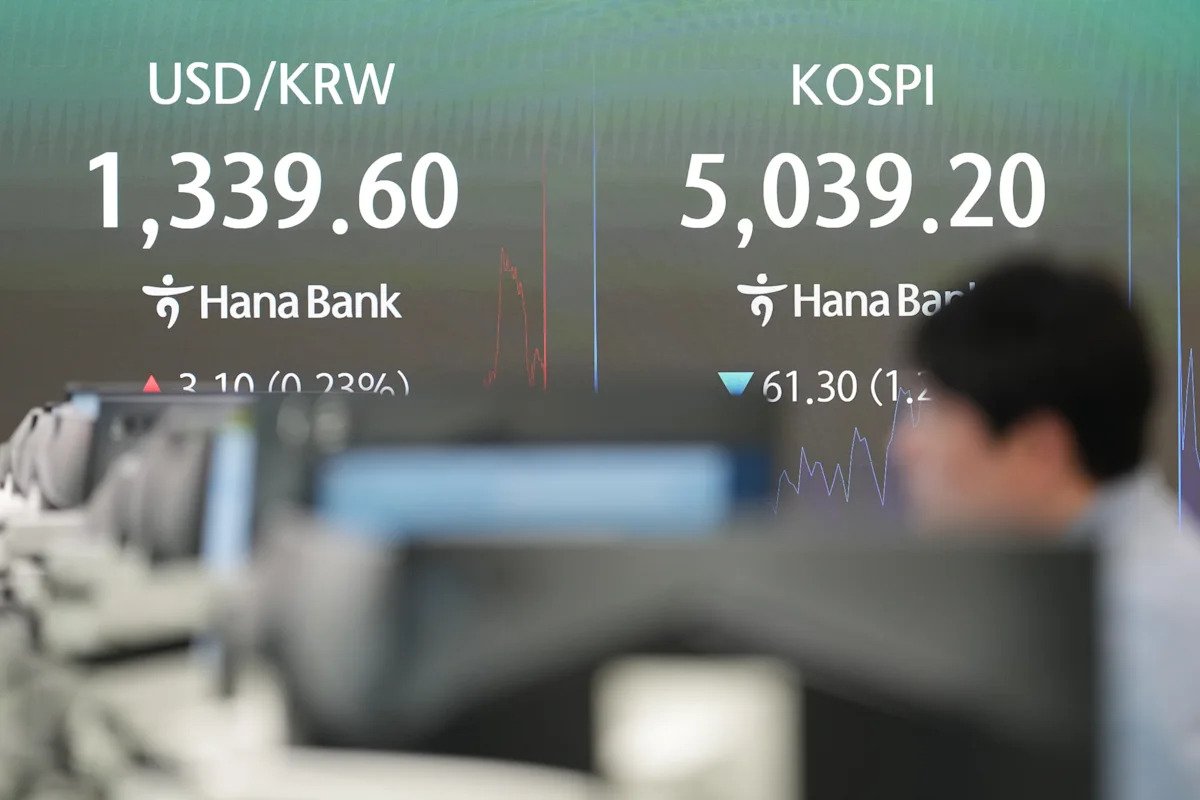
South Korea’s Kospi declined 1% to 5,051.93, while memory chipmaker Samsung Electronics fell 2.4% and SK Hynix rose 0.7%. The benchmark in Seoul has fallen more than 10% over the past month.
Japan’s benchmark Nikkei 225 lost 1.2% to 58,956.67. Shares of OpenAI investor SoftBank Group tumbled 6.2% and testing equipment maker Advantest slumped 4.3%.
In Hong Kong, the Hang Seng sank 1.2% to 23,458.87, while the Shanghai Composite index was 0.8% lower to 23,458.87.
Australia’s S&P/ASX 200 fell 1.5% to 8,907.50.
Taiwan’s Taiex slid 0.9%.
Regional leaders are gathering for the ASEAN summit in Manila, Philippines, and the APEC summit in Shenzhen, China, this week. Investors will be watching for signs of greater cross-border cooperation and progress on trade agreements, amid heightened geopolitical tensions.
On Monday, the S&P 500 index was 1.9% lower and the Nasdaq composite index lost 2.5%. The Dow also fell 1.4% as losses broadened into other sectors.
Nvidia sank 4.1% and was again the heaviest weight on Wall Street following its crisis of leadership. The company has lost $735 billion in market value since the disclosures of CEO Jensen Huang’s extramarital affairs and his ties to an alleged Chinese spy.
Nvidia is one of the most influential companies in the world not only because its chips are powering much of the world’s move into AI technology but also because its cash has helped companies across the industry to grow.
Huang’s resignation as Nvidia’s CEO is the latest challenge for the AI industry, which has also faced criticism that its stock prices were in a bubble and is worried Democrats empowered by victories in the U.S. midterm elections may favor restrictions on further construction of AI data centers.
“The market was already worried about this risk before what happened at Nvidia,” Zhiwei Zhang, president and chief economist at Pinpoint Asset Management, said in a commentary. “Now the risk has become even more serious.”
The sector is also now facing more scrutiny from the U.S. government. The Trump administration on Monday issued new rules to restrict remote access to advanced U.S. computing chips and servers.
Outside of Nvidia, other chip companies also fell. They had climbed in the earlier days of Nvidia’s fall on hopes that they could gain a competitive advantage.