This article first appeared on GuruFocus.
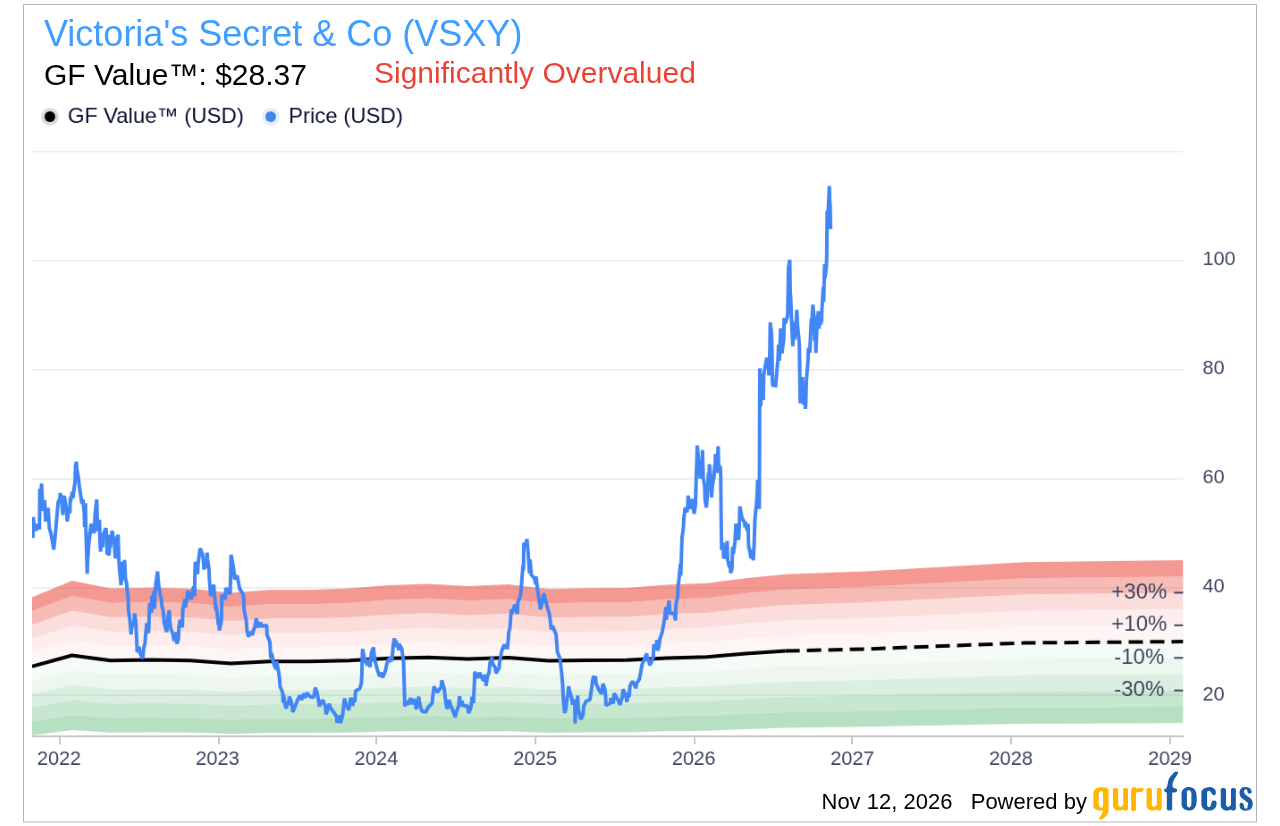
Victoria’s Secret (NYSE:VSXY) faces a tougher Wall Street outlook after Bank of America downgraded the lingerie retailer to Neutral from Buy, arguing that its dramatic turnaround is already reflected in its share price. The decision follows a 214% stock rally over the past year, raising questions about whether improving sales and profitability can justify further gains.

The company operates Victoria’s Secret and PINK, selling lingerie, beauty products and apparel through retail stores and online channels.
BofA raised its price target to $112 from $95 despite the downgrade, suggesting limited additional upside.
The bank noted that shares had gained approximately 25% over the past month while the S&P 500 declined 2%.
Analysts Mary Sport and Lorraine Hutchinson believe the opportunity for earnings upgrades has largely materialized.
BofA considers a valuation of 16 times earnings appropriate, given the company’s potential for double-digit earnings growth.
However, the bank sees little justification for a higher multiple without substantially stronger margins.
To support meaningful additional upside, Victoria’s Secret would need to achieve approximately 12% operating margins in fiscal 2027.
BofA considers that unlikely. Its own forecasts already assume mid-to-high single-digit sales growth and more than 150 basis points of margin expansion to approximately 10%.
The caution comes despite encouraging operating results.
Second-quarter revenue increased 10% to $1.61 billion, while comparable sales climbed 9%.
Adjusted operating income more than doubled to $124 million, prompting management to raise its full-year sales outlook to $7.1 billion$7.18 billion.
Investors Takeaway
Victoria’s Secret’s next earnings report will test whether its turnaround can exceed increasingly demanding expectations.
Investors should monitor comparable sales, full-price selling, gross margins and customer growth across Victoria’s Secret and PINK.
Freight costs and promotional activity could limit further profitability gains.
BofA’s fiscal 2027 earnings estimates already exceed consensus by approximately 20%, leaving little room for disappointment.
Stronger sales and operating margins approaching 12% could challenge the downgrade.
However, margin pressure or slowing consumer demand could trigger valuation compression.
For shareholders, the central question is no longer whether the turnaround is working, but how much improvement the stock has already priced in.