Researchers from London Business School and the University of Cambridge have estimated that there was as much as a 97% probability that AI-related stocks were in a financial bubble in September, before the recent sell-off wiped trillions of dollars off technology stocks.
The findings, highlighted Wednesday by London Business School, come from an analysis of 170 years of financial journalism. The researchers used artificial intelligence to determine whether the language journalists use to describe financial markets can help identify speculative bubbles before they burst.
You can now act on the news you read: Go long or short ANT with perpetual futures, all from your Decrypt Money Account.
September’s readings were comparable to or higher than those recorded at the peak of the dot-com bubble in March 2000, after which the Nasdaq lost roughly 77% of its value.
The research, titled Crying Wolf, was conducted by London Business School finance professor Marco Grotteria and Cambridge researchers Afonso Monteiro and Constantine Yannelis.
The team analyzed 795,964 articles published by The Economist between 1843 and 2013, identifying approximately 486,000 relevant to financial markets. They subsequently extended their index through September 2026.
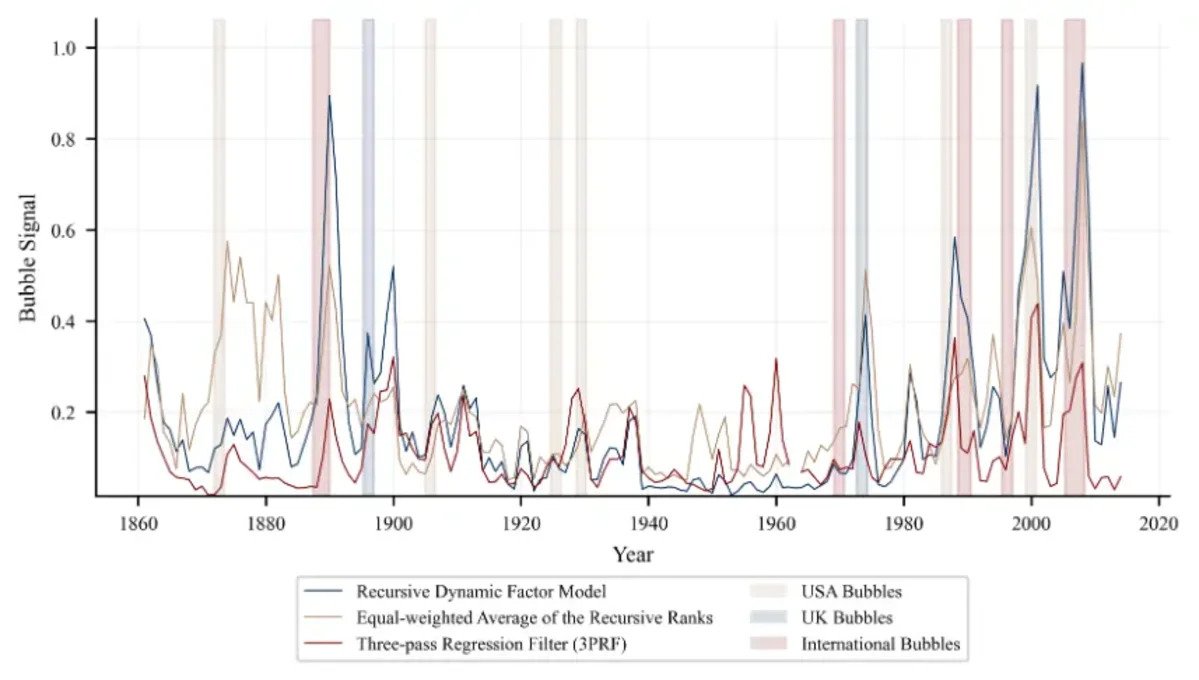
Instead of simply counting how many times journalists mentioned the word “bubble,” the researchers used large language models to identify language associated with excessive speculation, concerns about asset valuations, regulatory warnings, and investor euphoria. They then compared their monthly readings against 22 documented financial bubbles across 10 countries.
When the financial press cries wolf
One of the more interesting findings was just how frequently financial journalists get it wrong. Historically, their coverage implied an average 20% probability of a major market crash within six months, compared with an actual frequency of just 5.7%.
What proved useful was measuring how much more concerned journalists became relative to their usual coverage. In 74% of comparisons between months during financial bubbles and ordinary months, the researchers’ index registered a higher reading during the bubble, rising to 94% for the dot-com episode.
But the widely cited 97% figure represents the most pessimistic of the researchers’ estimates. Two alternative calculations put the probability at approximately 40%.
The index also proved useful in forecasting stock market performance. When tested against data outside its estimation sample, it reduced the average squared error of 12-month Nasdaq return forecasts by 11% compared with predictions based on historical average returns.