Anyone familiar with Berkshire Hathaway (NYSE: BRKA) (NYSE: BRKB) probably knows it owns a bunch of individual stocks largely hand-picked by former CEO Warren Buffett, or more recently, with some input from current CEO Greg Abel.
Have you ever thought about how these holdings are taxed though? It’s not like a mutual fund or exchange-traded fund, which require a yearly reckoning. As a C corporation, Berkshire’s stock holdings are taxed much like an individual investor’s are. That is, the capital gains tax bill is incurred for the tax year in which the asset is sold.
Missed AI’s “Act 1”? Act 2 Could Be 16x Bigger. Most investors think they missed the AI boat because they didn’t buy Nvidia in 2005. But according to our analysts, we’re only at the end of “Act 1″—the R&D phase. “Act 2” is the global rollout. Continue »
Regardless, there’s a pretty big future tax liability sitting on Berkshire’s books right now. Just don’t worry about it if you’re a shareholder. It’s unlikely you’ll even notice when the time comes to sell any of these positions.
The surprising numbers
As of the middle of this year, Berkshire Hathaway was sitting on $323.8 billion worth of individual stocks, including Coca-Cola, Apple, and American Express. It only paid a total of $106.5 billion for these picks over the course of the past many years, however, translating into unrealized net gains of $217.3 billion that will eventually become realized, taxable gains. For perspective on that figure, Berkshire’s total market cap at the time was $1.1 trillion. All of these numbers have changed somewhat since then, although not by much.

Current shareholders don’t need to worry too much about capital gains taxes chipping away at the conglomerate’s net profits, however. Like his predecessor, Abel moves big positions around pretty slowly, using time to the company’s full advantage.
And this raises the question: If its stock portfolio is currently worth $361.3 billion, while the organization’s market cap stands at nearly $1.2 trillion, what accounts for the remaining $828.7 billion in Berkshire Hathaway’s market valuation?
Another $365.5 billion of it is cash or near-cash equivalents, such as short-term government bonds. That means the other $463.2 billion reflects the perceived value of all the privately owned businesses that are part of the Berkshire Hathaway family, including Clayton Homes, insurer GEICO, Duracell batteries, and Dairy Queen, just to name a few.
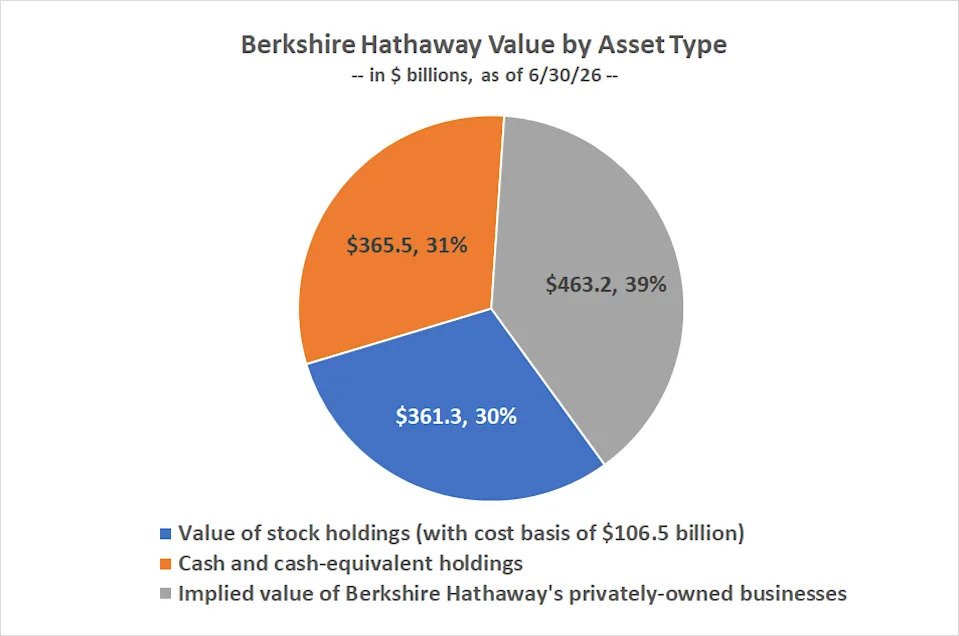
Yes, you’re seeing that right — Berkshire’s stocks are the smallest piece of its total value, and the businesses you rarely hear about are the largest.