
Stock market all-time highs are not always dangerous. But they are not all created equal.
We recently took a look at S&P 500 record highs and found that historically, they performed a lot like non-record days. The Nasdaq Composite (^IXIC) and Russell 2000 (^RUT) tell a more complicated story.
Outside of the broad large-cap benchmark, record highs have historically been less reliable entry points.
Since 1971, the Nasdaq’s median one-year gain after an all-time high was about 14%, slightly below its gain after non-record days. The gap widened over time. Five years after Nasdaq record highs, the median gain is about 60%, compared with 81% after non-record days.
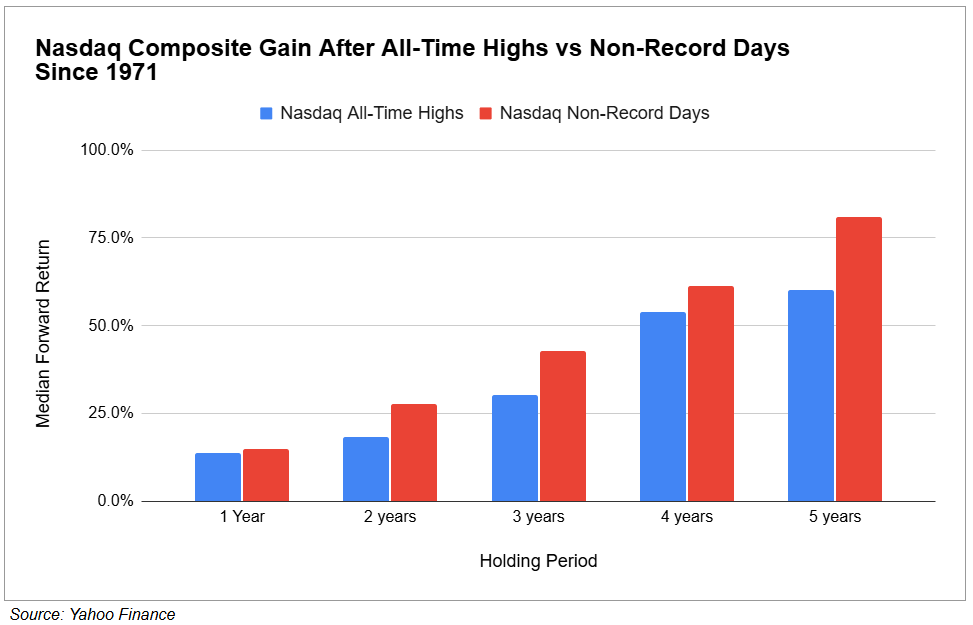
Far from a disaster, Nasdaq highs have still produced strong long-term returns. But they don’t behave like S&P 500 (^GSPC) highs, where record closes tend to do as well as ordinary entry points.
The ride is also rougher in the Nasdaq.
In the year after Nasdaq record highs, the index’s typical worst drop from the entry point is about 10%, compared with about 8% after non-record days. And the chances of a 10% drop were higher too: roughly half after record highs versus about 42% after non-record days.

The Russell 2000 shows the same problem from a small-cap angle.
Since 1979, the small-cap index’s median one-year gain after record highs was 6%, compared with 11% after non-record days. After five years, the gap was wider: 34% after highs versus 51% after non-record days.
The win-rate data tells the same story.
The Russell was higher one year after record highs 64% of the time, compared with 71% after non-record days. Two years out, the gap widened to 67% versus 81%.
Exactly why these differences even exist among indexes likely comes down to market structure.
The S&P 500 is anchored by the biggest and most profitable US companies. It tends to be more stable and less volatile than the Nasdaq, which is more growth-heavy. Meanwhile, the Russell 2000 is smaller, more cyclical, and has traded with more volatility.
That is where dollar-cost averaging — investing set amounts over time instead of all at once — can help.
If record highs are less reliable in a market, spreading out the entry can be more useful than trying to nail the perfect high — or dip.
Jared Blikre is the global markets and data editor for Yahoo Finance. Follow him on X at @SPYJared or email him at jaredblikre@yahooinc.com.
Click here for in-depth analysis of the latest stock market news and events moving stock prices
Read the latest financial and business news from Yahoo Finance