Crude oil prices spiked and equity futures sagged after Iran opened fire on ships transiting the Strait of Hormuz and an Asia-based AI stock sold off before the opening bell on Tuesday.
The main equity indexes moved up from their respective intraday lows during a typically light-volume summer session. But investors, traders and speculators remain wary on the cusp of yet another critical earnings season.
The front-month West Texas Intermediate crude oil futures contract was up 4.8% to $71.82 per barrel amid an uptick in attacks on tankers moving oil and gas from the Middle East to global markets.
Sign up for Kiplinger’s Free Newsletters
Profit and prosper with the best of expert advice on investing, taxes, retirement, personal finance and more – straight to your e-mail.
Profit and prosper with the best of expert advice – straight to your e-mail.
Price action for the iShares Semiconductor ETF (SOXX, -5.1%) once again reflected unease about how far and how fast the AI revolution has progressed and, beyond promise, the long-term prospects for real profits.
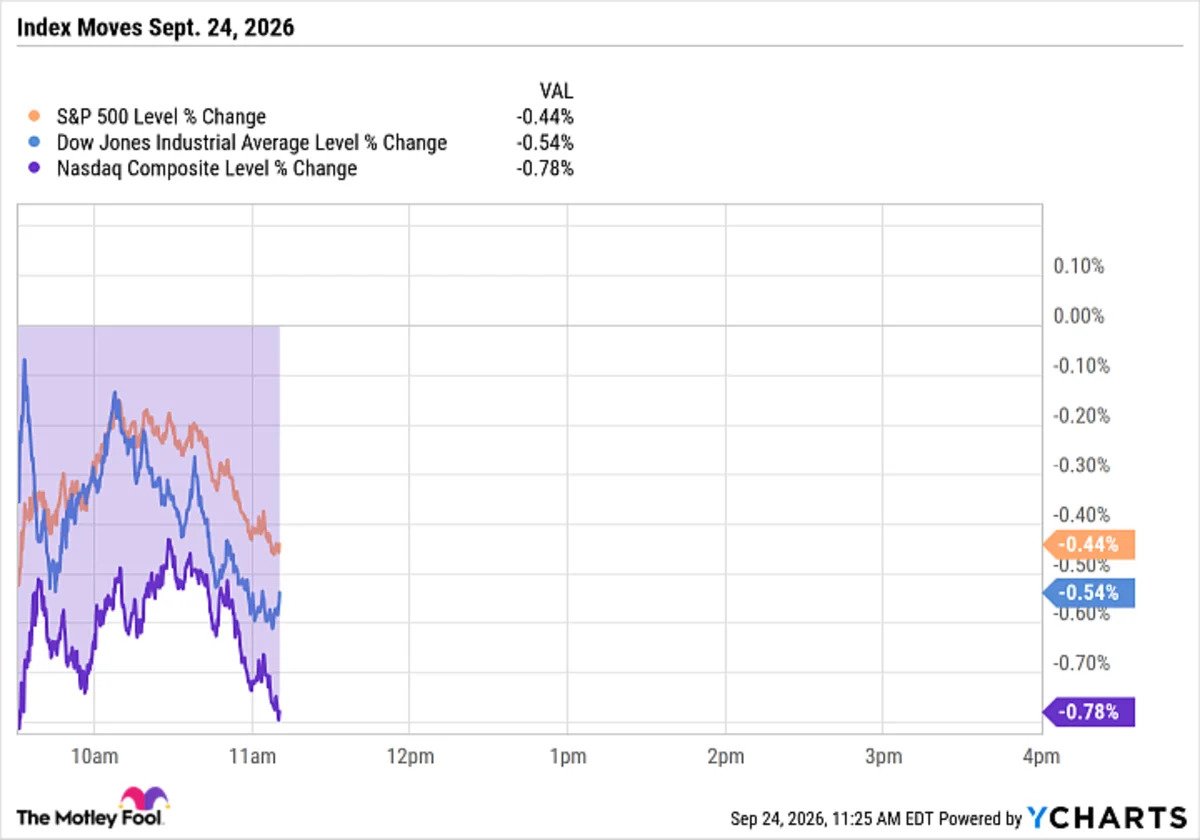
By the closing bell, the tech-heavy Nasdaq Composite was down 1.2% at 25,818, the broad-based S&P 500 had shed 0.5% to 7,503, and the blue-chip Dow Jones Industrial Average was off 0.3% at 52,924.
Why Samsung sank
Samsung Electronics was down 6.9% in South Korea after management of the semiconductor stock said in its preliminary report that revenue more than doubled and operating profit grew by 56% during the three months ended June 30.
Those are numbers that would make Nvidia (NVDA, +0.7%) proud. Indeed, Samsung stock has posted a year-to-date return of almost 150%, NVDA about 5%. And that’s the rub right now.
“As is often the case,” Trade Nation analyst David Morrison observes, “it can be better to travel than to arrive. And it seems that investors are concerned that semiconductor and other AI-adjacent stocks may struggle to maintain such high levels of sales and margins going forward.”
SK Hynix, another South Korea-based chipmaker, was down 6.1%. SK Hynix, which is up more than 270% so far in 2026, is on track to begin trading as an American Depositary Receipt under the symbol SKHY on the Nasdaq as soon as the opening bell on Friday.
The Korea Composite Stock Price Index fell 4.9% on Tuesday. Samsung and SK Hynix account for almost 55% of the KOSPI, which has generated a year-to-date return of 81.7%.
CAT got the Dow
Caterpillar (CAT, -3.1%) was the worst-performing Dow Jones stock on Tuesday, a big deal because at north of $900 it’s the second-biggest component in the price-weighted index.
Caterpillar announced the acquisition of Skywatch, which gathers and processes data for the mining industry. But, according to Barron’s, the problem here is a downgrade for Germany-based Siemens Energy (SMERY, -5.1%).
Barclays analyst Vladimir Sergievskii cut his rating on the electrical equipment maker from Equal Weight (Hold) to Underweight (Sell), citing valuation concerns and the trajectory of the capex boom to support AI infrastructure.
At the same time, Sergievskii raised his 12-month target price from €110 to €130. Still, electric power specialist GE Vernova (GEV, -6.5%) sold off hard, too.
Great expectations
PepsiCo (PEP, +1.2%) and Delta Air Lines (DAL, -3.3%) are big, well-known companies that will share important information about how people are spending their money when they take their respective before-the-opening-bell turns on the earnings calendar Thursday and Friday. Markets will take particular note of what they say about the impact of inflation as participants evaluate the near-term future for the beverage and passenger airline industries.
Indeed, as FactSet Senior Earnings Analyst John Butters notes, Wall Street trimmed its earnings-per-share estimate for consumer staples stocks by 2.5% and for industrials by 2.1% amid an energy shock during the second quarter.
So their bar isn’t as high as it is for high-flying tech stocks such as Samsung. But it is elevated right now, for the whole market: Analysts raised their aggregate EPS estimate for the S&P 500 by 3.4% from April 1 through June 30.
“In a typical quarter,” Butters explains, “analysts usually reduce earnings estimates.” The average EPS revision over the last five years is a decline of 2.7%. So consumer staples and industrial stocks are sort of outperforming here.
Looking for more timely stock market news to help gauge the health of your portfolio? Sign up for Closing Bell, our free newsletter that’s delivered straight to your inbox at the close of each trading day.
“In fact,” Butters adds, “this quarter marked the largest increase in the bottom-up EPS estimate during a quarter since Q2 2021 (+7.7%).”
Energy stocks saw the biggest EPS increase, 61.5%, followed by information technology at 8.7%. But Wall Street cut its EPS estimate for healthcare stocks by 15.8%.