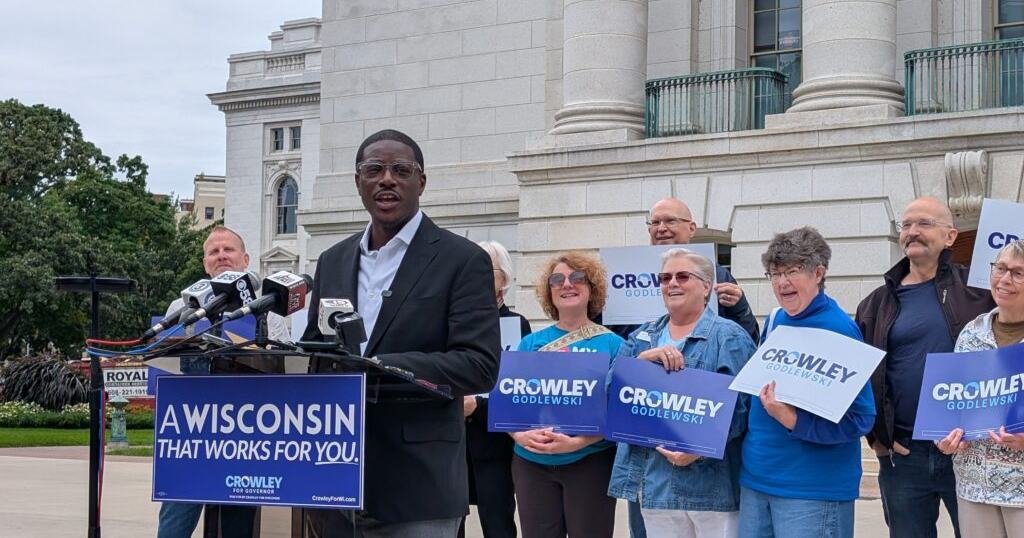
Democratic gubernatorial candidate David Crowley vowed Monday to pass a slate of measures to cut down on corruption in government with proposals he said would prevent elected and public officials from profiting from their positions.
Crowley, who is running against Republican U.S. Rep. Tom Tiffany, said he would include the policy items in the upcoming state budget if elected governor. Election Day is Nov. 3.
“State elected officials… are there to serve the public to do a public service, not to just sit in public office. They are there to use their offices to help people. That could be anything from helping get a pothole filled to securing legislation for a new healthcare facility,” Crowley said during a press conference outside the state Capitol. “It should not be a vehicle to get rich by gaming the system. We see that running rampant in Washington right now, while Wisconsinites are facing higher costs on everything from gas to groceries to their health care.”
Crowley said the proposals would demand transparency and accountability from elected officials in the face of Congress not taking similar steps.
Two of the proposals would seek to bar politicians from being able to make money from knowledge they acquire through their public work. Crowley wants to ban politicians from trading individual stocks and require public officials who already own stocks to place then in a mutual or index fund or blind trust so they don’t have specific knowledge of the individual stocks they own. Another proposal would prohibit elected officials from participating in prediction markets and prohibit public employees from using insider government knowledge to personally profit.
“Prediction markets should be used for things like sports — not profiting off of our politics,” Crowley said. “Our political system is already overrun with dark money from billionaires. We don’t need to give them or others any reason to make more money off of their money by trying to further influence our elections.”
Crowley also said he would seek to prohibit members of the Public Service Commission from working for utility or energy companies for two years after leaving office. PSC commissioners are responsible for regulating public utilities including electricity, natural gas, water and telecommunications.
Wisconsin law currently only bars former commissioners from testifying before the PSC for a year after leaving office.
Crowley said he wasn’t worried the restriction would discourage prospective commissioners. The governor is responsible for choosing appointees to the Public Service Commission and appointees are subject to confirmation by the state Senate.
Crowley did not point to any specific examples, but said the proposal is meant to prevent conflicts of interest.
The final policy would prohibit the deletion of documents and correspondence by state legislators.
Lawmakers in Wisconsin have had an exemption since 1961 from a law that requires a broad array of public officials to keep their records of communication and other official documents related to their work. The exemption allows legislators to delete emails and destroy records as long as they have not yet been requested under the public records law.
Crowley said changing this will ensure that “journalists, the courts and most importantly you, the public, can see how their elected officials are or are not serving them.”
Outgoing Gov. Tony Evers and Democratic lawmakers have previously sought to close the loophole, though the proposals have gone nowhere in the Republican-controlled Legislature.
“We have seen lawmakers try to hide how they spend taxpayer dollars on things that absolutely in no shape or form serve the public,” Crowley said.
Crowley said the proposals would help restore trust in the government.
“We need these laws on the books because the system as it is today does not work for working Wisconsin families,” Crowley said. “They see politicians across the state and in Washington doing better than them. They’re doing fine, and in many cases, they’re thriving, and how can that be when diesel right here in the state of Wisconsin is nearly $6 a gallon?… It’s because of legalized corruption.”
Tiffany said in a statement that he has not traded any stocks while serving in Congress. He said he agreed there should be strong policies implemented to “to root out fraud and corruption at every level of government” but said he would go further than Crowley.
“We should modernize OpenBook Wisconsin so taxpayers can easily search how their money is being spent, set clear response-time standards for open records requests, create agency dashboards that disclose contractors and violations, and strengthen ethics rules to prevent legislators from subcontracting for lobbying entities. As governor, I’ll also audit all of state government to uncover waste, fraud and corruption and make sure taxpayers are getting the results they deserve,” Tiffany said.
Originally published by Wisconsin Examiner, a nonprofit news organization.