Columns
An editorial warns that tying market gains to President Lee Jae Myung’s political fortunes risks deepening investor distrust and hurting retail traders when volatility strikes.

Lee Hyun-sang
The author is a columnist at the JoongAng Ilbo.
The following joke made the rounds at a recent dinner gathering: “The presidential office miscalculated by pushing stock prices up before the relatively less important June 3 local elections. It should have saved ‘Kospi 10,000’ for just before the 2028 general election, when soaring markets could have helped secure overwhelming public support and enough seats to amend the Constitution for President Lee Jae Myung’s re-election. Instead, an overzealous policy chief pushed too hard, even introducing single-stock leveraged ETFs [exchange-traded funds] to boost the market.”
At first, it sounded like little more than a conspiracy theory born of the frustration of retail investors angered by the market’s sharp decline. But after National Assembly Speaker Cho Jeong-sik recently raised the possibility of constitutional amendments related to presidential re-election, the joke came back to mind. Every satire contains a kernel of truth. Such remarks reflect growing public cynicism toward a governing camp that appears increasingly consumed by Lee’s legal troubles.
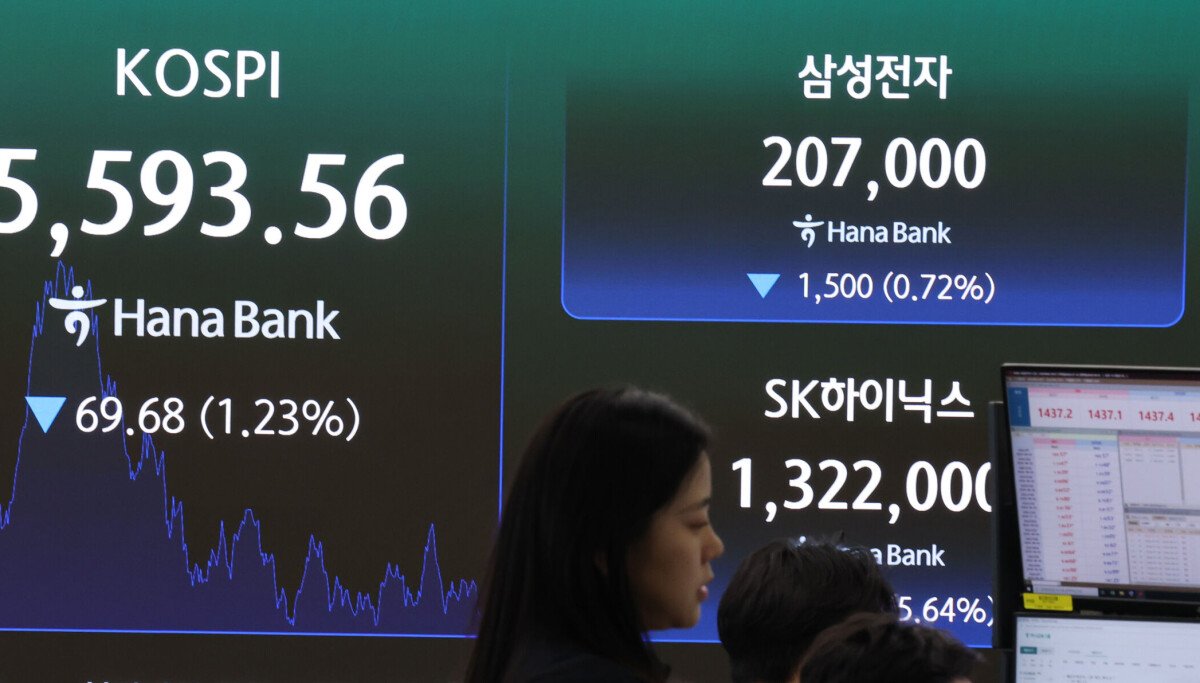
It would be an oversimplification to blame July’s market collapse entirely on the introduction of single-stock leveraged ETFs. Global semiconductor shares were also under pressure. Investors debated whether the industry’s boom had peaked, and rapid market swings were amplified by hedge fund strategies associated with firms such as Citadel, as well as by increasingly sophisticated forms of algorithmic trading and market positioning. Even so, retail investors directed much of their anger toward the government because the ruling camp had repeatedly claimed rising stock prices as proof of its economic success.
Lee, who once described himself as a seasoned retail investor, campaigned for the presidency by promising a “Kospi 5,000 era.” He pledged to revise the Commercial Act, crack down on unfair trading practices and eliminate the so-called Korea discount. After taking office, his administration maintained that revitalizing the stock market would redirect capital away from speculative real estate and toward productive investment in financial markets. Many investors interpreted the message as an invitation to sell property and buy stocks. Whenever the benchmark index climbed to new levels, Democratic Party lawmakers contrasted the gains with market performance under the previous Yoon Suk Yeol administration and cited investor confidence in Lee’s leadership.
July’s sharp reversal demonstrated, however, that financial markets do not move according to policymakers’ wishes. Stock prices are shaped by countless external variables and constantly shifting human psychology. To borrow former U.S. Defense Secretary Donald Rumsfeld’s famous phrase, markets are filled with “unknown unknowns.” High-risk products such as single-stock leveraged ETFs only added to the volatility, exposing inexperienced retail investors to even greater losses. Using something as inherently uncertain as stock prices as a measure of political achievement is therefore a dangerous strategy.
The controversy surrounding the president’s legal risks has deepened market skepticism. Investors have increasingly viewed government initiatives through a political lens. That skepticism is difficult to dismiss outright given recent developments, including ruling party lawmakers’ calls for dropping indictments against elected officials, efforts to establish a special counsel related to prosecutorial decisions and last-minute revisions to the Criminal Procedure Act that broadened the grounds on which courts could dismiss prosecutions. Taken together, these moves have reinforced perceptions about where the administration’s priorities lie.
Economist John Kenneth Galbraith once observed that there are two kinds of forecasters: those who know that they do not know, and those who do not know that they do not know. Legendary investor Howard Marks identified himself with the first group, warning against anyone who claims to know the future with certainty. The idea that a government can promise specific stock index levels reflects precisely the kind of overconfidence that Marks cautioned against.
July’s market turmoil illustrated how misguided it is to believe that government policy alone can engineer a sustained bull market or transform rising stock prices into political capital. The proper role of politics is not to promise an index target but to establish sound institutions and fair rules. Markets neither rise because governments cheer them on nor move according to political mobilization. The moment politicians turn stock prices into campaign billboards, visible and invisible bubbles begin to form in the capital market. When those bubbles inevitably burst, the bill is ultimately paid by ordinary retail investors.
This article was originally written in Korean and translated by a bilingual reporter with the help of generative AI tools. It was then edited by a native English-speaking editor. All AI-assisted translations are reviewed and refined by our newsroom.