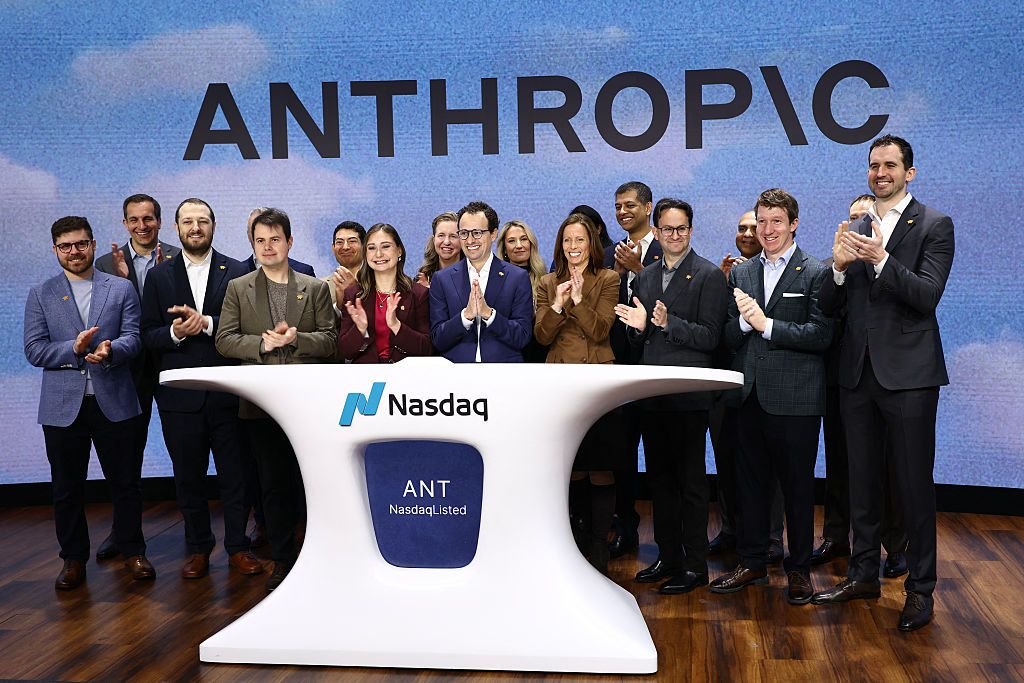
The Anthropic (ANT) IPO became the biggest initial public offering in stock market history, supporting a big gap-up open for stocks this morning. But the main equity indexes finished lower on Thursday, despite the record-breaking debut for the large language model (LLM) developer, amid rising AI skepticism.
ANT priced at $83 per share, well above its $70-to-$78 range, to raise $81.3 billion from the sale of approximately 980 million shares. Its market cap is $1.3 trillion, and ANT’s trading at about 40 times trailing 12-month sales.
The stock opened up 35% from the IPO price at $111.50, before closing with a gain of 17.1%. You can catch up on all the Day One action, including news and commentary, on our Anthropic IPO blog.
Sign up for Kiplinger’s Free Newsletters
Profit and prosper with the best of expert advice on investing, taxes, retirement, personal finance and more – straight to your e-mail.
Profit and prosper with the best of expert advice – straight to your e-mail.
According to Renaissance Capital, the investment case for ANT “rests on the company’s rapidly expanding enterprise business and its ability to translate AI adoption into increasingly attractive operating economics.”
At the same time, investors are “taking exposure to substantial infrastructure obligations, intense competition, and an unusual governance structure that limits shareholder influence.”
Looking for more timely stock market news to help gauge the health of your portfolio? Sign up for Closing Bell, our free newsletter that’s delivered straight to your inbox at the close of each trading day.
Now, as RenCap concludes, it’s all about growth, profitability and supporting the valuation established today.
The old IPO champ, SpaceX (SPCX, -3.5%), did not share a target range before it listed in June at $135 per share to raise $75 billion from the sale of approximately 556 million shares.
At its debut, SPCX traded at about 92 times trailing sales. Today, at a closing price of $138.43, its market cap is $1.9 trillion.
Read more: Should You Buy ANT Stock?
“So here’s the bottom line,” according to tech analyst Luke Lango. “The Anthropic IPO proves that the AI capital spigot is still open, but not gushing like it used to. That’s good enough for a short-term rally in AI stocks. It doesn’t, by itself, end the recent AI sell-off.”
Walmart fails to impress
By the closing bell, the blue-chip Dow Jones Industrial Average had fallen 2.2% to 49,097, the broad-based S&P 500 was down 2.0% at 7,175, and the tech-heavy Nasdaq Composite had shed 2.3% to 23,879.
Chevron (CVX, +0.4%), getting a boost from higher crude oil prices, was the only Dow Jones stock to close in the green. The front-month West Texas Intermediate futures contract was up 0.9% to $83.06 per barrel.
UnitedHealth (UNH, -5.6%) sank again on concerns about an audit of Medicare Advantage payments and was the biggest drag on the 30-stock index.
Neither Google parent Alphabet (GOOGL, -3.5%), which owns 1.8 billion shares of ANT, nor Amazon (AMZN, -3.9%), which owns 1.9 billion shares and some debt, got a lift from today’s big event.
And Walmart (WMT, -1.0%) was down, too, even though the mega-retailer beat Wall Street expectations with its fiscal 2027 third-quarter results and raised its full-year guidance.
Nvidia (NVDA, -3.3%), meanwhile, traded as high as $158.13 and as low as $145.71 vs yesterday’s close of $150.96, during one of the year’s most volatile trading sessions.
Indeed, the S&P 500, which was up 1.3% at one point on Thursday, posted its biggest intraday reversal since November 20, 2025, according to Dow Jones Market Data.
Does AMD have a China problem?
Advanced Micro Devices (AMD) was down as much as 11.2% after a short seller alleged that Chinese server maker IEIT Systems has used AMD startup firmware in its products as recently as an October 19 update, despite the fact that IEIT is on the U.S. export blacklist.
In addition to releasing the report from its affiliate Hunterbrook Media, Hunterbrook Capital disclosed that it has taken a short position in AMD, betting that the semiconductor stock will go down from here.
The risk for AMD, according to Hunterbrook, only begins with the U.S. government imposing additional restrictions and controls that could hurt its sales in Asia.
“If Nvidia is the Central Bank of AI, then AMD is more like the Silicon Valley Bank of AI,” Sam Koppelman writes. “On the surface, its financials look solid. But a proverbial AI capex bank run could test just how solid they are.”
The problem here is that “if the very customers whose growth AMD is helping finance pull back on their spending, even briefly, AMD could face weaker chip sales at the same time it remains on the hook for tens of billions worth of commitments.”