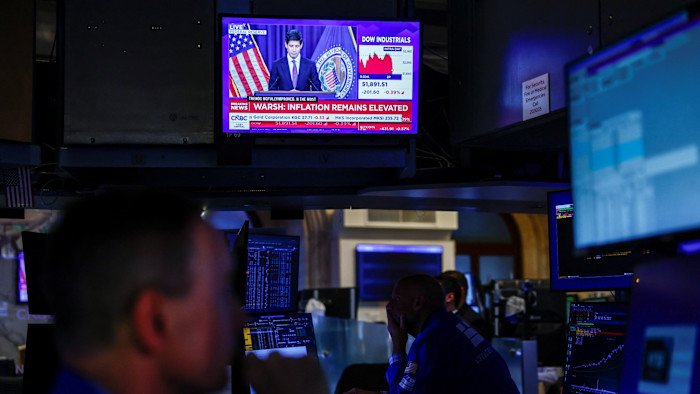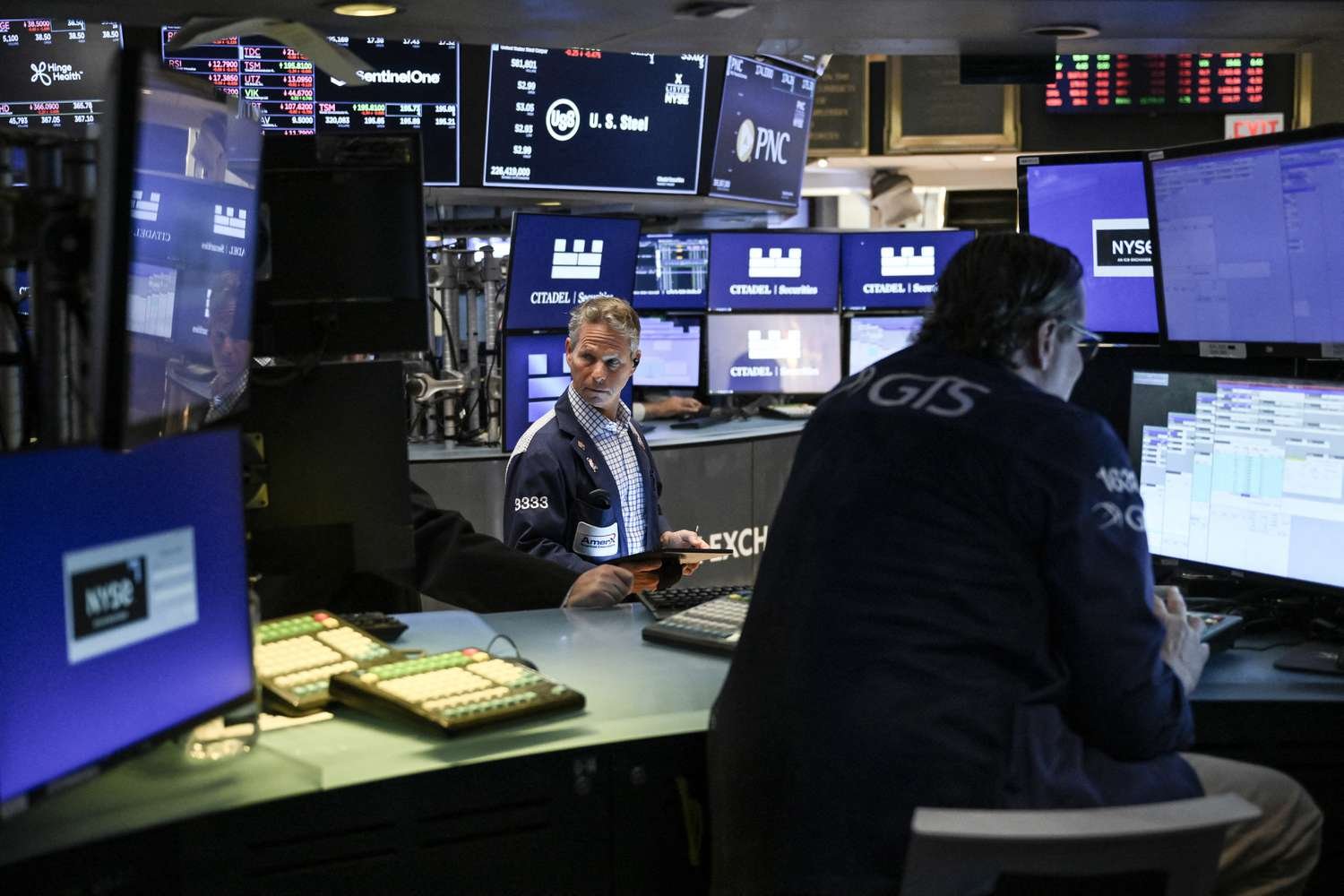
Stocks moved slightly lower in early trading Thursday as investors awaited more signs of progress on trade negotiations and responded to fresh economic data.
The Dow Jones Industrial Average was down 0.4% recently, as shares of Dow component Boeing (BA) tumbled following news of a deadly passenger plane crash in India. The S&P 500 and tech-heavy Nasdaq Composite each slipped 0.3% this morning, after the indexes had three-day winning streaks snapped yesterday.
Stocks have rallied in recent months—the S&P 500 enters the day just 2% away from a record high—amid investor hopes that the Trump administration will negotiate trade deals that result in lower tariffs, as well as optimism about generally strong corporate earnings and economic data. This week, U.S. and Chinese officials reached the framework for a trade agreement that still requires final approval from President Donald Trump and China’s Xi Jinping, while a closely watched report on inflation showed that consumer prices rose less than expected in May.
This morning, data on inflation at the wholesale level came in slightly better than expected, while weekly jobless claims numbers matched economists’ estimates. Meanwhile, market participants are awaiting more news on the China trade agreement, as well as dozens of other deals the White House has said it is negotiating.
Boeing shares dropped about 4% this morning to lead S&P 500 decliners after an Air India 787-8 carrying more than 200 passengers crashed shortly after takeoff in India. Shares of GE Aerospace (GE), which supplied the plane’s engine, were down more than 2%, while shares of Boeing supplier Spirit AeroSystems (SPR) declined 3%.
Shares of the world’s largest technology companies were mixed. Chipmakers Nvidia (NVDA) and Broadcom (AVGO) inched higher, as did Microsoft (MSFT), while Apple (AAPL) Amazon (AMZN), Alphabet (GOOG), Meta Platforms (META) and Tesla (TSLA) fell slightly. Tesla came into the day on a four-session winning streak, as the stock has recovered most of the ground lost after the sell-off last week sparked by a very public falling out between CEO Elon Musk and President Trump.
Among other notable movers, shares of Oracle (ORCL) soared nearly 12% in early trading to pace S&P 500 gainers, after the tech giant reported better-than-expected quarterly results and projected strong revenue growth.
The U.S. dollar index, which measures the performance of the dollar against a basket of foreign currencies, was down 0.8% at 97.80 in recent trading, after falling as low as 97.60, its lowest level since 2022, amid the trade uncertainty.
The yield on the 10-year Treasury note, which affects borrowing costs on all sorts of consumer and business loans, was at 4.37%, down from 4.41% at Wednesday’s close and 4.51% yesterday morning.
Bitcoin was at $107,100, down from around $108,500 yesterday afternoon. The digital currency moved as high as $110,500 on Wednesday, approaching its record high of just below $112,000, set on May 22.
West Texas Intermediate futures, the U.S. crude oil benchmark, fell 1.7% to $67 per barrel, after surging more than 5% yesterday amid geopolitical concerns. Gold futures were up 2.1% at $3,415 an ounce, trading at their highest level in a month, as some investors turned to the traditional safe haven amid the downturn in equities.
Watch These Quantum Computing Stock Price Levels
25 minutes ago
Quantum Computing (QUBT) shares lost ground in early trading Thursday after surging to their highest level since December on yesterday following Nvidia CEO Jensen Huang’s bullish remarks about the emerging technology.
Shares of quantum computing companies shot higher after Huang said the industry is “reaching an inflection point,” adding that he expects quantum computing to be able to solve some interesting problems in the coming years. The Nvidia (NVDA) chief’s comments struck a more optimistic tone that earlier this year when he said the technology was 15 to 30 years away.
Quantum Computing shares, which traded below $1 dollar a year ago, gained 25% on Wednesday, putting the stock back into positive territory for 2025. The company last month said it had finished construction of its Quantum Photonic Chip Foundry in Tempe, Ariz., and that it had deepened its engagement with both government and commercial partners amid growing interest in its photonic and quantum optics technology.
After retracing to the 200-day moving average (MA), Quantum Computing shares trended higher before forming a rectangle, a chart formation signaling a continuation of the stock’s longer-term strong uptrend.
That move higher started earlier this week, with the stock breaking out from the formation on the highest daily trading volume since mid-December. Moreover, the relative strength index confirms bullish price momentum, though the indicator also flashes overbought conditions, potentially leading to short-term pullbacks.
Investors should watch major overhead areas on Quantum Computing’s chart around $27 and $37.50, while also monitoring key support levels near $15 and $9.
The stock was was down 1.5% at $18.50 in early trading Thursday.
Read the full technical analysis piece here.
Boeing, GE Drop After 787-8 Crashes in India
52 minutes ago
Boeing (BA) shares slumping in premarket trading after a 787-8 aircraft was involved in an Air India plane crash early Thursday.
The Air India Flight 171, which was carrying 242 passengers, was departing the western Indian city of Ahmedabad for London Gatwick airport and crashed “after take off,” Air India said in a post on the X social media platform. It departed the Indian city at 1:38 p.m. local time, the airline said.
“We are in contact with Air India regarding Flight 171 and stand ready to support them. Our thoughts are with the passengers, crew, first responders and all affected,” a Boeing spokesperson said in a statement to Investopedia.
GE Aerospace, which provides engines for many Boeing aircraft, including the 787, also said it is ready to support the crash probe. “We have activated our emergency response team, and we are prepared to support our customer and the investigation,” the company said in a post on X.
The 787 model, popularly known as the Dreamliner, has never had a fatal accident in its nearly 14 years in service, according to The Wall Street Journal.
Boeing’s reputation took a hit last year following a series of mishaps at its planes, including a door plug detaching in midair on an Alaska Airlines 737 Max 9 flight in January. Earlier this month, the plane maker agreed to settle a Justice Department case related to two fatal 737 Max crashes that claimed the lives of more than 300 people.
Boeing shares were down 6% in recent premarket trading but are up 20% so far this year through Wednesday. Shares in other makers of Dreamliner parts also lost ground: Engine maker GE Aerospace (GE) shares were down more than 2%, as were those of Spirit AeroSystems Holdings (SPR), which Boeing is in the process of reacquiring.
Major Stock Index Futures Down Slightly
1 hr 13 min ago
Futures tied to the Dow Jones Industrial Average were down 0.4%.
TradingView
S&P 500 futures were off 0.3%.
TradingView
Nasdaq 100 futures slipped 0.2%.
TradingView