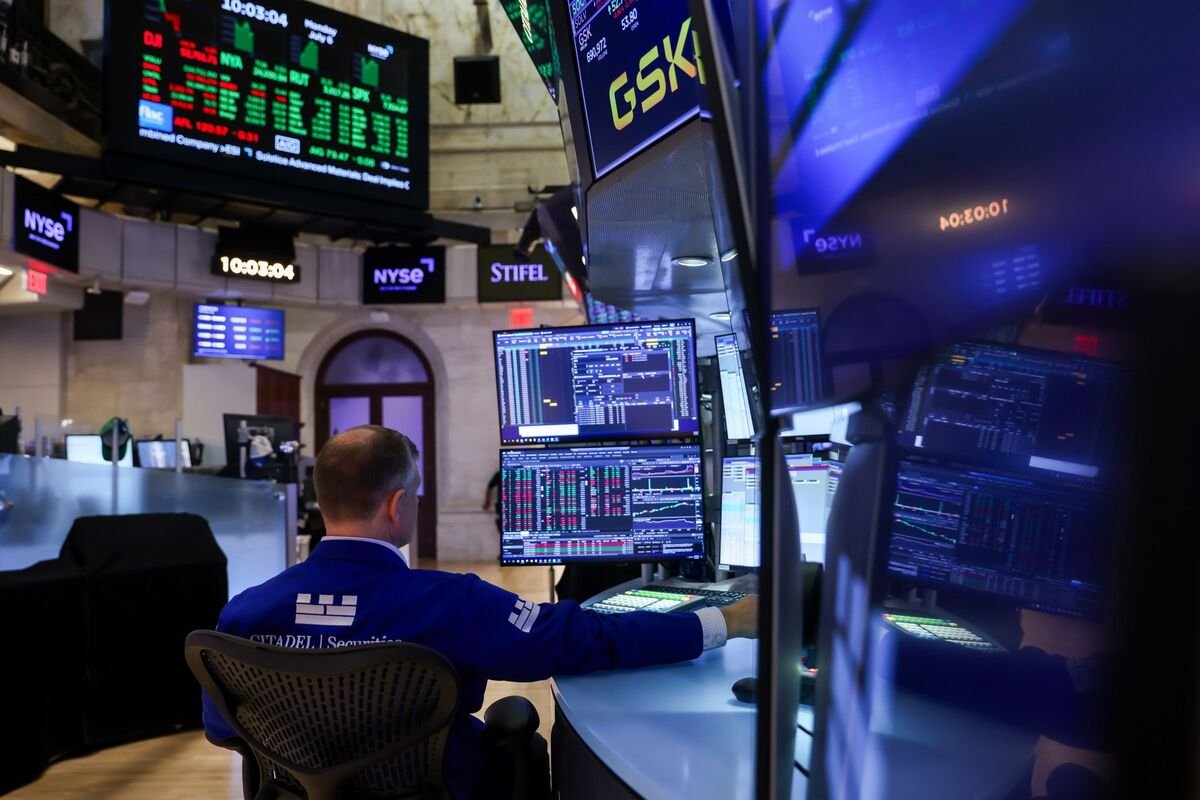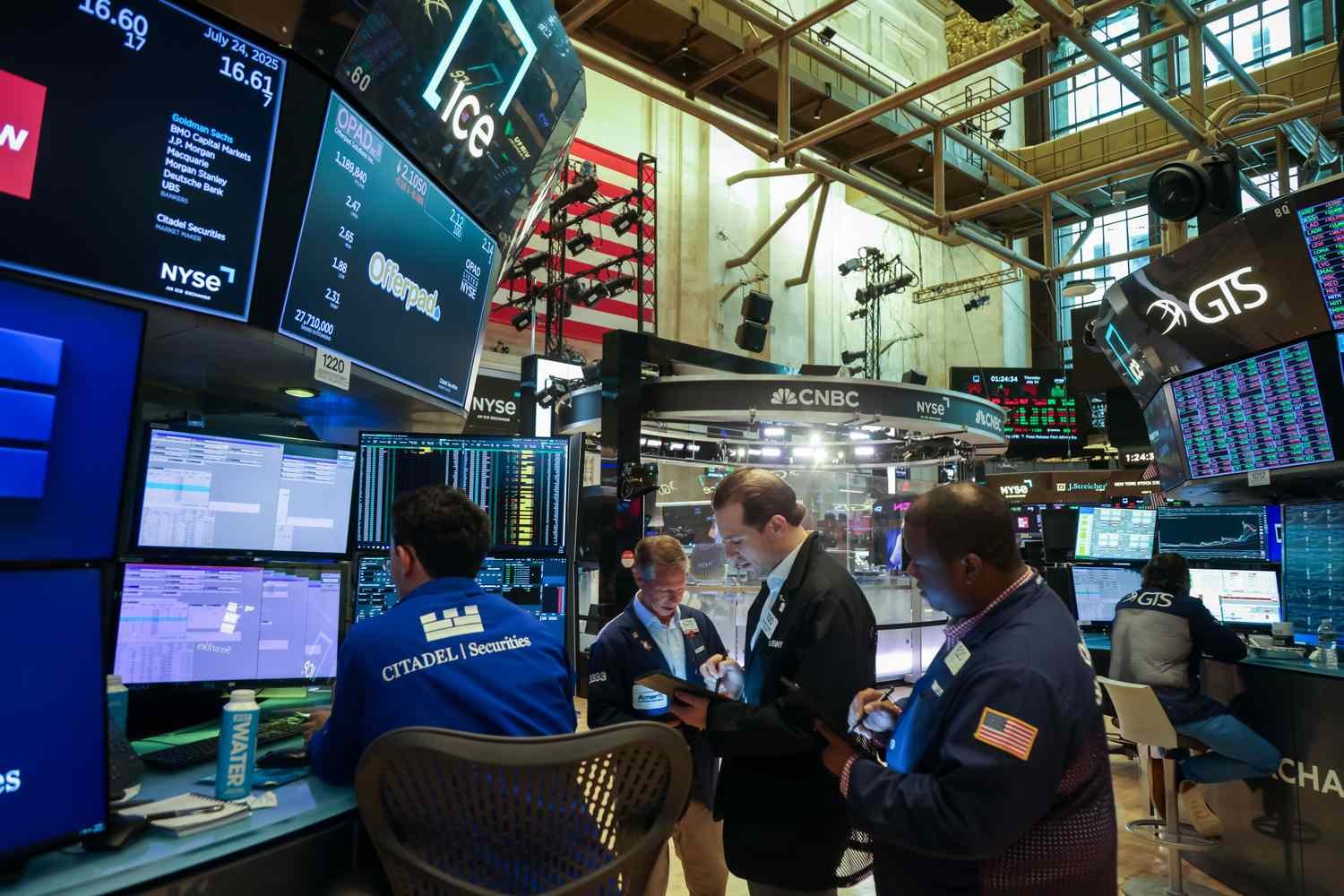
Stocks were lower in late trading Thursday as major indexes retreated from their early-session highs amid a flurry of news on tariffs.
The S&P 500 (SPX) and Dow Jones Industrial Average (DJI) were recently down 0.4% and 0.7%, respectively, while the tech-heavy Nasdaq Composite (IXIC) slipped 0.1%. Stocks were coming off a winning session on Wednesday, leaving the benchmark S&P 500 index less than 1% away from a record closing high and the tech-heavy Nasdaq Composite just a few points away from a record.
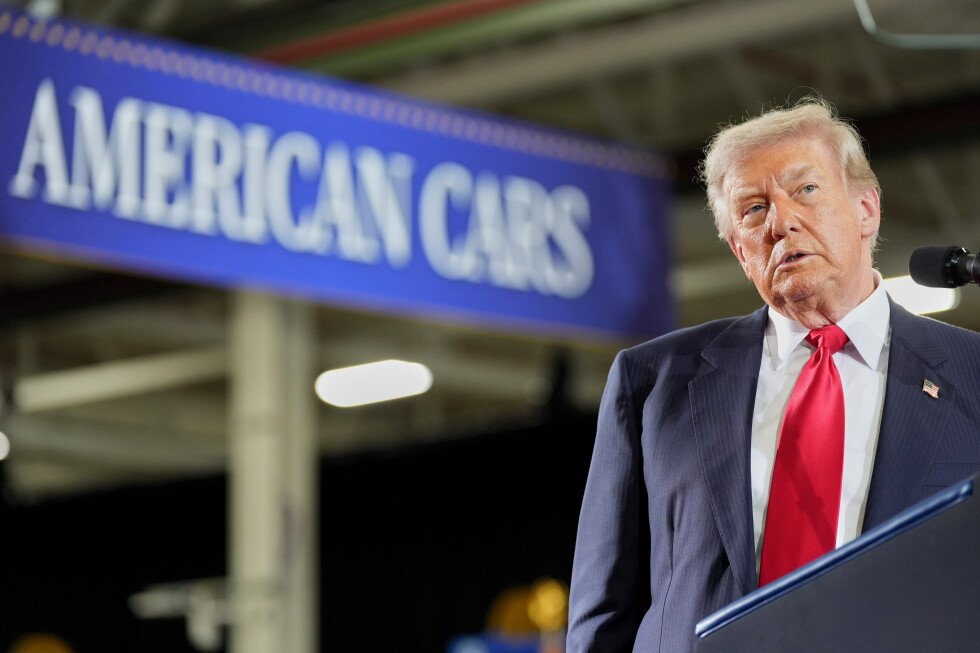
Stocks have rebounded in recent days after stumbling last week—the S&P 500 posted its biggest weekly decline since May—amid concerns about tariffs and the health of the U.S. economy. Those concerns have moderated this week, even as so-called “reciprocal” tariffs on dozens of countries went into effect overnight and President Donald Trump announced that he plans to impose a 100% tariff on chip imports.
Chip stocks were among the noteworthy gainers on Thursday after Trump said that companies that commit to manufacturing in the U.S. will be exempt from tariffs. Advanced Micro Devices (AMD) and Taiwan Semiconductor Manufacturing Co. (TSM) climbed 5% and 4%, respectively, while Micron (MU) tacked on nearly 3%. The VanEck Semiconductor ETF (SMH) rose 1%.
Intel (INTC) was bucking the chip sector rally, falling more than 3%, after Trump said in a Truth Social post this morning that CEO Lip-Bu Tan, who took the helm at the struggling chipmaker in March, is “highly conflicted and must resign, immediately.”
Shares of the world’s largest technology companies were mostly lower. Microsoft (MSFT) and Meta Platforms (META) each dropped more than 1%, while Alphabet (GOOG), Amazon (AMZN) and Tesla (TSLA) posted smaller declines. Chips giant Broadcom (AVGO) was also down slightly, while rival Nvidia (NVDA) rose fractionally, as the stocks gave back sizable early-session gains.
Apple (AAPL) was the sole mega-cap stock to turn in a strong performance on Thursday. Shares jumped 3%, adding to yesterday’s 5% surge, after CEO Tim Cook and Trump announced that the iPhone maker would invest an additional $100 billion in U.S. manufacturing.
Shares of Eli Lilly (LLY) plunged 13% after disappointing results from a trial of its oral weight-loss drug overshadowed the pharmaceuticals giant’s better-than-expected earnings report and boosted outlook.
Crypto-related stocks moved higher as the price of bitcoin jumped—the digital currency was at $116,600 recently, up from an overnight low of $114,300. Major bitcoin buyer Strategy (MSTR) and crypto exchange Coinbase Global (COIN) climbed 5% and 2%, respectively.
The U.S. dollar index, which measures the performance of the dollar against a basket of foreign currencies, was up 0.2% at 98.38.
The yield on the 10-year Treasury, which affects borrowing costs on all sorts of loans, notably mortgages, was at 4.25%, up from 4.23% at yesterday’s close. The yield fell as low as 4.18% this week, its lowest level in three months, as market expectations for interest rate cuts by the Federal Reserve increased following last Friday’s weak jobs report.
West Texas Intermediate futures, the U.S. crude oil benchmark, were down 0.8% at $63.80 per barrel, losing ground for the sixth straight day. Gold futures rose 0.6% to $3,455 an ounce, extending a week-long rally that has pushed the price of the precious metal back near record-high levels.
Why Crocs Stock Lost a Quarter of Its Value Today
59 minutes ago
Shares of Crocs lost more than a quarter of their value Thursday after the maker of brightly colored clogs said it expects tariffs to hurt current-quarter results.
The Broomfield, Colo.-based footwear firm reported adjusted earnings per share of $4.23, while analysts surveyed by Visible Alpha had expected $4.05. Revenue increased more than 3% year-over-year to $1.15 billion, matching expectations.
However, Crocs did not provide a full-year outlook, “given the continued uncertainty from evolving global trade policy and related pressures around the consumer,” and said it sees third-quarter revenue down 9% to 11%, below expectations. Crocs said its operating margin would likely be negatively impacted by tariffs.
“The current operating environment is uncertain and challenging to predict,” CEO Andrew Rees said. “Against this, we have chosen to focus on managing expenses including the $50 million in cost savings we have already implemented, reducing our inventory receipts, and pulling back on promotional activity to protect brand health in the marketplace. Although these actions will impact the topline of our business in the short term, they will position our business to win, drive margin dollars, and support continued cash flow generation longer term.”
Crocs shares were down 28% Thursday afternoon to $77.75. If they end the session at that price, it’d be their lowest finish since Nov. 3, 2022, when the stock closed at $76.60.
Space Tech Firm Firefly’s Stock Pops in Trading Debut
1 hr 23 min ago
Shares of Firefly Aerospace (FLY), a space tech company that counts the government’s Space Force among its major clients, soared in their debut on the Nasdaq Thursday.
The stock last traded hands around $62, up 38% from its initial public offering price at $45 per share, which was above its expected range of $41 to $43, and had been revised up from an initial $35 to $39.
Firefly sold more than 19 million shares in the offering, raising roughly $868 million in proceeds. That would give it a market capitalization of over $9 billion, based on the number of shares outstanding listed in a regulatory filing. The company said it plans to use the proceeds in part to pay down debt.
Firefly, which claims to be the first commercial firm to “achieve a fully successful soft-landing on the Moon” with its Blue Ghost lander in March, says Lockheed Martin (LMT), Northrop Grumman (NOC), and L3Harris (LHX) are also among its high-profile clientele, along with the government’s Space Force.
Michael Nagle / Bloomberg / Getty Images
The space tech company posted first-quarter revenue of $55.9 million, more than six times its sales in the same period a year earlier and nearly as much as it reported in all of 2024 at $60.8 million, according to its prospectus filing. However, it has yet to turn a profit, with a first-quarter net loss of $60.1 million.
Firefly’s launch comes after a series of strong IPOs this year, including those of design software maker Figma (FIG) last week, and stablecoin issuer Circle’s (CRCL) in June.
Why Chip Stocks Are Rising Despite 100% Tariff Threat
2 hr 24 min ago
Chip stocks rose on Thursday, the day after President Donald Trump said companies that manufacture in the U.S. or have committed to doing so will be exempt from 100% semiconductor tariffs.
“We’ll be putting a tariff of approximately 100% on chips and semiconductors. But if you’re building in the United States of America, there’s no charge,” Trump said during a White House press conference Wednesday afternoon. The tariffs were disclosed alongside Apple (AAPL) CEO Tim Cook, who appeared with Trump to announce plans to invest $100 billion in U.S. manufacturing, on top of the $500 billion committed earlier this year.
President Trump’s off-the-cuff announcement was light on details. For example, it was unclear whether existing commitments to manufacture in America would be sufficient, or if the president wants chipmakers to make new investments to win an exemption. It also remains unclear whether the tariffs and exemptions apply to electronics that contain semiconductors, or just the chips themselves, according to Jefferies analysts.
“We await full details likely in the next week or so before jumping to any conclusions, as it has always been a bad move to extrapolate too much from Trump’s words or social media post[s],” said Angelo Zino, senior vice president and equity analyst at CFRA Research.
Nonetheless, investors seemed to think Wednesday’s announcement removed a significant overhang for semiconductor stocks. The PHLX Semiconductor Index (SOX) was up 1.2% in recent trading. AI chip giants Nvidia (NVDA) and Broadcom (AVGO) were recently both up about 0.5%, though down from their earlier highs, while competitor Advanced Micro Devices (AMD) jumped 5%. Contract chip manufacturer Taiwan Semiconductor Manufacturing Co. (TSM) also advanced 5%, and manufacturing equipment maker Applied Materials (AMAT) rose more than 2%.
“From a high level, the 100% headline number seems intimidating, but in practice we expect a much lower impact,” wrote Bank of America Securities analysts in a note on Wednesday.
U.S.-based companies with domestic manufacturing capacity, such as Intel (INTC), Micron (MU), and Texas Instruments (TXN), should not be affected by the tariffs, according to Citigroup analysts. And fabless chip designers, including giants Nvidia, AMD, Broadcom, and Qualcomm (QCOM), should also be able to avoid the tariffs by contracting with major foundries like TSMC, Samsung, and GlobalFoundries (GFS), all of which have U.S. manufacturing facilities.
“If Taiwan Semi does get a full exemption … it would bode well for the broader tech semiconductor/hardware ecosystem and our positive stance on the space,” Zino of CFRA said.
Even European semiconductor companies without a U.S. presence are expected to be spared the 100% levy. The EU-U.S. trade deal announced late last month capped semiconductor tariffs at 15% and guaranteed zero-for-zero tariffs for semiconductor equipment makers like Netherlands-based ASML (ASML).
European Commission spokesperson Olof Gill on Thursday reportedly said the Trump administration had guaranteed that the 15% cap established by the trade deal would not be overwritten by other tariffs.
Peloton Stock Volatile After Surprise Profit, Layoff News
3 hr 28 min ago
Shares of Peloton Interactive (PTON) swung wildly Thursday after the connected fitness company said it swung to a surprise fiscal fourth-quarter profit and announced a restructuring plan that includes layoffs.
Peloton, known for its stationary bikes and other exercise equipment, reported a GAAP profit of 5 cents per share when a loss of 5 cents per share was expected by analysts surveyed by Visible Alpha. Revenue of $606.9 million fell 6% year-over-year but topped estimates.
“Our operating expenses remain too high, which hinders our ability to invest in our future,” CEO Peter Stern wrote in a shareholder letter. “Today, we are launching a cost restructuring plan intended to achieve at least $100 million of run-rate savings by the end of FY26 by reducing the size of our global team, paring back indirect spend, and relocating some of our work. This is not a decision we came to lightly, as it impacts many talented team members, but we believe it is necessary for the long-term health of our business.”
For fiscal 2026, Peloton sees revenue of $2.4 billion to $2.5 billion, with the midpoint above consensus estimates.
Peloton shares advanced as much as 14% this morning but were down about 2% recently.
Has Apple Cracked the Code on Avoiding Tariffs?
4 hr 7 min ago
If there’s a playbook companies can follow to avoid more tariffs, Apple (AAPL) may have found it.
President Donald Trump said yesterday that the iPhone maker and other companies like it could be exempt from future semiconductor tariffs, based on its recent investments in U.S. manufacturing, in a major win for Apple after a tough start to the year dogged by worries about tariffs and its progress in AI.
“The good news for companies like Apple is if you’re building in the United States or have committed to build—without question committed to build in the United States, there will be no charge,” Trump said yesterday, after Apple CEO Tim Cook joined the president at the White House to announce a $100 billion pledge to invest in U.S. manufacturing, adding to a $500 billion investment announced in February.
Demetrius Freeman / The Washington Post / Getty Images
The move will see Apple making more of its components domestically, though it stopped short of promising full-fledged production stateside, suggesting companies don’t actually need to move all of their operation to the U.S. to win similar exemptions.
Cook also isn’t the only major tech CEO who’s managed to score some concessions from the Trump administration after a high-profile visit to the White House.
Nvidia (NVDA) CEO Jensen Huang, who reportedly met with Trump yesterday as well, has made a number of visits to the White House in the past few months, with some signs of success in winning Trump’s favor. The chipmaker said last month that it’s looking forward to obtaining approvals to resume sales of key AI chips to China, after Trump tightened export restrictions earlier this year, citing national security concerns.
Shares of Apple were up about 3% at $189 in recent trading, extending yesterday’s 5% gain ahead of the company’s announcement.
Wall Street analysts widely cheered the move by Apple, with Bank of America analysts raising their target to $250 from $240, while JPMorgan analysts called Cook’s moves a “masterclass in managing geo-political uncertainty,” and reiterated their price target at $255.
Wedbush analysts led by longtime Apple bull Dan Ives said it was a “strategic poker move for Cook,” and maintained their Street-high target of $270.
Eli Lilly Shares Slide on Disappointing Drug Trial
5 hr 31 min ago
Ely Lilly (LLY) shares sank Thursday after the pharmaceutical firm reported disappointing results from a late-stage study of its experimental obesity pill. The news offset Lilly’s strong quarterly results.
The stock was down 14% recently, trading at its lowest level since early last year.
TradingView
The company said in a Phase 3 trial, patients taking a 36 milligram dose of its oral GLP-1 drug, orforglipron, without food and water restrictions showed an average weight loss of 12.4%, or 27.3 pounds, in a 72-week period. That’s below the 15% average weight loss of rival Novo Nordisk’s (NVO) Wegovy injectable treatment. Some on Wall Street were looking for orforglipron to come in closer to that level.
In an interview with CNBC, Lilly CEO David Ricks argued that the company wasn’t disappointed with the results even though they were “one or two points below what (the) Street had.” Ricks added the goal was to create a pill that was convenient to take, could be made on a huge scale, and would provide weight loss that was competitive with other GLP-1 medicines, “and that’s what we’ve achieved.”
The company said it plans to seek regulatory approval of orforglipron by the end of the year.
Along with the orforglipron announcement, Lilly released its second-quarter financial data Thursday, reporting adjusted earnings per share of $6.31, with revenue up 38% year-over-year to $15.56 billion. Both exceeded Visible Alpha forecasts by a wide margin.
The gains came from soaring demand for its current weight-loss drug, Zepbound, which had a 172% jump in sales to $3.38 billion. Sales of another GLP-1, Mounjaro, used to treat both obesity and Type-2 diabetes, were up 68% to $5.20 billion.
Lilly raised its full-year adjusted EPS range to $21.75 to $23.00, compared to the earlier estimate of $20.78 to $22.28. It sees revenue of $60 billion to $62. billion, versus the previous outlook of $58 billion to $61 billion.
Intel Shares Slip as Trump Calls for CEO to Step Down
6 hr 27 min ago
Intel (INTC) shares fell in early trading Thursday after President Donald Trump called for new CEO Lip-Bu Tan’s resignation.
“The CEO of INTEL is highly CONFLICTED and must resign, immediately,” Trump wrote on his Truth Social network. “There is no other solution to this problem.”
Earlier this week, Sen. Tom Cotton (R-Ark.) sent a letter to Intel Chairman Frank Yeary in which he wrote that “Mr. Tan reportedly controls dozens of Chinese companies and has a stake in hundreds of Chinese advanced-manufacturing and chip firms. At least eight of these companies reportedly have ties to the Chinese People’s Liberation Army.”
Andrej Sokolow / Picture Alliance / Getty Images
Tan formerly was CEO at Cadence Design Systems (CDNS), which recently pleaded guilty in a criminal case involving sales to China during his tenure.
Tan assumed the CEO role at the struggling chipmaker in March. Late last month, it was reported that Intel was looking to spin off its networking unit as it moves to shed assets under Tan.
TradingView
Intel shares were down about 2% in recent trading. The stock price is near unchanged in 2025, after shedding 60% of its value last year.
Major Index Futures Poised to Open Higher
7 hr 23 min ago
Futures linked to the Dow Jones Industrial Average were up 0.4%.
TradingView
S&P 500 futures rose 0.6%.
TradingView
Nasdaq 100 futures added 0.8%.
TradingView