Two predominant drivers of the economy—inflation (including from the war in Iran) and the potentially revolutionary artificial intelligence wave—highlight post-pandemic dualities and disparities.
Since the pandemic, the rich and Wall Street investors have reaped financial gains via rising stock markets, while those lower on the income ladder have struggled with higher prices and costs of living.
The dichotomous dynamics are continuing this year with inflation from the war, record highs for U.S. stock markets and disparate views of the impacts of AI.
“Households with equity holdings are offsetting rising inflation costs with increases in portfolio wealth, while wage earners are absorbing inflation through fuel, rent, and utilities without a wage increase to compensate,” said Lacey Kaelani, CEO and co-founder of Metaintro, a New York-based digital employment platform.
“Real wages for workers in the lowest two quintiles have remained flat, while compensation for top earners continues to increase through equity grants and bonuses tied to performance in the equity markets,” she said.

Gas prices are displayed at a Shell gas station in Miami, Tuesday, May 12, 2026. (AP Photo/Marta Lavandier)
Marta Lavandier
WAR IMPACTS
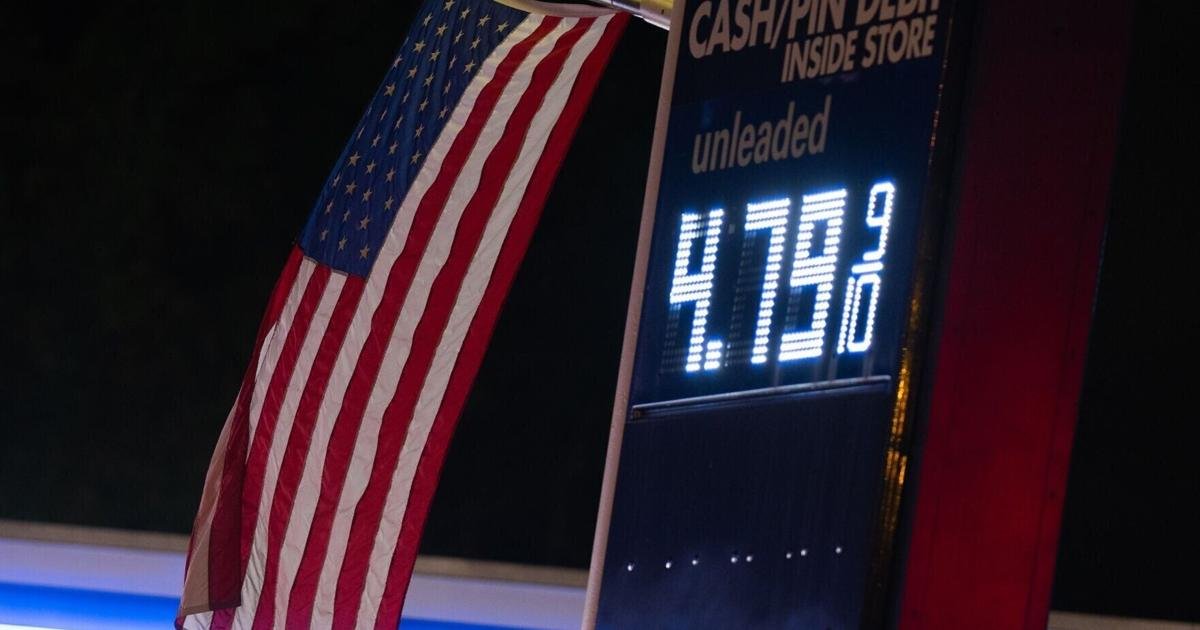
Since the start of the U.S./Israel war with Iran, oil and gasoline prices have risen and inflation has accelerated, adding to many American households’ economic stresses.
Inflation came in at 3.8% year-over-year in April, according to the latest Consumer Price Index.
Energy and utility costs are up, overall prices are up 30% since April 2020 and the COVID-19 pandemic, according to the U.S. Bureau of Labor Statistics.
Gas prices average $4.56 per gallon nationally as of Wednesday, according to AAA.
Erick Parker, COO for Ohio-based Global Business Consultants, said recent uncertainty about U.S. tariffs, and now higher energy costs, have made many employers careful about hiring and capital expenditures.
“They are not sure what’s going to go on with the economy,” he said.
Parker said the current economic landscape, including higher costs, curtailed some hiring.
But he said some of those same employers are reluctant to cut jobs, fearing they won’t be able to refill those positions.
“There is a cost of rehiring,” Parker said of the need to train new workers and persistent workforce challenges faced by some industries.
The current wave of higher prices are stressing already inflation-weary Americans.
A new poll by CBS News shows 77% of those surveyed say their income is not keeping up with inflation versus 23% who say their finances are able to keep up with higher prices.
The same poll shows 76% of Americans surveyed are concerned, and another 67% are stressed about the economy.
“The current economic situation is widening this gap: energy-related expenses disproportionately affect the working class, while the market rewards those with assets insulated from inflation,” Kaelani said.
American households are carrying a record $18.8 trillion in household debt, according to the New York Federal Reserve Bank.
The CBS survey shows 29% of those polled feel the U.S. economy is in good shape.
STOCKS UP
But life has been good for the other half of the economic coin, the wealthy and Wall Street.

President Donald Trump speaks as he tours Ballroom construction around the outside the White House, Tuesday, May 19, 2026, in Washington. (AP Photo/Jacquelyn Martin)
Jacquelyn Martin
Stock markets have been up with the Dow Jones Industrial Average flirting with 50,000 and the Nasdaq and S&P 500 hitting record highs.
President Donald Trump, who contends the war is needed to stop Iran from developing nuclear weapons, touts risking stock markets and contends inflation will ease once the conflict ends.
The S&P 500 is up 78% in the past five years, 23% since Trump’s return to office last year and more than 8% this year.
The Dow is up 45% since May 2021. The blue-chip index is up 14% since Trump began his second term in January 2025 and more than 3% this year, according to Google Finance and Yahoo Finance.
The Nasdaq has gained more than 93% in the past five years and 31% since the start of Trump’s second term, according to Google Finance.
Who’s benefiting from Wall Street’s gains?
According to Federal Reserve data, the wealthiest 10% own 90% of U.S. stock wealth and the poorest 50% of Americans own 1%.
America’s billionaire class saw their wealth grow by almost $1.5 trillion last year (a 22% gain), according to Americans for Tax Fairness, citing Forbes data.
According to the Institute for Policy Studies, the wealthiest 1% saw their household wealth go from $11.7 trillion in 1989 to $50 trillion in 2024.
The top earners’ share of U.S. wealth went from 23% in 1989 to 31% in 2024, according to the progressive group.


Trader Aaron Ford works on the floor of the New York Stock Exchange, Thursday, May 7, 2026. (AP Photo/Richard Drew)
Richard Drew
The number of American billionaires, according to Forbes data, has grown from 66 in 1989 to 905 in 2025.
AI SPLIT
The Nasdaq’s bullish nature, in particular, has been driven by Wall Street and corporate expectations for artificial intelligence (AI).
Capital expenditures for AI, including data centers, are projected to be $7.6 trillion through 2031, according to Goldman Sachs.
Numerous businesses and industries see exponential efficiencies and innovations with AI. They discount fears and worries that AI will take workers’ jobs.
“Those people are wrong,” Amazon founder Jeff Bezos told CNBC Wednesday, referring to AI fears.
“What’s really is going to happen (is) it’s going to elevate those people,” said Bezos, who also owns the Blue Origin space technology firm and the Washington Post
“What’s reality going to happen. We are going to have so much productivity in our economy,” Bezos said, contending AI could reduce the cost of food, construction materials and other products.

Amazon founder Jeff Bezos speaks at the America Business Forum, Thursday, Nov. 6, 2025, in Miami. (AP Photo/Rebecca Blackwell)
Rebecca Blackwell
“Just keep your eyes open to the possibilities,” Bezos told the business network.
On the flip side, many workers and college graduates worry about AI taking jobs and eroding personal privacy.
The CBS News poll, which was conducted with survey firm YouGov, found 65% of those surveyed believe AI will cut into jobs versus 18% who believe it will help jobs.
“I think we are all trying to figure out AI,” Parker said of how businesses are looking at where automation and machine learning might fit into their workflows.
“Business owners are still trying to figure that out,” he said.
Many of those same businesses, across multiple sectors, also see a deluge of AI-touted technology pitches for their operations.

A shopper shops at a grocery store in Schaumburg, Ill., Thursday, May 14, 2026. (AP Photo/Nam Y. Huh)
Nam Y. Huh
JOBS PICTURE
In April, the U.S. economy added 115,000 jobs, according to the Bureau of Labor Statistics.
That beat economists’ and Wall Street’s expectations of 55,000 new jobs.
A deeper dive shows a number of occupations and industries gaining the most jobs that pay lower wages.
Last month, 37,900 messengers, couriers and delivery drivers jobs were added to the U.S. economy.
Another 10,800 new jobs were added in home health services, 24,000 in social work, 18,300 at big-box stores and 12,500 at home improvement and building materials stores.
Those fields added a combined 103,500 jobs nationally last month, according to BLS.
They also tend to pay lower wages with some including that part of workers’ ‘side hustles’ to help make ends meet.
A recent 1,000-person survey by Payless Power (a Texas-based energy technology firm) found 89% of those working hustle jobs cite food, utility, housing and medical costs as their top affordability challenges.
The same research shows 89% of side hustlers earn less than $1,000 per month from those positions.
“The overall number of jobs created has been driven primarily by gig and warehouse hiring, rather than traditional full-time jobs that provide benefits,” Kaelani said.
“According to our data, the growth has been concentrated in delivery, logistics, eldercare, and other side hustle jobs. There has been little to no increase in job postings for white collar jobs like technology, finance, or marketing from last year to this.”
Kaelani sees AI taking jobs.
“AI is not replacing those jobs by automating existing work; AI is taking those jobs away by reducing the amount companies are willing to pay for work,” she said. ”Businesses are starting to hire AI agents and validate AI output for free while laying off analysts, coordinators, and entry-level engineers.”
Others, including top business and technology executives, see AI as having revolutionary benefits via innovations and productivity.
“Picture AI is going to cure cancers, reduce work weeks and kids will live longer, planes will be safer, cars will be. Less people will die and you will have new drugs,” said JPMorgan Chase CEO Jamie Dimon, in an interview with Bloomberg News. “It’s going to be good.”

An American flag flies near a sign for fuel prices at a gas station on Wednesday, May 6, 2026, in Portland, Ore. (AP Photo/Jenny Kane)
Jenny Kane