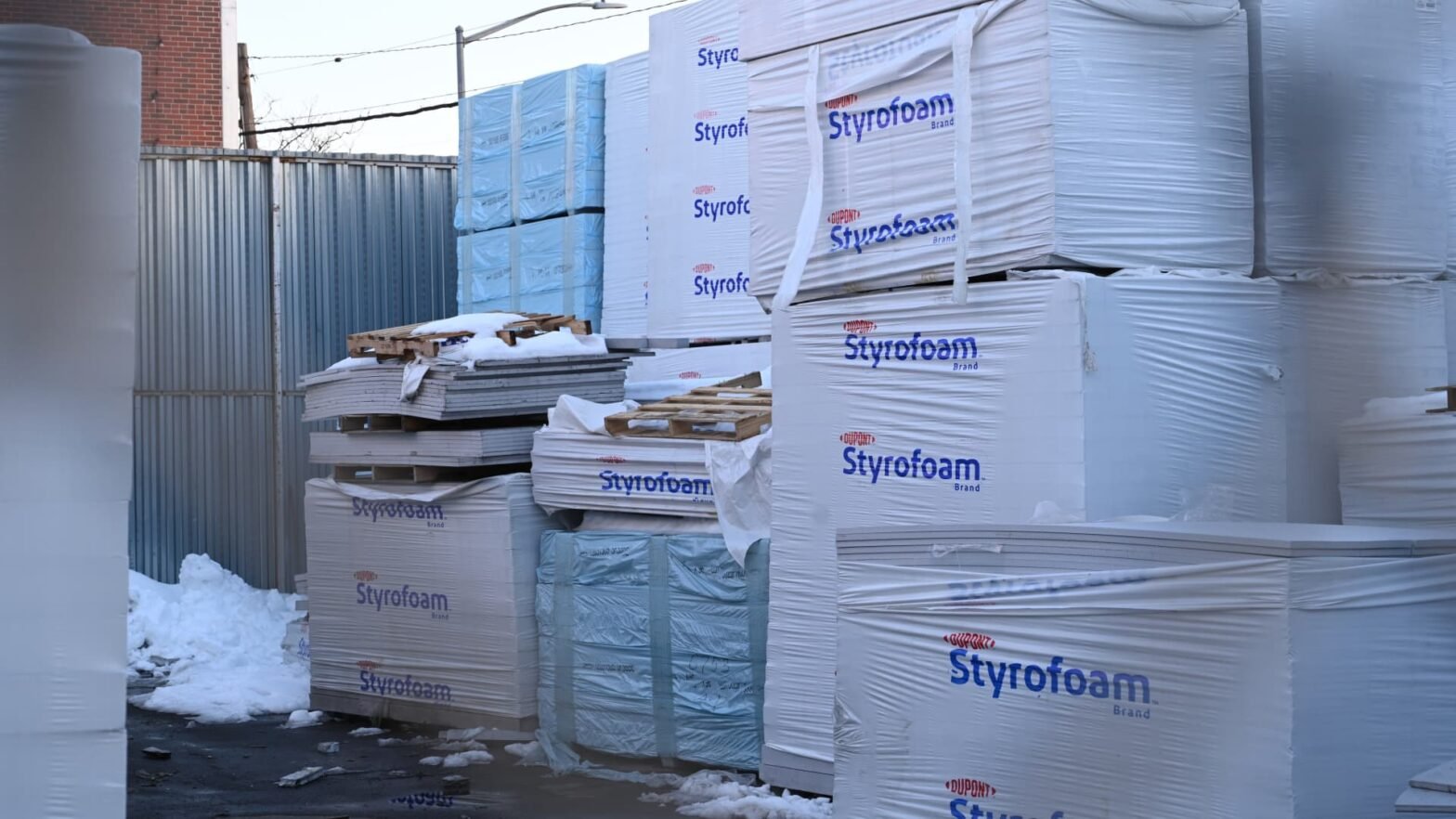
DuPont delivered an impressive earnings beat on Tuesday by navigating disruptions from the war in Iran, sending shares of the maker of medical packaging, clean-water technology, and industrial products soaring. Challenges remain, but we’re not selling into strength. Revenue in the three months ended in March rose 4% to $1.68 billion, topping the LSEG consensus of $1.67 billion. On an organic basis, sales grew 2% from the year-ago period. Adjusted earnings per share (EPS) totaled 55 cents, ahead of the 48-cent consensus, LSEG data showed. Adjusted EPS jumped 53% from a year ago. Shares of DuPont soared 9% on Tuesday to over $49 apiece. The stock closed above $51 a share on a couple of occasions in February following its strong fourth-quarter results . But not long after, the Iran war broke out, pressuring the stock ever since as investors feared a hit to DuPont’s business. Shares entered Tuesday’s session down almost 10% from their prewar levels. It is a “great time to not sell your DuPont,” Jim Cramer said on Tuesday’s Morning Meeting. DD YTD mountain DuPont’s year-to-date stock performance. Bottom line DuPont is doing a commendable job of navigating the fallout from the war in Iran, and the market is clearly recognizing this in its stock reaction. The conflict is impacting the company in two primary ways. The first is a direct hit to its Water Technologies unit in the first quarter, which saw a mid-single-digit organic decline due to logistics disruptions in the Middle East. The region relies heavily on DuPont’s desalination technology to turn salt water into clean drinking water, so it’s a key hub for the business on both the consumption and production sides . About $10 million in sales couldn’t be shipped out of the Middle East in the quarter. Without that hit, organic sales for Water Technologies would’ve been flat to slightly down. Now for the good news: Those stranded orders have already shipped in April. In other words, it’s delayed revenue, not lost revenue. Plus, DuPont isn’t baking in “a ton of disruption” for this business tied to the Middle East in the second quarter, CEO Lori Koch said. Its full-year guidance of mid-single-digit organic growth is also on track. Other parts of its water business — most notably, its purification technology used in semiconductor manufacturing — saw strong volumes in the quarter. This is one way that DuPont benefits from the artificial intelligence boom. Why we own it DuPont represents an industrial way to play the semiconductor and electronics recovery, which has strong multiyear outlooks driven by advancements in artificial intelligence. DuPont’s plan to break itself up has sweetened the fundamental investment case. Competitors: 3M , PPG Industries Portfolio weighting: 1.88% Most recent buy: Aug. 5, 2025 Initiated: Aug. 7, 2023 The big thing to watch is whether some large desalination projects in the Middle East slated for the second half of the year get off the ground as planned. “Right now, we continue to expect them to be on track, but we’ll have to watch as the broader situation evolves,” Koch said. The second main way the conflict is impacting DuPont is broader and far from a company-specific problem: higher input costs thanks to elevated oil, raw materials, and transportation prices. Among the areas where DuPont is seeing the higher costs is its Tyvek lineup. Tyvek is a type of durable plastic, high-density polyethylene, used to create industrial packaging for products such as fertilizer and cement. Another Tyvek product is HomeWrap, which may be familiar to anyone who has looked at a house being built before the siding is installed. Admittedly, construction remains one of DuPont’s softer end markets. It was last year and again in the first quarter. A stronger piece of the Tyvek portfolio is right now health-care packaging used to keep surgical instruments, pharmaceuticals, and other medical products sterile. This is attractive long term. Tyvek is an important brand for DuPont. Now for the good news: DuPont is applying surcharges and raising prices to counter its higher input costs. Some price increases kicked in on April 1; others started this month. The company expects an incremental $90 million in costs to be fully offset this year and, accordingly, raised its full-year organic sales growth outlook to 4% from 3%. This is encouraging because it suggests DuPont doesn’t expect higher prices to dent demand or reduce volume. CFO Antonella Franzen said DuPont’s order trends in April were very similar to what they have been seeing. “Order trends are doing well,” Franzen said. Later in the call, CEO Koch added: “We haven’t received an abnormal amount of pushback. … We’re not looking to profit. We’re looking to just cover it. The conversation [with customers] has been constructive.” An important thing to monitor is whether the Middle East conflict is resolved and commodity prices start to normalize; this would lower input costs and likely reduce any potential drag on order growth. Franzen said DuPont’s guidance assumes current oil and natural gas prices will remain in place for the remainder of the year. “Clearly, if this were to escalate or get even worse from where we are today, that would obviously have some impact on the assumptions we’ve made,” she said. “But we’re not planning on it going away,” she said. If necessary, she said, “the team would obviously see what other actions we could take in order to mitigate any disruptions.” Those comments are encouraging and reinforce our commitment to owning shares of the new DuPont, which last year spun off its electronics business into the standalone Qnity . Club name Qnity is a major AI winner thanks to booming chip manufacturing, and we’re glad we own both stocks. Of course, DuPont may not be as buzzy as Qnity because it’s not a pure AI story. However, Koch and Franzen are proving to be a deft management team capable of improving the company to benefit shareholders. They’re making DuPont more efficient and profitable — as evidenced by the strong year-over-year improvement in operating margins — and more consistent overall. In years past, DuPont’s stock was hurt by a propensity to deliver good quarters but weak guidance. With improving operations, DuPont is becoming a more reliable beat-and-raise story, which the market typically rewards with a higher price-to-earnings multiple. DuPont currently trades at nearly 21 times forward earnings, up from roughly 16.5 three years ago, according to FactSet. Koch is also intent on reshuffling DuPont’s business portfolio to make the medical and water end markets a bigger part of the pie. That will also help support a better stock multiple. Currently, DuPont is split roughly 50-50 between its Healthcare & Water and Diversified Industrials segments. As Jim mentioned during Tuesday’s Morning Meeting , we’re hopeful DuPont can make some acquisitions in these faster-growing, less cyclical areas. In the meantime, the sale of the Kevlar and Nomex brands to a private-equity firm is smart and provides more cash to work with. That transaction closed April 1, bringing in $1.1 billion in net proceeds. With some of the money, DuPont on Tuesday announced a $275 million accelerated share repurchase program — a strong signal about management’s attitude toward the stock price heading into earnings. This comes on top of a $500 million ASR that DuPont disclosed alongside its fourth-quarter report in February. We love that confidence, but are maintaining our hold-equivalent 2 rating and price target of $55. It’s not our style to chase big one-day rallies, but we also believe there is more upside, assuming the situation in the Middle East doesn’t worsen materially. Guidance DuPont’s revised full-year guidance (all estimates are from FactSet): Net sales in the range of $7.155 billion to $7.215 billion, up $80 million at the midpoint. Even the low end of the range is above the consensus of $7.104 billion. Organic sales growth of 4% year over year, up from 3% to incorporate the aforementioned pricing actions. Operating EBITDA (earnings before interest, taxes, depreciation, and amortization) in the range of $1.73 billion to $1.76 billion, up $5 million at the midpoint of $1.745 billion. The consensus was $1.731 billion. Adjusted EPS in the range of $2.35 to 2.40, an increase of 10 cents at the midpoint. That’s above the $2.28 expectation. For the second quarter, DuPont expects: Net sales of $1.8 billion, in line with expectations. Organic growth of 3% year over year. Healthcare & Water organic growth in the mid-single-digits range. Diversified Industrials organic growth in the low single-digit range. Operating EBITDA of $430 million, a touch light versus the $439 million consensus. Adjusted EPS of 59 cents, a penny above consensus. (Jim Cramer’s Charitable Trust is long Q and DD. See here for a full list of the stocks.) As a subscriber to the CNBC Investing Club with Jim Cramer, you will receive a trade alert before Jim makes a trade. Jim waits 45 minutes after sending a trade alert before buying or selling a stock in his charitable trust’s portfolio. If Jim has talked about a stock on CNBC TV, he waits 72 hours after issuing the trade alert before executing the trade. THE ABOVE INVESTING CLUB INFORMATION IS SUBJECT TO OUR TERMS AND CONDITIONS AND PRIVACY POLICY , TOGETHER WITH OUR DISCLAIMER . NO FIDUCIARY OBLIGATION OR DUTY EXISTS, OR IS CREATED, BY VIRTUE OF YOUR RECEIPT OF ANY INFORMATION PROVIDED IN CONNECTION WITH THE INVESTING CLUB. NO SPECIFIC OUTCOME OR PROFIT IS GUARANTEED.
DuPont is ripping higher after an impressive beat and raise — here’s our next move
May 5, 2026