
Earlier this year, a share trader in Mumbai got a message inviting him to join a WhatsApp group. The group claimed to be run by a well-known stock brokerage. He was experienced, not a beginner. Over the next few weeks, he watched his money grow on a trading app: a few lakhs became, on screen, ₹2.1 crore. When he finally tried to withdraw his profits, the excuses started. By the time he stopped trying, he had lost nearly ₹87 lakh. He knew the stock market well. It did not matter. The thing that defeated him was not the market at all.
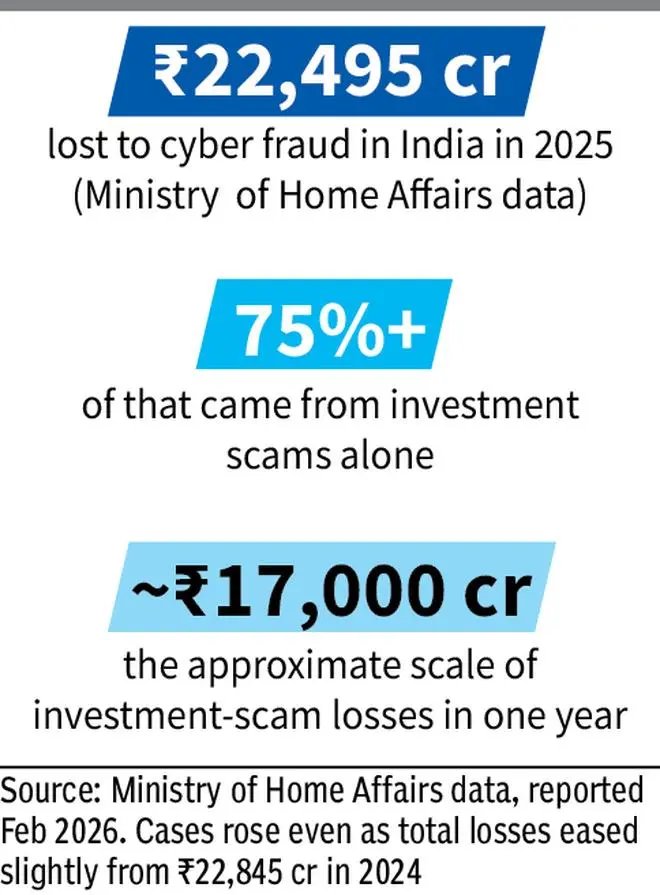
That is the point of this article. Most investing advice warns you about bad trades. This is about something that happens before a real trade takes place at all — organised fraud, built to look, sound and feel genuine. According to government data, India lost close to ₹22,500 crore to cyber fraud in 2025. More than three out of every four of those rupees — roughly ₹17,000 crore — came from investment scams alone.
Here are the five scam patterns behind almost all of it, and what every investor needs to know to stay safe.
1. THE “GUARANTEED TIP” THAT’S REALLY A COIN TOSS
A fraudster contacts a hundred people with a confident stock tip. Fifty are told to buy a particular stock. The other fifty are told to sell it. The next day, whichever way the stock moves, one group of fifty has received a “correct” call — not through skill, but arithmetic. That winning group is split again and given opposite tips on a new stock. After two or three rounds, a small number of people have received several “accurate” calls in a row, with no way of knowing they are simply the survivors of a coin that kept landing the same way.
This is usually when the pitch changes: a subscription fee for “premium calls,” or, in the cleverer version, no upfront fee at all, just a share of future profits. That second version feels safer, because it seems like the fraudster is sharing the risk. The same scheming pattern explained above happens in the case of the fraudster asking for no fee, but only share in profits to win your trust. While it has the hood of genuiness, underneath lies a deceptive tactic to make money of you In reality, the people who get each call wrong are simply dropped and forgotten, while those who get the right calls are milked till the groups cant be split any more with opposite calls.
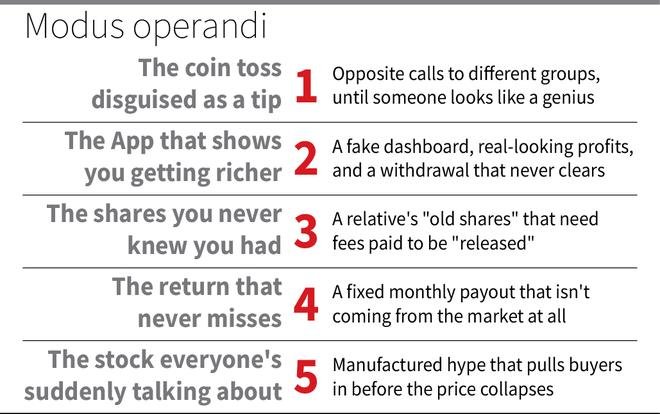
2. THE APP THAT SHOWS YOU GETTING RICHER
This is the trick that caught the Mumbai trader above, and it may be the most dangerous of the five, because it does not ask you to believe a story — it shows you what looks like proof. The pitch usually promises something exclusive: an “institutional account,” or a guaranteed IPO allocation, sometimes through an app copying a real broker’s own platform.
You transfer money, and the app shows it growing — ₹5 lakh becomes ₹6.2 lakh becomes ₹8.5 lakh, in something close to real time. They ask you transfer more money to buy more such lucrative stocks, which is mostly done willingly when a person sees amazing returns on the app. Only when you try to withdraw does the real scam begin: a “tax,” a “compliance charge,” a “settlement fee,” a delay that never quite ends. Investors who have just watched their money apparently triple often pay these fees willingly, because refusing feels like giving up money that’s already theirs. It never was.
SEBI, India’s market regulator, has repeatedly flagged fraudulent apps that mimic real brokers, spread through unsolicited WhatsApp and Telegram links, often backed by forged certificates carrying real-looking logos. The documents look completely authentic — that’s the entire point of forging them.
3. THE “OLD FAMILY SHARES” TRICK
A caller tells you that your late father, mother or another relative bought physical share certificates decades ago — now apparently worth several lakhs. To “release” this money, the caller says, the shares need dematerialisation (conversion to electronic form), which requires fees: transfer charges, stamp duty, “verification” costs, sometimes backed by a forged certificate.
What makes this convincing is that the caller often already knows something true — a relative’s name, an old employer — doing most of the persuading before a rupee changes hands. This scam particularly targets families dealing with an inherited estate.
Never verify such a claim using the phone number the caller gives you. Contact the company’s registrar, the depository, or a trusted broker yourself, using contact details you find independently.
4. THE RETURN THAT NEVER MISSES
The oldest scam in the book survives because the pitch is so comforting: eight to ten per cent every month, guaranteed, principal completely safe. Early returns often really do arrive, building trust as the invested amount grows into several lakhs, sometimes more.
What’s usually happening underneath has nothing to do with the market. This is a Ponzi scheme: today’s “returns” are yesterday’s new deposits from other investors, and it works only as long as new money arrives faster than old money leaves. When it stops, so do the payments, replaced first by excuses and eventually by silence.
Markets go up and down — that’s what makes them markets. Anyone promising a fixed return regardless of what the market does isn’t describing an investment. They’re describing a countdown.
5. THE STOCK EVERYONE IS SUDDENLY TALKING ABOUT
This one doesn’t ask for your money directly — it asks for your buying. A group quietly buys shares in a small, thinly traded company, then manufactures excitement across WhatsApp, Telegram and YouTube: a big institutional order about to land, an “insider tip,” an implausible target price. As investors buy in, the rising price becomes its own proof — surely something must be happening — which draws in still more buyers.
Once the price has run far enough, the early buyers sell into the demand they created, and the price falls back, leaving the newest buyers holding the loss. It can genuinely work for the first wave, which is exactly what recruits the second.
WHAT ALL FIVE SCAMS HAVE IN COMMON
Look past the details, and these five scams pull the same small set of psychological triggers. Greed makes an unusually good offer feel too exciting to question. Urgency — “today only,” “limited slots” — removes the time a calm person would use to check the facts. Authority borrows credibility from elsewhere: a brokerage’s name, a forged certificate. Fake proof — screenshots, testimonials, a dashboard updating in real time — does the emotional work a genuine track record would otherwise need years to earn. And underneath it all sits a small, believable early win, designed to lower your guard before the real request for money arrives.
None of this requires the victim to be careless. It only requires the fraud to be well built — and today, it usually is.
A CLOSING THOUGHT
There is nothing wrong with taking real, informed risk in the stock market. But there is a wide gap between accepting the market’s ordinary risk and handing your money to an unverified stranger who has simply talked that risk away. A genuine opportunity has never once needed you to decide in the next ten minutes. A genuine adviser has never once been unable to produce a real, checkable registration number.
Before you invest, before you transfer money, before you trust — verify first. It is a smaller habit than any investment strategy. It may also be the one that saves you the most money of all.
The author is an AMFI & APMI-registered MF/SIF/PMS distributor, private investor and educator
Published on September 12, 2026