
(Kitco NewsWire) – Spot gold and silver prices were sharply lower in late U.S. trading Friday, extending their recent selloff as a historic technology-led equity market decline and expectations for additional Federal Reserve interest rate increases pressured precious metals. Gold approached the psychologically important $3,500 level, trading at its lowest prices since September 2025, while silver suffered even heavier losses amid concerns about industrial demand and deteriorating global risk sentiment. The metals failed to benefit from sharply lower Treasury yields as investors reduced exposure to commodities alongside equities. At 5 p.m. ET, spot gold was trading near $3,537.90 an ounce, down $86.30, or 2.38%, while silver was trading near $41.120, down $1.637, or 3.83%, on the session. Gold traded as low as $3,502.93 during the day, while silver touched $40.660.
Friday’s U.S. economic data offered some evidence of easing inflation expectations and improving consumer sentiment, although the figures provided little relief to precious metals amid the broader financial-market selloff. The University of Michigan’s final November consumer sentiment index increased to 51.5 from 48.0 in October, a 7.3% monthly improvement and its highest reading since August. The current economic conditions index rose to 49.4 from 46.7, while the expectations index increased to 52.9 from 48.8. More significantly for monetary policy, consumers’ one-year inflation expectations declined to 3.7% from 4.7% in October, while longer-term expectations eased to 3.3% from 3.5%. The improvement reflected some relief from falling gasoline prices and expectations for changes in economic policy following the midterm elections. However, concerns about artificial intelligence valuations and recent stock market losses continued to weigh on households with substantial financial assets. The figures followed Thursday’s weaker jobless claims and Philadelphia Fed manufacturing reports, reinforcing the increasingly uneven outlook for economic growth and inflation.
Market positioning remained focused on the Federal Reserve’s Dec. 8-9 policy meeting, although Friday’s sharp equity selloff and renewed demand for Treasury securities encouraged some reassessment of the potential pace of monetary tightening. Wednesday’s minutes from the Fed’s October meeting indicated that nearly all policymakers anticipated additional interest rate increases, while persistent inflation remained a central concern. However, the latest futures assessments indicated that expectations for a larger 50-basis-point increase had diminished substantially, with markets continuing to favor a 25-basis-point move in December. The benchmark 10-year Treasury yield declined approximately 10 basis points toward 4.94%, its lowest level in several weeks, while the two-year yield eased toward 4.65%. The dollar also retreated from recent highs, although the decline provided little support to gold. The divergence between falling Treasury yields and declining bullion prices suggested that broader portfolio liquidation and concerns about economic growth were dominating traditional interest-rate relationships. Investors now turn to Monday’s preliminary November purchasing managers’ indexes and Chicago Fed National Activity Index, along with additional Federal Reserve commentary, for signals about the strength of economic activity and the outlook for interest rates.
The Strait of Hormuz and U.S.-Iran situation remained unsettled Friday as continuing military threats and attacks on commercial shipping maintained significant risks to petroleum exports through the strategic waterway. Recent reports of tankers striking naval mines, together with Houthi attacks targeting Saudi Arabia’s capital, Riyadh, underscored the continuing instability surrounding Gulf shipping and regional energy infrastructure. However, petroleum exports from the Middle East have recovered substantially despite the unresolved conflict, reducing immediate concerns about a sustained global supply shortage. The United States continued its blockade of Iranian ports, while no comprehensive diplomatic agreement had been reached over sanctions, maritime security and the broader confrontation. The prospect of renewed attacks or additional military escalation maintained a geopolitical risk premium in crude oil, although expectations for recovering global supply constrained prices. For gold, continuing tensions supported the potential for defensive demand, but Friday’s sharp decline indicated that financial-market liquidation, restrictive monetary policy expectations and concerns about global economic growth remained more immediate influences on bullion.
Crude oil prices recovered modestly Friday but recorded a third consecutive weekly decline as expectations for a global petroleum surplus offset continuing concerns about Middle Eastern supply disruptions. January Brent crude futures advanced approximately 0.6% to settle at $92.57 a barrel, while December Nymex WTI crude gained approximately 0.9% to finish at $83.98. Despite Friday’s gains, Brent declined 3.4% for the week, while WTI lost 5.2%. Recovering Middle Eastern production and stronger petroleum exports through regional shipping routes continued to reduce the geopolitical supply premium, even as attacks on commercial vessels maintained the possibility of further disruptions. Global petroleum inventories are expected to increase as supply growth exceeds near-term demand, with the surplus potentially expanding during 2027. The combination of recovering supply and weaker industrial demand expectations has contributed to the recent decline in crude prices, which could eventually help moderate inflation pressures. However, Friday’s weakness in precious metals suggested that broader asset liquidation and uncertainty surrounding the Federal Reserve’s policy path remained dominant market considerations.
North American equity markets finished sharply lower Friday as accelerating selling in artificial intelligence-related companies and technology shares drove the S&P 500 into correction territory. The Dow Jones Industrial Average declined 949.73 points, or 1.93%, to close at 48,147.33, while the S&P 500 plunged 3.70% to finish at 6,910.39, more than 10% below its Oct. 6 record high. The Nasdaq Composite tumbled 5.28% to 22,617.73, turning negative for the year, while the Russell 2000 declined approximately 2.8% to finish near 2,581.79. The selloff reflected growing concerns about elevated artificial intelligence valuations, heavy capital spending and the sustainability of investment returns across the technology sector. For the week, the Nasdaq lost approximately 10%, while the S&P 500 declined 8.6% and the Dow fell about 8%. The sharp deterioration in risk sentiment encouraged demand for Treasury securities, but gold and silver continued falling alongside equities, indicating that some investors were liquidating precious metals rather than increasing defensive allocations.
Canada’s S&P/TSX Composite Index also finished sharply lower Friday, extending its losing streak as declining precious metals prices and heavy selling in technology shares weighed on the resource-heavy Toronto market. The benchmark fell 838.88 points, or 2.47%, to close at 33,189.85, its lowest finish in approximately six months. The materials sector remained under heavy pressure as gold and silver extended their declines, while base metals producers also weakened amid concerns about global industrial demand.
European equity markets finished sharply lower Friday, extending the week’s losses as technology companies, banks and mining shares came under renewed pressure amid the global retreat from risk assets. The pan-European Stoxx 600 declined 2.00% to close at 625.65, while Germany’s DAX fell 2.60% to 24,802.78. France’s CAC 40 lost 1.89% to 7,927.75, and the U.K.’s FTSE 100 declined 1.02% to 10,346.34. Technology and semiconductor companies were among the weakest performers as concerns about artificial intelligence investment and corporate valuations spread from Wall Street to European markets. Mining companies also declined sharply as gold, silver and industrial metals weakened, while banks faced pressure from concerns about slowing economic growth. Defensive sectors, including health care and food and beverage companies, demonstrated relative resilience. The declines reflected the broader deterioration in international risk sentiment, with falling government bond yields providing limited support to equities.
The key outside markets see Nymex WTI crude oil futures modestly higher after settling at $83.98 a barrel, while Brent crude finished at $92.57. The benchmark 10-year U.S. Treasury yield declined toward 4.94%, while the two-year yield eased near 4.65%, reflecting strong demand for government securities during the equity market selloff. The U.S. dollar softened from recent highs, although the weaker currency and falling Treasury yields offered little relief to gold and silver as investors continued reducing exposure to risk assets. The combination of deteriorating equity markets, weaker industrial commodities and uncertainty about the Federal Reserve’s tightening trajectory maintained pressure on precious metals despite improving inflation expectations. (Kitco Global Index shows how much of today’s gold move is the dollar versus the gold market itself.)
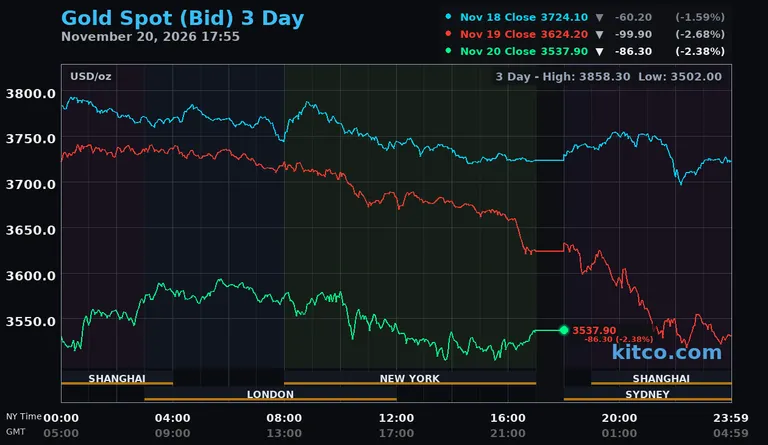
Technically, spot gold bulls’ next upside price objective is to push prices back above the $3,597.00 to $3,699.00 resistance zone, with a sustained recovery targeting $3,713.95. Bears’ next near-term downside price objective is a sustained break below $3,500.00, with deeper downside targets at $3,475.00 and then $3,421.00, followed by the $3,400.00 to $3,420.00 support zone. First resistance is seen at $3,597.00 and then at $3,699.00. First support is seen at $3,475.00 and then at $3,447.00.
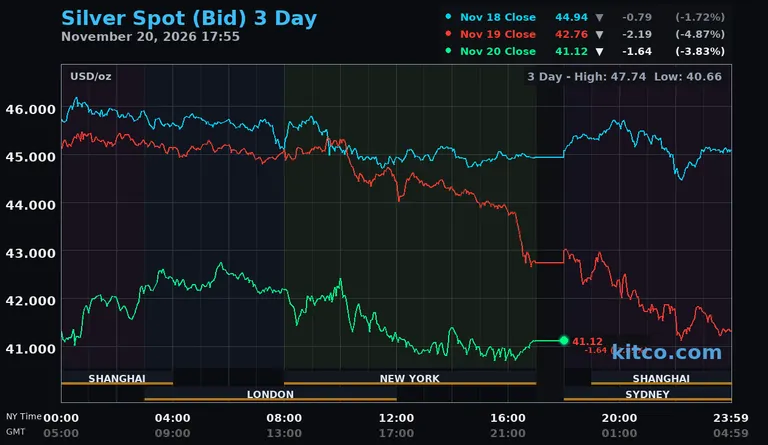
Spot silver bulls’ next upside price objective is to drive prices back above the $42.060 to $42.780 resistance zone, with a sustained recovery targeting $44.000 and then $44.500. The next downside price objective for the bears is a break below $40.660, with deeper downside targets at $40.500 and then $40.290. First resistance is seen at $42.060 and then at $42.780. Next support is seen at $40.660 and then at $40.500.
See live precious metals prices for gold, silver, platinum and palladium — in USD, CAD and 12 more currencies.

Disclaimer: The views expressed in this article are those of the author and may not reflect those of Kitco Metals Inc. The author has made every effort to ensure accuracy of information provided; however, neither Kitco Metals Inc. nor the author can guarantee such accuracy. This article is strictly for informational purposes only. It is not a solicitation to make any exchange in commodities, securities or other financial instruments. Kitco Metals Inc. and the author of this article do not accept culpability for losses and/ or damages arising from the use of this publication.