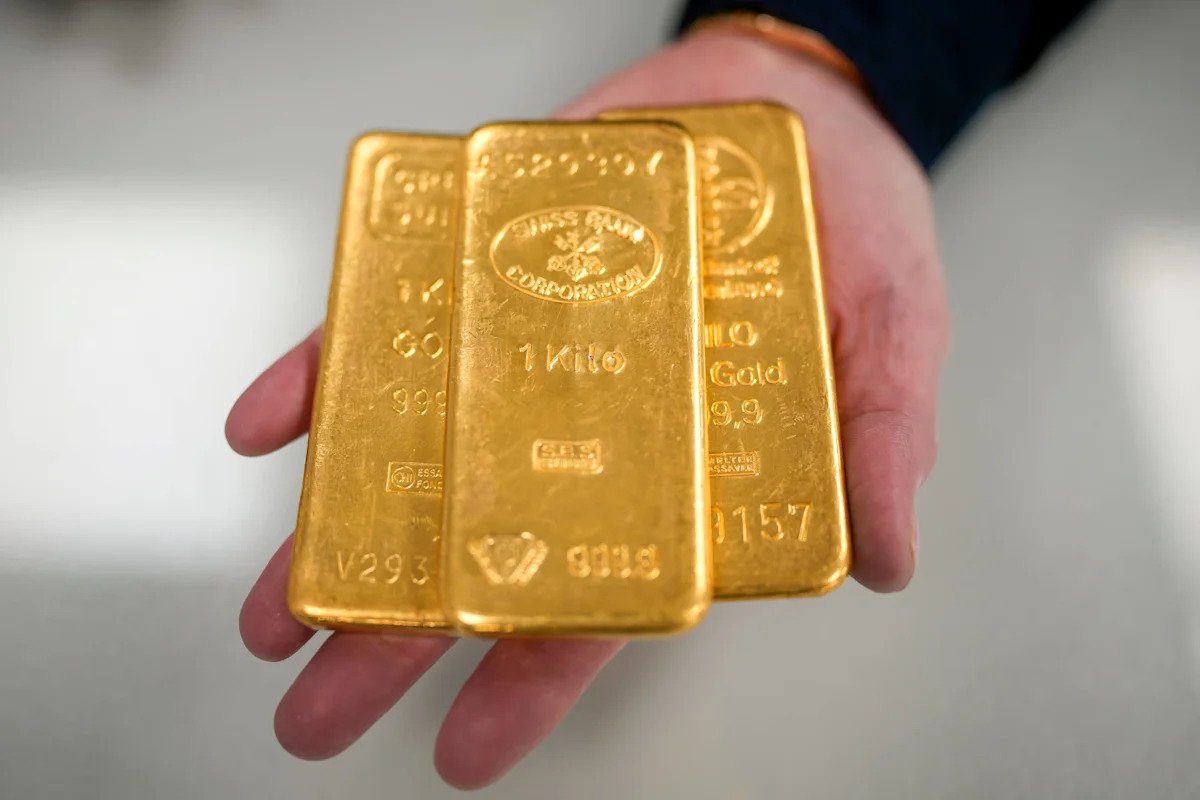
Gold is supposed to help investors sleep at night. When the stock market wobbles, inflation bites, or the economy looks uncertain, owning something tangible feels remarkably reassuring.
That said, gold hasn’t been especially reassuring lately.
After climbing to $5,595 an ounce in January, the precious metal has tanked 29%. On Friday, spot gold slipped below $4,000, a round number investors have been watching much more closely, and finished near $3,996.
That comes as a huge surprise after last year’s epic run for the shiny yellow metal and serves as an uncomfortable reminder that even a traditional safe haven can suffer a steep selloff.
And the next test could be even more important than the first: With gold finally finding a floor, does the correction still have further to run?
Gold prices break $4,000, putting a crucial July low to the test
Spot gold finished Friday, October 23, at about $3,995.80 an ounce, after slipping as low as $3,975.64. Bullion lost roughly 4% for the week, its worst showing since June, and stood nearly 29% below January’s $5,595 peak.
Gold’s retreat wasn’t just another bad day for precious metals.
Surprisingly, the sell-off comes at a point when technology stocks are also taking a hammering. For perspective, the Vanguard Information Technology ETF is down 5% for the month, with the S&P 500 also in the red according to Seeking Alpha data. Yet gold wasn’t providing the protection investors often expect when Wall Street gets nervous.
The $4,000 mark is an obvious line in the sand. Traders watch round numbers, and a break can trigger stop-loss orders or encourage more selling. But the more meaningful test sits slightly lower.
In an October 20 technical report shared with me, Bank of America strategist Paul Ciana identified $3,943, gold’s July low, as a level to watch for a potential double bottom. Hold it, and a recovery case remains possible.
Break it, and the bank’s corrective scenario points toward $3,886 and eventually $3,700.
But the pressure isn’t coming from charts alone. Oil prices jumped on fears of Middle East supply disruptions, reviving inflation concerns just days before the Federal Reserve’s October 27-28 meeting.
Traders largely expected interest rates to remain unchanged next week but increasingly anticipated a December increase. Higher yields make non-interest-paying gold less appealing, while a stronger dollar adds another headwind.