Home Depot (NYSE: HD) is a classic blue chip stock.
The company pioneered the big-box home improvement retail category, opening its first store in the late 1970s at a time when smaller hardware stores dominated the landscape.
Missed AI’s “Act 1”? Act 2 Could Be 14x Bigger. Most investors think they missed the AI boat because they didn’t buy Nvidia in 2005. But according to our analysts, we’re only at the end of “Act 1″—the R&D phase. “Act 2” is the global rollout. Continue »
These days, Home Depot has more than 2,000 stores worldwide and earns wide profit margins and a high return on capital, a sign of its competitive advantage.
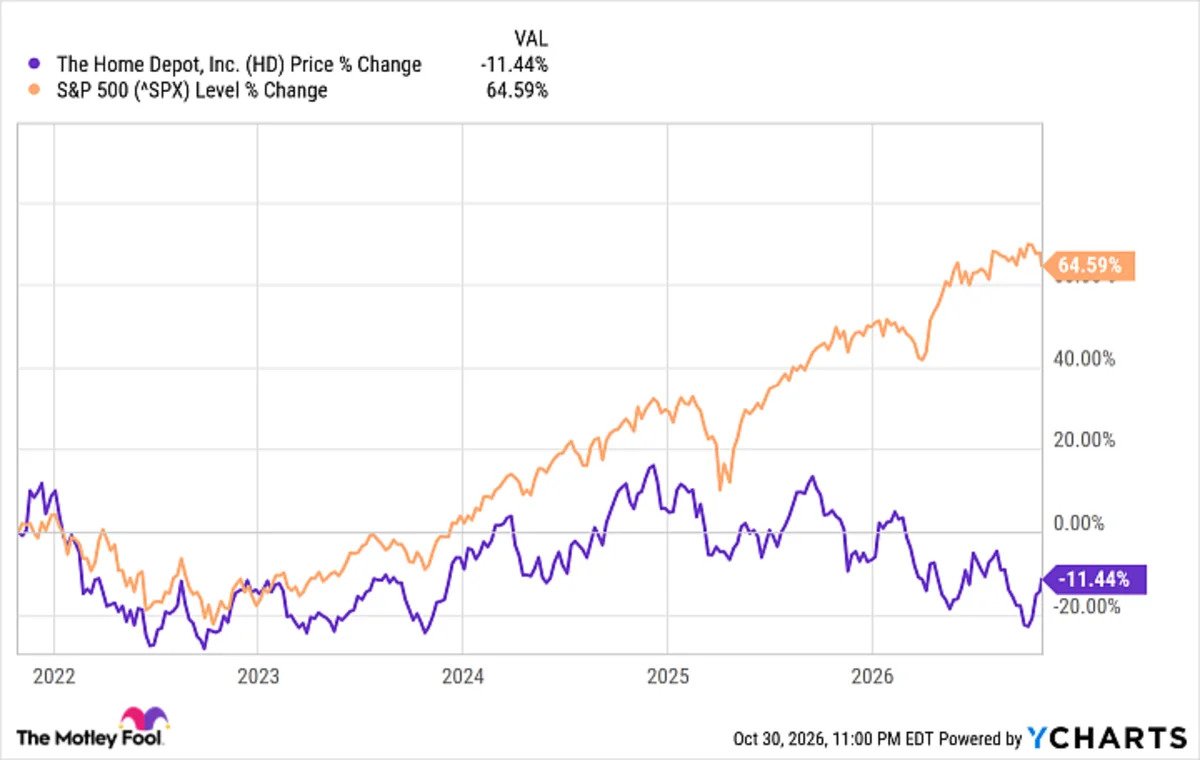
However, the stock has not been a winner in recent years. Like other stocks with exposure to the housing market, Home Depot has disappointed, as shares are actually down 11% over the last five years, badly underperforming the S&P 500 during that time, as you can see from the chart below.

Despite the results, I still think Home Depot is worth holding for the next decade. Here are four reasons why.
1. A strong set of competitive advantages
Along with rival Lowe’s, Home Depot is part of a duopoly in the home improvement retail segment.
The two companies have unmatched scale, reach, technology, and product range, which gives them significant market share in a fragmented industry.
Home Depot has differentiated itself from Lowe’s in some important ways as well. Compared to Lowe’s, the company is known for its focus on the professional contractor segment, and it now sees that as its primary growth opportunity. It acquired SRS Distribution, a building materials distribution company, to lean into the pro segment and grow that business.
The company has also invested heavily in omnichannel capabilities, making it easy for customers to order through its app for delivery or in-store pickup. It even offers digital project-planning apps to help consumers figure out what they need and get their projects done.
2. Its industry leadership position is solid
Unlike some other retail categories, Home Depot faces little risk from disruption. It’s not an easy category for a company like Amazon to gain market share in, as many of its SKUs are heavy and bulky, like lumber. Its stores also serve as distribution hubs, enabling easy pickup of e-commerce orders.
A pure-play e-commerce company wouldn’t be able to compete with it, and it’s hard to see another brick-and-mortar retailer expanding to match Home Depot and Lowe’s.