If there is one constant amid this AI-fueled, record-setting run for the stock market, it’s the debate over whether it’s all one big bubble.
“I don’t think it’s a mania. Taxi drivers are not talking to me about AI server orders or GPUs yet. It hasn’t happened yet. So we’re not in the full mania phase yet,” EMJ Capital founder and veteran tech investor Eric Jackson said on Yahoo Finance’s Opening Bid (video above).
“People are buckling in,” he added. “They are spending real dollars, unlike the dot-com period. And this thing [AI] is real. So there’s more to come.”
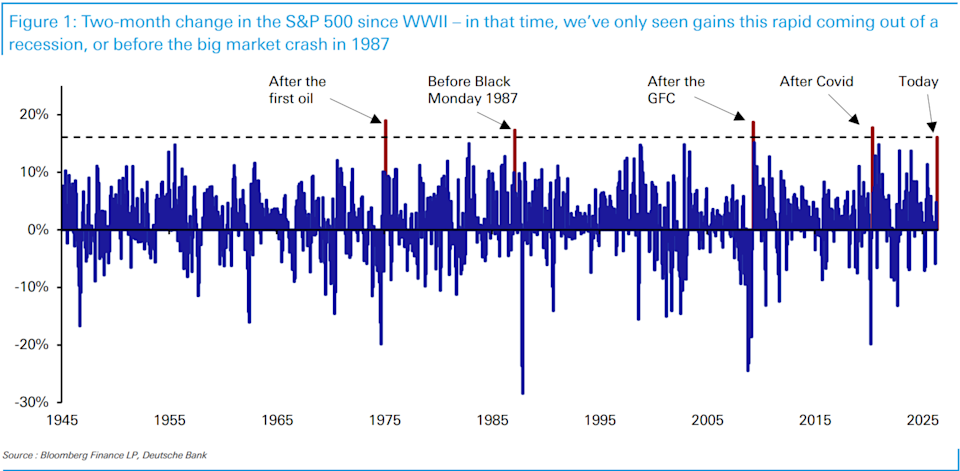
But others naturally disagree. Deutsche Bank strategist Jim Reid published the chart below, which I posted on my X account. It continues to attract a feverish number of replies as it draws attention to Black Monday.
Black Monday refers to Oct. 19, 1987, the single worst day in stock market history by percentage decline. The Dow Jones Industrial Average (^DJI) crashed a staggering 22.6% in a single trading session.
The sell-off was global, instantaneous, and devastating, wiping out hundreds of billions of dollars in market value as panic spread from Hong Kong to London to New York. It was fueled by a toxic combination of rising interest rates, trade deficit fears, overvalued markets, and the relatively new phenomenon of computerized program trading that accelerated the selling.
Along with the chart, Reid shared his thoughts on where the market stands today relative to prior steep pullbacks.
We wanted to publish Reid’s latest analysis (see below) in full so you have full context on this debate.
By no means are we saying there’s a stock market crash coming. The economy is growing strongly, and corporate earnings have remained impressive. Market-leading stocks such as Nvidia (NVDA) and Apple (AAPL) aren’t trading at insane historical valuations, at least based on Yahoo Finance AlphaSpace research.
What we are doing here is serving up a reminder that the market is nearing priced for perfection levels. With that, there are certain expectations that have to be met, or the market will adjust.
Reid said:
Despite the geopolitical turmoil, the S&P 500 was up +16% over April and May. That’s a genuinely historic pace, and since WWII we’ve only seen four other occasions where the two-month gain for the S&P has been that rapid.
There is one alarming stat. On 3 of those 4 occasions, it was a classic post-recession bounceback, when the economy was emerging from the first oil shock, the Great Financial Crisis, and Covid-19.
However, the other time it happened was in 1987, and like today that occurred without a recession. Over January and February that year, there was a big +17% rally, and the momentum continued until the summer. But then it came to a sudden halt, with the S&P down by a third in less than two months, including a single-day decline of -20.5% on Black Monday.
The precise causes of Black Monday are still debated, but several issues sound familiar. One was question marks about valuations, with the S&P 500already up +39% on a year to date basis by late-August. The Fed had been hiking rates in the leadup as well, and today we’ve also seen market pricing shift hawkishly. Moreover, there were wider fears circulating about the trade and budget deficits at the time, which seemed large by contemporary standards.
So since WWII, the only other time the S&P 500 has risen this rapidly (except after a recession) was months before a huge market crash. As Henry notes, clearly there are factors supporting the advance today, like AI excitement and strong data, but even so, the speed is still remarkable. It feels like the tails of the distribution are getting much bigger from here.
So will 1999 turn into 2000 or 1987? Or will the clock reset back to 1996 when Greenspan warned of irrational exuberance 4 years too early. It feels increasingly binary.