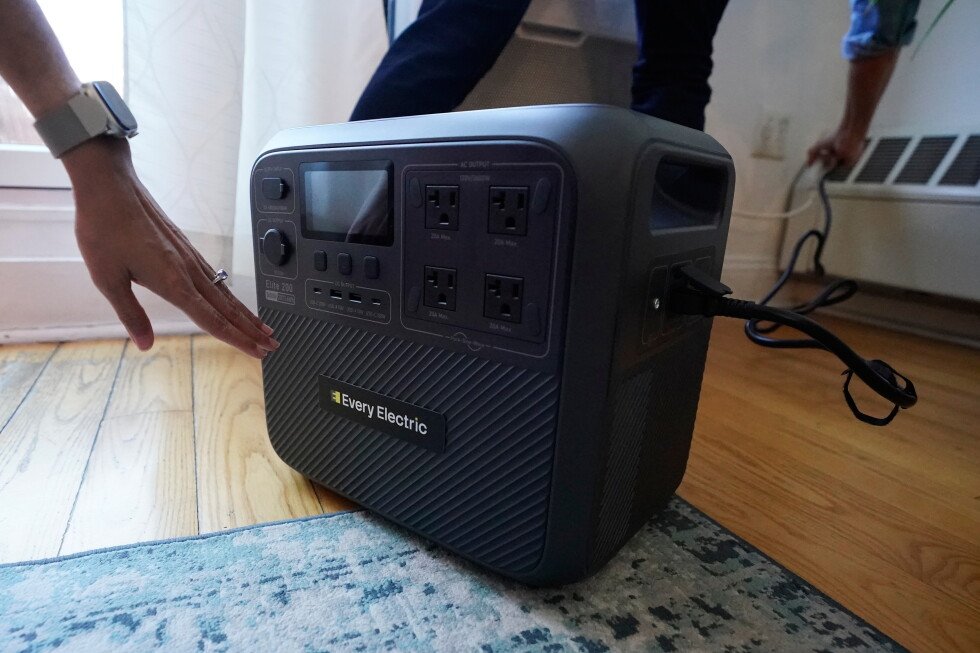
From portable battery banks and generators to whole-house systems, there are many backup power choices to consider as extreme weather ramps up and outages happen more often and last longer.
People need solutions to keep medical devices, cellphones and other important appliances powered up.
“If you’re deciding between different backup power options for what you need, different conditions are going to require different elements, like a heat wave versus a hurricane,” said Noah Kittner, associate professor at the University of North Carolina’s Gillings School of Global Public Health.
Experts offer tips for finding the right backup to keep your home running when electricity is out in your area during a storm, heat wave or other conditions.
From portable battery banks and generators to larger home systems, there are many backup power choices to consider as extreme weather ramps up and outages happen more often and last longer.
When battery banks work
If you just need to charge a few small items for short periods, portable battery banks might be the best bet.
Power banks that can recharge a phone a few times — and are often about the same size as one — typically cost less than $100. Many have built-in USB ports. Between uses, they can be recharged by plugging them into an electric outlet. Larger and more powerful ones can be a few hundred dollars and have traditional sockets for plugging in multiple items.
They’re extremely portable and typically work best for the basics: phones, computers, flashlights and small lights — but not for larger appliances such as dishwashers or air conditioning, experts say.
What a traditional, portable generator offers
Kaylin Johnson, whose home is one of the few that survived the Eaton Fire in her neighborhood in Altadena, Calif., walks past a generator running to provide power at her home Jan. 14, 2025. (AP Photo/Jae C. Hong, File)
Kaylin Johnson, whose home is one of the few that survived the Eaton Fire in her neighborhood in Altadena, Calif., walks past a generator running to provide power at her home Jan. 14, 2025. (AP Photo/Jae C. Hong, File)
Traditional, portable generators are fueled by diesel, propane or gasoline. They’re about the size of a microwave oven or a mini fridge, and are typically on wheels so they can be moved around. They must be used outdoors and away from your home because they emit carbon monoxide and other gases harmful to humans and the planet.
These options, depending on their wattage, can power larger items such as refrigerators and freezers, window air-conditioning units, fans and televisions, but they typically can’t power an entire house.
Conventional generators can run 6 to 12 hours at a time or longer, depending on what they’re powering and how much fuel is consumed.
Their prices can range from several hundred dollars to $1,000 or more, but keep in mind any maintenance and fluctuating fuel costs as well.
“The standard designs for fuel tank capacity are no longer sufficient to deal with multiday outages, which we’re increasingly seeing due to extreme weather,” said Mark Dyson, a managing director at energy nonprofit RMI. “That’s a really important consideration as folks think about the trade-offs between a traditional fuel-based backup, where increasingly you have to buy a lot of fuel storage to cover yourself for a really extended outage, which are becoming more common and more likely.”
When to consider a whole-house system
Whole-house systems may make sense in areas with frequent or long-lasting outages, or for people with life-saving medical devices that cannot experience a disruption. The systems are hard-wired to the home’s electrical system, often with a connection to natural gas or propane tanks.
When power goes out, these detect the outage and use an automatic transfer switch to shift the home from the grid to generator power.
These units can cost $5,000 to $20,000 or more, depending on the size of your home, the system and installation costs. If your home system is a medical necessity, check to see if it can qualify as tax-deductible, or if there are programs that can cover some of the expense. Installation typically requires days or weeks of lead time.
Integrated home battery systems that provide electricity on a similar scale by using rooftop solar or grid energy, instead of liquid fuel, could cost even more.
Solar power and other clean options to consider
Brayan Santos, left, and Theodore Tanczuk, right, of solar installer YellowLite, put solar panels on the roof of a home in Lakewood, Ohio, April 16, 2025. (AP Photo/Sue Ogrocki, File)
Brayan Santos, left, and Theodore Tanczuk, right, of solar installer YellowLite, put solar panels on the roof of a home in Lakewood, Ohio, April 16, 2025. (AP Photo/Sue Ogrocki, File)
Portable power stations that operate without fossil fuels are becoming more popular. They use small solar panels or wall outlets to store energy for when it’s needed. Consumers can find smaller, less expensive options about the size of a lunchbox for a few hundred dollars, or heavy-duty options the size of a suitcase for $3,500 or more.
They can power computers, modems, televisions, fans, freezers and other medium-sized devices.
“Our solutions now rival that of traditional gas generators,” said Rachel Stotts, communications head at Jackery, which sells power stations. “Maybe a decade ago, it was a camping solution, it was portable power on the go that you stuck in your car and you could run all your basic equipment … But now you could run 99.9% of anything you want in your house — and need.”
Other power station manufacturers include EcoFlow and Anker.
The next step up: People who have rooftop solar can pair it with large battery systems that store power from the sun for later use.
“Having solar electricity that’s coupled with the battery system is quite unique, especially in an extended outage, because you have the capability to replenish your battery over time as the days go by,” Kittner said.
Installation of a solar-and-battery system could cost at least $20,000, but the added costs can be offset by other benefits in the long run, experts say.
“I would look beyond just the up-front cost of providing power during those outages,” Kittner added, “but also other benefits you might get year-round from having a battery even when electricity is in service.”
During outages, people with electric vehicles can also use the batteries in their cars for power, though the EV has to be equipped to do so. It works by essentially feeding the power stored in the EV battery to the home, during an outage or even during times of peak demand on the grid.
___
Alexa St. John is an Associated Press climate reporter. Follow her on X: @alexa_stjohn. Reach her at [email protected].
___
Read more of AP’s climate coverage.
___
The Associated Press’ climate and environmental coverage receives financial support from multiple private foundations. AP is solely responsible for all content. Find AP’s standards for working with philanthropies, a list of supporters and funded coverage areas at AP.org.