The S&P 500 (^GSPC -0.33%) is hovering near a record high, but the large-cap index’s lofty valuation could limit its upside potential from here. It currently has a Shiller Cyclically Adjusted Price-to-Earnings (CAPE) ratio of 41.8. That makes this the second-most-expensive market in history, behind only the peak of the dot-com bubble in 1999 and 2000.
A number of catalysts could derail this euphoric bull market, including the conflicts in the Middle East, high inflation, Federal Reserve interest rate hikes, and the midterm Congressional elections in November. Therefore, this might be a good time for investors to take some money off the table.
Stocks with high valuations tend to be the most vulnerable to sharp corrections when there is turmoil in the broader market, because investors start to question whether the underlying companies can grow as quickly as optimists had previously hoped they would. I’ve identified two stocks trading at sky-high valuations that might be worth selling if the S&P 500 starts to head lower.

Image source: Getty Images.
The first stock to sell: SpaceX
Space Exploration Technologies (SPCX +1.55%) was founded by Elon Musk in 2002, with an initial goal to reduce the costs of launching payloads into space. It continues to make significant progress on that front, and it has also built highly lucrative satellite internet connectivity and artificial intelligence (AI) infrastructure businesses.
SpaceX uses its Falcon 9 and Falcon Heavy reusable rockets to blast around 2,500 tons of payloads into orbit each year on behalf of businesses and government agencies. The company’s new Starship rocket, which has a significantly greater capacity than the Falcon series, is expected to enter commercial service next year.
SpaceX has also used its rockets to launch more than 10,000 of its own Starlink satellites into orbit, where they currently provide internet access to 12 million paying customers here on Earth. This business accounts for most of the company’s revenue right now, and management estimates that satellite connectivity could be a $1.6 trillion addressable market.

Today’s Change
Current Price
However, SpaceX’s most valuable opportunity might be in AI, where management has identified $26.5 trillion worth of opportunities across infrastructure, consumer subscriptions, and enterprise applications. This is currently the company’s fastest-growing business, and it could overtake the satellite connectivity segment in terms of revenue by the end of 2026.
In fact, Chief Financial Officer Bret Johnsen thinks the AI business could achieve an annual revenue run rate of $100 billion by the end of the year as AI developers like Anthropic, Alphabet, and Reflection AI line up to rent computing capacity from SpaceX’s state-of-the-art data centers.
But here’s the rub for investors. SpaceX generated $23 billion in total revenue over the last four quarters, and based on its market capitalization of $1.92 trillion (as of the market close on Friday, Aug. 28), its stock has a price-to-sales (P/S) ratio of 83. It’s a whopping 13 times as expensive as the Nasdaq-100 technology index, which has a P/S ratio of just 6.2.
Even if we assume SpaceX’s total revenue will grow to $105 billion in 2027 like Wall Street expects (according to Yahoo! Finance), its forward P/S ratio is still 18. Therefore, although SpaceX stock is already down 37% from its recent peak, its elevated valuation leaves room for more downside.
The second stock to sell: Datadog
Businesses use Datadog‘s (DDOG +0.03%) cloud observability platform to monitor their digital infrastructure around the clock, because it can immediately warn them if a technical glitch is impacting their sales channels or operational software. This allows them to implement fixes before customers are affected, minimizing downtime and lost sales.
But over the past couple of years, Datadog has launched a series of observability products specifically for the AI industry. There is LLM Observability, which helps developers identify technical issues, track costs, and monitor output quality when they are building large language models (LLMs). There is also GPU Monitoring, which helps businesses track costs and technical bugs when deploying AI infrastructure.
Datadog had 33,400 customers at the conclusion of the second quarter, and 750 of them were AI-native enterprises. “All 10 of the top 10 AI leaders are Datadog customers,” said the company on its Q2 earnings call. So, although Datadog did not specifically name them, it’s reasonable to assume the likes of Anthropic and OpenAI are among its clients.

Today’s Change
Current Price
Datadog recently increased its annual revenue guidance for 2026 to between $4.45 billion and $4.47 billion, but that might be a conservative range because of how rapidly the use of its AI products is growing. For example, the company said Model Context Protocol (MCP) server calls quadrupled during the second quarter compared to the first quarter, which means there was substantially more AI activity happening in the Datadog ecosystem.
But Datadog’s valuation might be a problem for investors who are looking for big returns. Its stock is trading at a P/S ratio of 21.8, so it’s far more expensive than the Nasdaq-100. It also makes Datadog pricey compared to many other companies in the AI software space, including industry leaders like Microsoft and Alphabet.
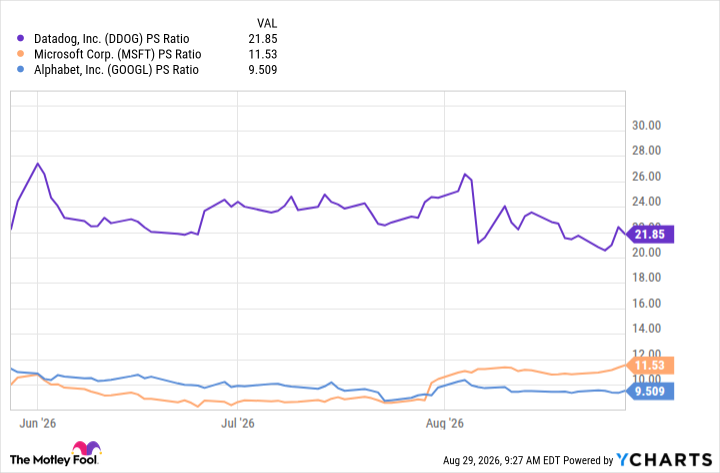
DDOG PS Ratio data by YCharts.
As a result, I think Datadog stock could be vulnerable to a sharp correction if the broader market runs into turbulence.