Amazon (AMZN 0.51%), the world’s largest e-commerce and cloud infrastructure company, reached an all-time high of $263.99 per share on April 24, 2026. It’s pulled back below $260 as of this writing, but it’s still up nearly 40% over the past 12 months.
Could that rally mark the start of a much bigger move for Amazon? Let’s review its biggest catalysts to see if it’s a once-in-a-decade buying opportunity for patient investors.

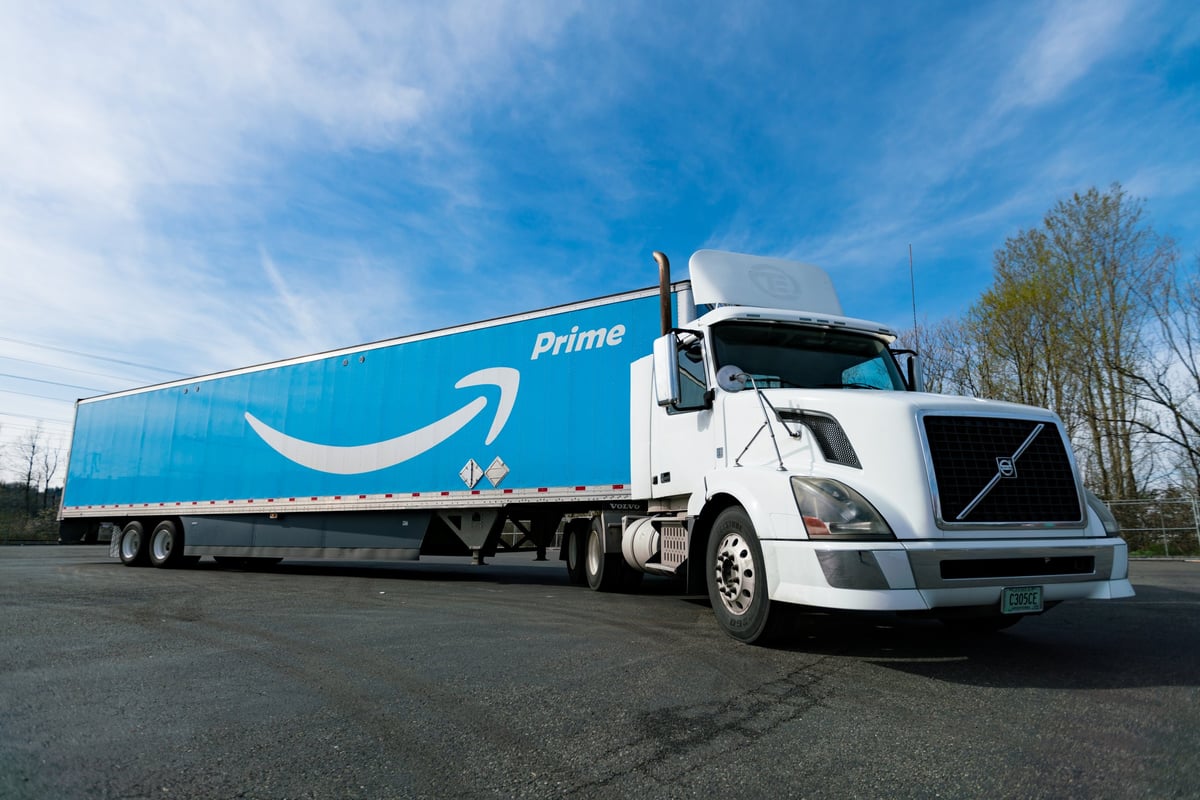
Image source: Amazon.
Why did Amazon’s stock soar?
Amazon generates most of its revenue from its e-commerce business, but it relies on Amazon Web Services (AWS) for most of its profits. AWS is the world’s largest cloud infrastructure platform, and the segment’s higher-margin revenue enables Amazon to expand its Prime ecosystem through low-margin or loss-leading strategies. It’s also been expanding its smaller integrated advertising business as a secondary, high-margin profit engine alongside AWS.

Today’s Change
Current Price
In 2022, Amazon suffered a slowdown as inflation throttled consumer spending and rising interest rates drove companies to rein in their cloud spending. But over the following three years, its revenue rose again by double digits as its operating margins expanded.
|
Metric |
2022 |
2023 |
2024 |
2025 |
|---|---|---|---|---|
|
Net Sales Growth |
9% |
12% |
11% |
12% |
|
Operating Margin |
2.4% |
6.4% |
10.8% |
11.2% |
Data source: Amazon.
Amazon’s retail business recovered as it upgraded its logistics capabilities, expanded more aggressively overseas, and faced milder macro headwinds. AWS also grew as the generative AI boom drove more companies to upgrade their cloud infrastructure.
Amazon’s expansion of Bedrock (a platform that allows companies to remotely access multiple AI models), its agentic AI tools, its custom AI chips, and the deployment of its own AI tools across its e-commerce ecosystem also made it a hot AI stock again. Instead of trying to win the AI war, it’s hosting all of the winners — including OpenAI and Anthropic.
Amazon plans to increase its capex from $131.8 billion in 2025 to $200 billion in 2026 to expand its own cloud and AI infrastructure. Those spending plans initially sank its stock earlier this year. Still, the rapid growth of its AI-driven businesses, the automation of its own services, and other cost-cutting initiatives (including thousands of layoffs) should cushion that blow.
Where could Amazon’s stock be in ten years?
From 2025 to 2028, analysts expect Amazon’s revenue and EPS to grow at CAGRs of 13% and 19%, respectively. That growth should be driven by AWS’s AI-driven reaccleration, with its demand shifting from cloud migration to AI infrastructure consumption; the expansion of its higher-margin advertising business, and the automation of its logistics network. Its growing constellation of internet satellites could also evolve into a new high-growth business.
Amazon’s e-commerce business will still face competition from cheaper marketplaces like PDD‘s Temu, while Microsoft‘s Azure will remain a formidable rival for AWS. However, Amazon can leverage its scale to reduce its prices, acquire more companies, and pull other levers to widen its moat against those challengers.
From 2026 to 2033, Grand View Research expects the global e-commerce market to grow at a 21.6% CAGR as the global AI market expands at a 30.6% CAGR. If Amazon stays at the top of these booming markets, it could evolve into an even larger company.
If Amazon matches analysts’ estimates through 2028, grows its EPS at a 15% CAGR through 2036, and trades at a reasonable 25 times its current year’s earnings by the final year, its stock price could surge more than 250% over the next decade. That wouldn’t be as impressive as its 756% gain over the past ten years, but it would still likely beat the S&P 500. So while Amazon might not be a screaming once-in-a-decade buying opportunity at these levels, it’s still a reliable long-term play on the growth of the e-commerce, cloud, AI, and digital advertising markets.