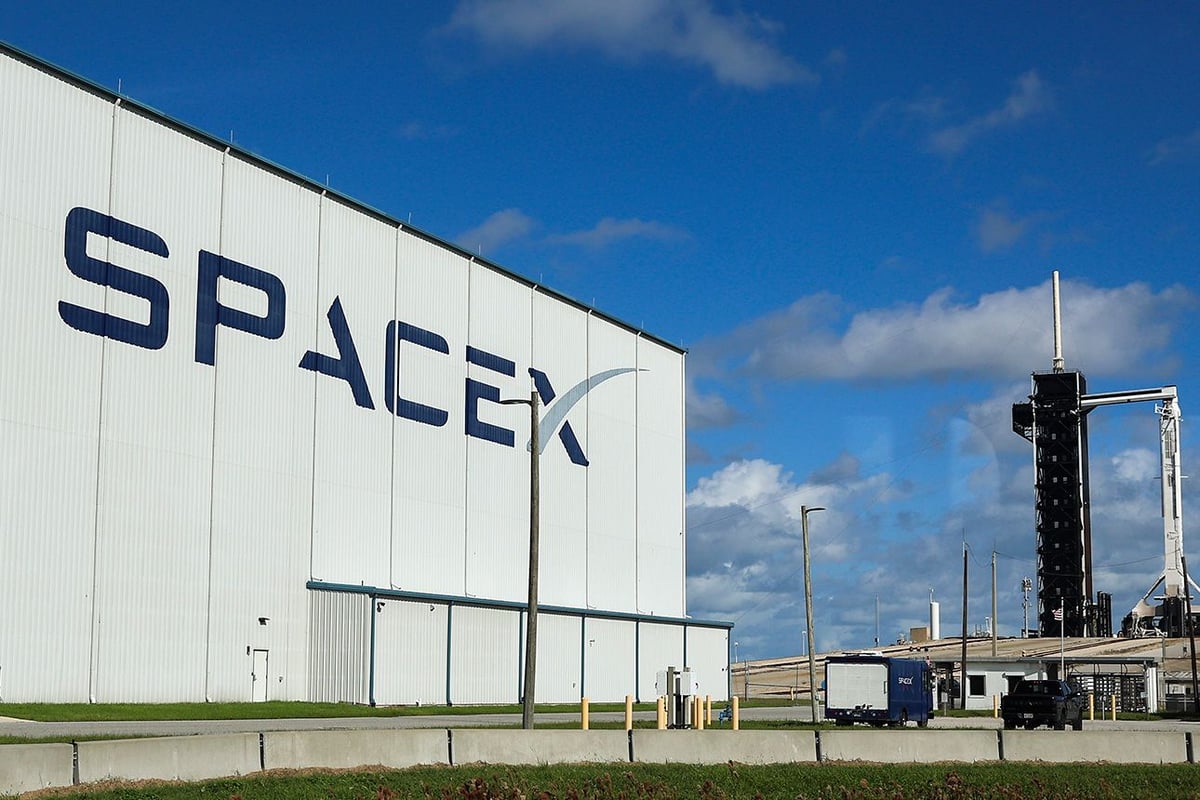
Space Exploration Technologies (SPCX -0.59%) has grand ambitions: revolutionizing space travel, making space tourism commonplace, building a human colony on Mars, among others. The rocket company has taken incremental steps toward these goals since it became a publicly traded corporation in June, but its stock has been volatile. It has actually declined from its opening-day closing price.
That said, we are still in the early innings of SpaceX’s life as a publicly traded company, and if it can get close to achieving its goals in the next decade, it could deliver above-average returns along the way. Should investors get in now and consider holding SpaceX’s shares through 2036?

Image source: Getty Images.
Massive opportunities ahead
SpaceX’s financial results have been pretty strong this year. Through the first nine months of the year, the company’s revenue increased 97.5% year over year to $27.1 billion. It also turned an operating loss of $1.2 billion in the first nine months of 2025 into an operating income of $705 million this time around.
And its net loss per share shrank to $0.15, compared with $0.89 per share in the year-ago period. SpaceX’s Connectivity and Super Intelligence segments (SI, which offers various artificial intelligence-related services) were profitable in the third quarter, although the space business remains unprofitable.
The rocket company identified a large $26.5 trillion AI opportunity, and according to management, SpaceX could generate $1 trillion in revenue by 2030, most of which would likely come from its SI business. Suppose we require a 12% rate of return. From SpaceX’s current market cap of $1.9 trillion, the stock would have to be worth $2.99 trillion by 2030 for its current valuation to make sense.
Now, assuming management’s 2030 revenue guidance is correct, SpaceX would need to trade at about 3x sales by then to deliver the required annual rate of return. If SpaceX can pull that off while making progress across several areas that will help it unlock even more opportunities, the stock could realistically offer outstanding returns through the next five to 10 years.
Consider some of the company’s plans. SpaceX thinks it can bring 10 gigawatts of compute online in 2027. Combined with its existing capacity, this could make it one of the world’s leaders in this category, potentially enabling it to meet soaring demand for its services. As management has pointed out, SpaceX could rent out several times its current capacity if it accepted every request.
The SI business is growing rapidly, and as of the third quarter, it accounted for more than half of the company’s total revenue. If that momentum continues unabated, SpaceX’s 2030 guidance isn’t out of the question. And that’s before we mention the company’s opportunities in connectivity, including its goal to challenge the major existing mobile carriers.
SPCX Space Exploration Technologies
$139.11-$0.83 (-0.59%)
NASDAQ · As of 4:00 PM ET 11/13/26
Is the price right?
However, we have to pump the brakes and consider the risk and uncertainty SpaceX faces. For one, the $1 trillion revenue target is by no means certain. While Musk is confident, the CEO has often set long-term targets that his other company, Tesla (TSLA -1.82%), failed to achieve.
That doesn’t mean the same thing will happen with SpaceX, but we certainly can’t take Musk’s word at face value. Some analysts have projected much lower revenue estimates for SpaceX for 2030, including a $474 billion estimate. That single change in our assumption would change the result — by a lot.
There are many reasons why SpaceX’s revenue might not grow as fast through 2030 as management expects. One is that the AI industry‘s growth could slow considerably. Right now, corporations are pouring small fortunes into AI infrastructure. That may not hold up over the medium term.
Another possible headwind may come from lawmakers. During the recent U.S. midterm elections, many voters sent a clear message: They want a slowdown of AI data center expansion, and they elected officials who promised to deliver.
Given these recent developments, it’s somewhat doubtful whether SpaceX can bring as much capacity online in 2027 as it hopes. There are other potential issues. SpaceX could encounter headwinds in developing its next-gen rocket, Starship. Meanwhile, the stock’s current price-to-sales is a whopping 56.5 — that may be the biggest problem.
SpaceX is a great business, in my view, but it isn’t trading at attractive levels right now. I expect it to remain a leader across space launch and satellite-based connectivity over the long run, while also establishing itself in the AI industry. But it’s not clear that it can beat the market over the next 10 years from current levels, which is why I’d rather stay away for now.
Where to invest $1,000 right now
When our analyst team has a stock tip, it can pay to listen. After all, Stock Advisor’s total average return is 823%* — a market-crushing outperformance compared to 209% for the S&P 500.
They just revealed what they believe are the 10 best stocks for investors to buy right now, available when you join Stock Advisor.
*Stock Advisor returns as of November 15, 2026.