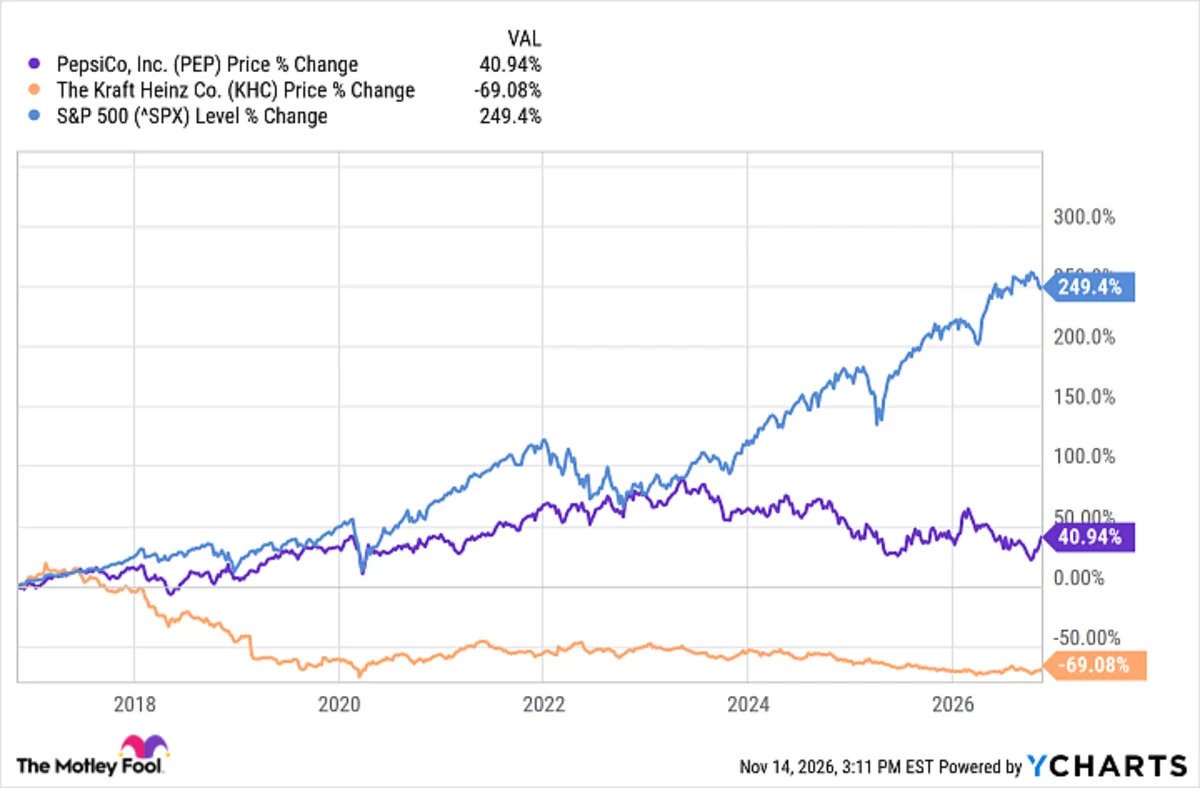
As consumer habits shift toward value and health, established giants Kraft Heinz (NYSE:KHC) and PepsiCo (NASDAQ:PEP) are competing for both kitchen pantry dominance and a spot in your long-term portfolio.
Kraft Heinz focuses primarily on meal essentials and condiments, while PepsiCo balances a diverse empire of beverages and snacks. Investors often compare them to determine which company offers a better mix of defensive stability and valuation.
The case for Kraft Heinz
Kraft Heinz operates a diverse portfolio of brands among consumer staples stocks, focusing on condiments, cheese, and prepared meals. Its products reach consumers through retail and foodservice channels in approximately 40 countries. Walmart (NASDAQ:WMT) accounted for roughly 21% of net sales in 2025, and customer concentration like this adds a layer of risk to the business.
In the 12 months ended Sept. 26, 2026, revenue reached nearly $24.8 billion. This represented a decrease of approximately 1.5% compared to the prior period, continuing a recent downward trend in total sales. The company reported a net loss of close to $3.5 billion, resulting in a negative net margin of roughly 14%.
As of its December 2025 balance sheet, the debt-to-equity ratio is approximately 0.5. This ratio compares total debt to shareholder equity to measure financial leverage. The current ratio, which measures the ability to pay short-term debts with short-term assets, is roughly 1.2. In the fiscal year ended Dec. 27, 2025, free cash flow was nearly $3.7 billion.
The case for PepsiCo
PepsiCo manages a vast portfolio of snacks and drinks across 200 countries and territories. Its largest customer is Walmart and its affiliates, which represented nearly 14% of consolidated net revenue in 2025. Customer concentration like this adds a layer of risk to the business, though the company maintains a strong global distribution network.
In the 12 months ended Sept. 5, 2026, revenue reached nearly $98.2 billion. This reflects revenue growth of approximately 6.4% over the preceding 12 months, following a period of steady annual increases. The company reported net income of roughly $10.9 billion, resulting in a net margin of approximately 11.1%.
As of Pepsi’s December 2025 balance sheet, the debt-to-equity ratio is roughly 2.4. The current ratio is approximately 0.9, suggesting short-term liabilities slightly exceed short-term assets. In the fiscal year ended Dec. 27, 2025, free cash flow was nearly $7.7 billion.
Risk profile comparison
Kraft Heinz faces intense competition from both national brands and private label alternatives. Fluctuations in commodity prices and energy costs often impact its bottom line despite active hedging strategies. The company also navigates regulatory risks, including litigation over its “ultra-processed” labels, and uncertainty following the pause of its proposed spin-off in early 2026.