The unemployment rate has fallen to 4.4 per cent in May, down from 4.5 per cent in April, according to the Australian Bureau of Statistics.
Meanwhile, the ASX is trading lower on falls across mining, energy and banking, with business lender Judo crashing after a trading update.
Follow the day’s financial news and insights from our specialist business reporters on our live blog.
Disclaimer: this blog is not intended as investment advice.
Thu 25 Jun 2026 at 4:25pm
Market snapshot
- ASX 200: -0.7% to 8,748 points (live values below)
- Australian dollar: -0.1% to 68.92 US cents
- Asia: Nikkei +4.6%, Hang Seng -1.6%, Shanghai +1.4%, Kospi +6.7%
- Wall Street: S&P 500 -0.1%, Dow +0.4%, Nasdaq -0.4%
- Europe: Dax -0.6%, FTSE +0.3%, Eurostoxx -0.3%
- Spot gold: -0.4% to $US3,983/ounce
- Oil: Brent -1.7% to $US72.48/barrel, WTI -1.4% to $69.39/barrel
- Iron ore: +2.0% to $US100.56/tonne
- Copper (LME): -2.0% to $US13,373/tonne
- Bitcoin: +1.1% at $US61,564
Prices current at around 4:15pm AEST
Live updates on the major ASX indices:
Thu 25 Jun 2026 at 4:19pm
Labor’s signature budget measures pass federal parliament
Labor’s signature budget legislation has just passed federal parliament, paving the way for changes to capital gains tax and negative gearing.
It will replace the 50 per cent capital gains tax discount with a discount based on inflation and apply a minimum 30 per cent minimum tax on gains. It will apply on and after July 1, 2027.
Labor’s legislation also limits negative gearing to new property builds but doesn’t affect people who used the concession before budget night.
The measures also include a $250 Working Australians Tax Offset (WATO) and a $1,000 standard deduction for work-related expenses for individuals.
Labor cut a deal with the Greens on Tuesday to get the bill through the Senate. As part of the deal, self-managed super funds will be prevented from borrowing to purchase housing.
Applause erupted in the chamber after the passage of the bill, which has now become law.
Thu 25 Jun 2026 at 3:56pm
Then there’s the next RBA move is down school of thought …
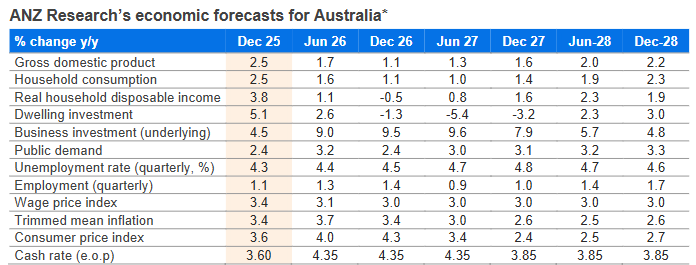
I know we said we’d limit our view to RBA hikes vs pausing, but in the spirit of the earlier gag, unsurprisingly, we’ve got another economist with another view. Admittedly, ANZ’s Adam Boyton’s forecast for a cut is way off into Q4 2027, but it is in his spreadsheet.
Here’s how he and the ANZ team see things unfolding.
The Australian economy will slow over 2026 and into 2027 under the combined influence of higher interest rates, a housing market slowdown and uncertainty associated with the Middle East conflict.
The slowdown in growth that we expect over 2026 and into 2027 should give the RBA comfort that inflation will ultimately ease back toward target.
The most recent monthly inflation data point to Q2 2026 trimmed mean inflation at 3.7% y/y, a little below the RBA’s May forecast of 3.8% y/y. That and the softening in consumer spending over recent months and the drift higher in the unemployment rate are giving us more comfort that the current 4.35% will mark the peak in the cash rate.
Inflation remains a risk though, and further tightening in monetary policy is possible if price pressures prove more persistent than expected.
The more likely outcome is that the soft outlook for demand, pressure on businesses’ margins and a resolution to the Middle East conflict will keep the RBA on hold in 2026 before a very modest easing cycle over the second half of 2027.
Thu 25 Jun 2026 at 3:29pm
Take 2: What does the data tell us about the RBA’s next move
The old gag goes along the lines of “ask five economists and you’ll get five different answers — six if one went to Harvard.”
We’ll spare you the confusion by getting a Harvard wonk on the blog, but it’s fair to say this week’s release of the key inflation and jobs data hasn’t inspired a wave of group-think among market economists on the next move from the RBA on interest rates.
Also, we’ll limit the post to just two economists:
A case for raising rates: George Tharenou, UBS
Underlying inflation pressure continues to build, with trimmed mean CPI still picking up further to a cycle high of 3.6% y/y, and is tracking closer to the RBA’s forecast.
Put simply, inflation remains too high, especially after the RBA already missed its inflation target for ~5 years.
Meanwhile, the labour market is easing somewhat but remains relatively tight.
Looking ahead, the key downside risk to our view is dwelling prices fall more sharply than expected.
However, the housing market correction so far is still only relatively small, and based on the RBA’s historical reaction function, it should not ‘stop out’ the RBA from still hiking rates by 25bps in Aug-26.
The case for holding: Michael Hayes, NAB
Today’s labour market data came in as expected.
The trend unemployment rate rose to 4.4% and trend employment growth remained relatively flat at 20k, a level marginally below what is required to keep the unemployment rate stable.
The RBA’s May SoMP forecast the unemployment rate would average 4.2% in Q2 and 4.3% in Q4.
Even after today’s data, unemployment is tracking above that forecast, which plays to the view the RBA will not be pushed by the data to tighten further.
Thu 25 Jun 2026 at 3:14pm
Sydney and Melbourne tipped to lead housing price drops as market cools
Domain forecasts house prices could drop up to 7% in Sydney and up to 8% in Melbourne over the next year, as interest rate hikes and tax policy changes impact the market.
A separate report from Cotality showed the median gain from home resales hitting a record in the first quarter of the year, as sellers benefited from years of price rises.
Domain expects unit prices to outperform houses in the coming financial year, as first-home buyers look for affordable options.
My colleagues business reporter Stephanie Chalmers and business editor Michael Janda have more.
Thu 25 Jun 2026 at 2:59pm
ABC Business Daily podcast: The data deluge, Karl Stefanovic and the whole damn thing
It’s been a big week for economic data — with fresh jobs numbers in from the ABS, showing that employment increased in May.
But how do these numbers relate to the bigger economic picture in light of yesterday’s CPI data and the RBA’s July decision?
And talking of unemployment, or perhaps more correctly, underemployment, Karl Stefanovic’s expected departure from Channel Nine may spark a media shake-up/shake down.
Meanwhile, APRA has issued an AI warning to Australia’s financial institutions. What’s behind the regulator’s message to ‘fight fire with fire?’
It’s a deep morass to wade through, but Carrington Clarke and Alicia Barry are up for it on the ABC’s Business Daily podcast.
Check it out here:
Thu 25 Jun 2026 at 2:28pm
Precious metals lose their lustre as US rate hikes loom
Gold and its cohort of precious metals are under pressure as the US dollar continues to rise on expectations of Federal Reserve interest rate hikes this year.
- Gold: -0.2% to $US3,991/ounce
- Silver: -1.4% to $US56.61/ounce
- Platinum: -1.1% to $US1,560.60/ounce
- Palladium: -0.1% to $US1,165.63/ounce
Bullion’s tumble below $4,000/ounce marks an almost 30% decline from the peak of $US5,595/ounce in late January.
Silver and platinum are now hovering a their lowest price since November, while palladium is at a nine-month low.
More from Reuters:
Traders expect three Fed rate hikes this year and are pricing in an about 67% chance of a September increase, according to the CME FedWatch Tool
Bullion-backed exchange-traded funds could face renewed outflows if expectations rise for rate hikes, analysts say.
While gold is traditionally seen as an inflation hedge, it loses its appeal as a non-yielding asset in a high-interest-rate environment.
“Gold is simply in a bearish momentum trade at this point amid a strong US dollar environment,” StoneX analyst Matt Simpson said.
Thu 25 Jun 2026 at 1:41pm
Asian markets jump on AI rebound
While the ASX is weighed down by its miners and banks, further north, Asian markets have surged on another wave of AI buying thanks to a stellar result from chip maker Micron.
At 1:30pm AEST:
- Nikkei (Japan): +3.9%
- Kospi (South Korea): +6.1%
- Shanghai composite (China): +0.8%
- Hang Seng (Hong Kong): -1.2%
Both Japanese and Korean markets have a strong representation in AI related stocks linked to the US based Micron.
Micron, a key supplier for Nvidia AI processors alongside South Korean chipmakers, forecast quarterly profit and revenue well above expectations and said customers had committed $US22 billion to secure memory chip supply, sending its shares surging 12% on Wall St in after-hours trade.
Shares in Korea’s SK Hynix, also a supplier to Nvidia, rose as much as 11.1% in early morning trade. Samsung Electronics is up 6.2%.
Together, Samsung Electronics and SK Hynix account for around 55% of the Kospi’s market capitalisation. At $US1.5 trillion, Samsung is now more valuable than Meta and Tesla.
“The Nikkei’s sharp gain is simply due to Micron’s earnings,” GCI Asset Management senior portfolio manager Takamasa Ikeda told Reuters
“The U.S. semiconductor index, which is highly correlated with the Nikkei, will probably rise later in the day.”
Japanese chip-testing equipment maker Advantest jumped 11.8% and chip-making equipment maker Tokyo Electron was up 7.9%.
While, Japan and South Korea are roaring ahead, trading in China is more subdued, while Hong Kong’s Hang Seng is down more than 1%
Thu 25 Jun 2026 at 1:20pm
Economy and employment both slow down but inflation remains high, economists say
As we have reported earlier, Australia’s unemployment rate slipped to 4.4% in May, down from 4.5% in April.
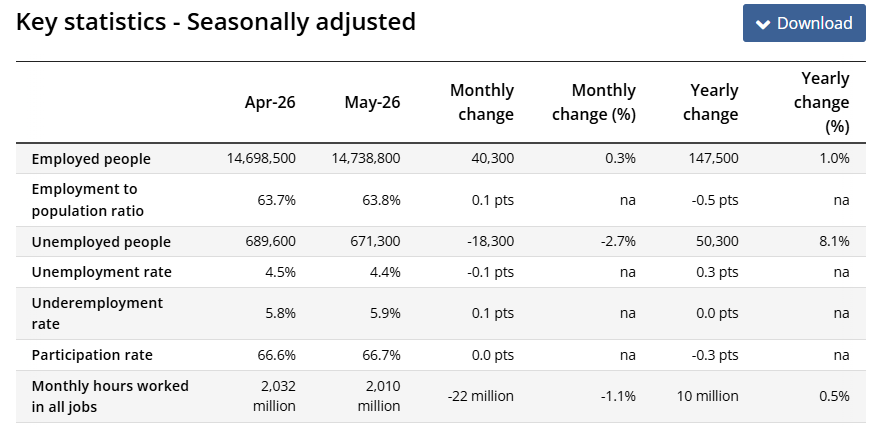
Data show 40,300 extra people gained employment in May, and the number of unemployed people declined by 18,300.
But in trend terms, which smooths out seasonal volatility, the unemployment rate lifted slightly to 4.4%, up from 4.3%, its highest level in trend terms since the lockdown period ended in 2022.
BetaShares chief economist David Bassanese said the gradual employment slowdown was underway.
Read more on the reporting by my colleague Gareth Hutchens.
Thu 25 Jun 2026 at 1:05pm
Australian household spending up 1.3pc with strong rises in discretionary expense
Household spending rose 1.3 per cent in May 2026, following a fall of 1.1% in April and a rise of 1.7% in March, according to the Australian Bureau of Statistics (ABS).
Tom Lay, ABS head of business statistics, said the rise in household spending largely reversed the April decline, reflecting a lift across all nine spending categories.
Transport spending rose by 1.4% in May after falling by 4.7% in April, ABS says, adding this was mostly due to travel-related refunds returning to normal after being significantly elevated in April due to flight cancellations associated with the Middle East conflict.
There were strong rises in household spending across discretionary categories, including hotels, cafes and restaurants (up 1.9%) and Clothing and footwear (up 2.7%), the ABS data showed.
“The rise in spending at Hotels, cafes and restaurants was driven primarily by catering services, including restaurant meals, takeaway and dining out,” Mr Lay said.
“Demand was also likely supported by sporting and cultural events across Australia, alongside higher catering and hospitality prices.”
Clothing and footwear spending also rose in May following an April fall, driven by discounting across mid-season clearance, stocktake, and early end-of-financial-year sales events offered by retailers, ABS said.
A 1.1% rise in food spending also contributed to the May result, reversing an April fall due to higher grocery prices, it added.
Thu 25 Jun 2026 at 1:01pm
Market snapshot
- ASX 200: -0.4% to 8,774 points (live values below)
- Australian dollar: -0.1% to 68.91 US cents
- Wall Street: S&P 500 (-0.1%), Dow (+0.4%), Nasdaq (-0.4%)
- Europe: Dax (-0.6%), FTSE (+0.3%)
- Spot gold: -0.5% to $US3,980/ounce
- Oil: -5% to $US70.96/barrel
- Iron ore: +2% to $US100.56/tonne
- Bitcoin: -0.3% at $US60,712
Prices current at around 1pm AEST
Live updates on the major ASX indices:
Thu 25 Jun 2026 at 12:52pm
Gold futures drop below $US4,000: CBA
Gold futures have dropped below $US4,000/ounce on the back of a stronger US dollar, according to Vivek Dhar, CBA’s lead mining and energy commodities strategist.
“A stronger US dollar is typically inversely related to gold futures as a strong US dollar increases the cost of gold for consumers outside the US,” Mr Dhar said.
“The recent US dollar strength is primarily tied to safe‑haven demand due to the AI‑led selloff in US equity markets and a hawkish re‑pricing of the Fed Funds rate.
“The US equity market selloff has separately contributed to lower gold futures too — consistent with the initial stages of an equity market selloff where gold is sold for liquidity to cover margin calls.”
Meanwhile, gold futures are no longer handicapped by higher energy prices that have stoked fears of stronger inflation and consequently higher interest rates in recent weeks, Mr Dhar says.
“Higher interest rates (and yields) typically reduce the appeal of gold relative to US‑interest bearing assets.
“But the sharp selloff in oil and refined product has yet to translate through to any near‑term reduction in Fed Fund rate expectations.
“For example, market pricing for the Fed Funds rate for December 2026 has moved lower by only about 3bp since the Memorandum of Understanding was signed between the US and Iran on 17 June.
“Comparatively, Brent oil futures have dropped about 7% in the same time frame.”
Mr Dhar adds that gold futures may now only rise to $US4,500/ounce by Q4 2026 under certain circumstances.
“Our view that the Fed needs to raise the Fed Funds rate by 75 bps from December, which the market is under‑pricing, suggests further headwinds to gold futures.
“All in all, the case for materially higher gold prices by year‑end has now weakened considerably — especially with our views that energy prices have limited downside risks from current levels and Fed independence concerns have materially reduced.”
Thu 25 Jun 2026 at 12:40pm
Stronger-than-expected labour data builds case for another rate hike: KPMG
Today’s figure actually adds to the case for another rate rise and sooner rather than later, according to KPMG chief economist Brendan Rynne.
Dr Rynne says it’s this strong labour market that’s continuing to underpin aggregate demand and fuel core inflation.
“The monthly response was much stronger than anticipated in terms of jobs being generated in the economy, but the vast majority are part-time, not full time,” he added.
Thu 25 Jun 2026 at 12:30pm
Insolvencies hit a two-year low in May, but payment defaults spiked
Credit reporting agency CreditorWatch says despite insolvencies hitting a two-year low in May, businesses across the economy are facing a tougher operating environment.
ASIC reported 1051 first-time insolvencies in May, the lowest figure since 2024.
However, the May Business Risk Index reports a number of factors squeezing operators, including fuel, interest rates, landfill levies, compliance costs and construction exposure.
Two key indicators for potential insolvency are payment defaults and ATO tax defaults — which have both been rising.
CreditWatch suggests there are mixed pressures ahead. While oil prices are likely to come back down, interest rate increases and recent large minimum and award wage increases will continue to be headwinds for business.
Overall, it predicts insolvencies are likely to trend higher in the months ahead.
Thu 25 Jun 2026 at 12:20pm
Land and dwelling values drive up household wealth: ABS
Total household wealth rose by 1.2%, or $224.9 billion, in the March quarter 2026, the latest data from the Australian Bureau of Statistics (ABS) show.
Mish Tan, ABS head of finance statistics, said the value of residential land and dwellings grew by 2.5%, or $302.0 billion, adding 1.6 percentage points to the growth in household wealth.
“The mean price of residential dwellings continued to see annual growth, with the strongest rises in Western Australia, the Northern Territory and Queensland. Increases in New South Wales and Victoria have been comparatively modest,” Dr Tan said.
The ABS analysis has also revealed that household superannuation assets fell by 1.6% ($72.9 billion) for the first time since the March quarter 2025.
This fall came in response to the Middle East conflict, as higher risks of inflation slowed domestic and overseas equity markets, it said. This reduced household wealth by 0.4 percentage points.
Meanwhile, household borrowing grew 1.3% ($45.9 billion), reducing the overall growth in household wealth by 0.2 percentage points, according to ABS.
Thu 25 Jun 2026 at 12:10pm
Waste services sector in trouble
Credit reporting agency CreditorWatch says waste services, which was once a defensive sector, has turned distressed.
According to the May Business Risk Index, insolvencies in the sector are at their highest level in two years and payment defaults and 60+ arrears are near record highs.
CreditWatch says when these three factors are elevated simultaneously, it points to a system under acute strain.
“What we’re seeing in waste services is one of the clearest signals yet that credit risk in Australia is becoming more concentrated, more fast-moving and more behavioural,” said CreditorWatch CEO Patrick Coghlan.
He says for much of the past decade, waste services was considered a defensive part of the economy, with stable demand and low insolvency rates.
However, since the pandemic, the sector has operated under cost and policy conditions that are more volatile.
As a transport-intensive industry, diesel is one of the sector’s highest costs, so it has been hit hard by the 2026 fuel crisis.
Thu 25 Jun 2026 at 11:58am
Analysis: Unemployment may have fallen last month, but the trends are negative
While the headline fall in unemployment from 4.5% to 4.4% will get most of the attention, there are some reasons for caution about how strong the jobs market actually is.
First of all, while the seasonally adjusted unemployment rate fell, the smoothed out trend figure rose from 4.3% to 4.4%, which is the highest rate since November 2021.
Secondly, separate ABS quarterly job vacancies data from May showed a 2.1% decline in open positions that employers were seeking to fill.
That is the first fall since August last year, and the 329,500 jobs being advertised over the quarter is more than 30 per cent below the peak of vacant positions being filled four years ago.
The ABS analysis showed the weakness in hiring was also broad-based across states and in both the private and public sectors.
Financial and insurance services had the largest quarterly percentage drop of 21.4 per cent, followed by accommodation and food services, which was down by 16.1 per cent.
The largest percentage rises in job vacancies were in manufacturing, up by 16.9 per cent, followed by a 9.6 per cent rise for information media and telecommunications.
Job vacancies fell in seven of the eight states and territories, with Tasmania the only area recording a modest rise in vacancies. Victoria had the largest decrease, down by 8 per cent, followed by South Australia, which fell by 6.5 per cent.
Job vacancies in the private sector decreased by 1.4 per cent, or 4,000 vacancies, in the three months to May 2026. At the same time vacancies in the public sector dropped by 7.9 per cent, or 3,000.
Thu 25 Jun 2026 at 11:46am
Take a look at some key stats on the unemployment figures
If you’re interested in a more detailed look at the jobs numbers, here are some key stats (seasonally adjusted) in a handy table!
Thu 25 Jun 2026 at 11:42am
Backlog of job seekers eases in May, ABS says
Further to the unemployment rate data.
Sean Crick, ABS head of labour statistics, said that over the past few months, higher proportions of unemployed people waiting to start jobs had remained unemployed the following month.
“The backlog of people waiting to start a job has eased in May, contributing to the 40,000 rise in employment and 18,000 fall in unemployed persons,” he said.
Full-time employment grew by 5,000 and part-time employment by 35,000, according to ABS data.
The underemployment rate rose 0.1 percentage points to 5.9% in May.
However, hours worked were down 1.1% in May, after a 0.9% rise last month, ABS says.
“In April, less people took leave during the Easter holiday period and instead worked their usual hours, contributing to non-seasonal strength in hours worked,” Mr Crick added.
“The fall this month brings hours worked back in line with employment growth since the end of the pandemic in June 2022.”
Thu 25 Jun 2026 at 11:36am
Fortescue served with class action
Australian mining giant Fortescue has been served with a national sex discrimination class action, alleging disturbing rates of misconduct on its remote W-A mine sites.
The case filed in the Federal Court in Melbourne details allegations that women working at Fortescue mines have been subjected to assaults, rape and stalking.
Law firm JGA Saddler says thousands of women have come forward.
The company — owned by billionaire Andrew ‘Twiggy’ Forrest — said that behaviours that are unlawful or make people unsafe have no place at Fortescue.
In a statement, Fortescue said it’s committed to providing a safe, respectful and inclusive workplace for all employees and contractors.
Mining giants BHP and RIO TINTO are fighting similar class actions.