The Australian share market has risen in morning trade as global investors bet on the US-Iran war being over within months.
That’s despite fuel shortages, surging inflation and the possibility of a global economic slowdown.
See how the trading day unfolds on our blog.
Disclaimer: This blog is not intended as investment advice.
Key Events
Market snapshot
- ASX 200: +0.1% to 8,982 points
- Australian dollar: +0.1% at 71.30 US cents
- Wall Street: Dow Jones (+0.7%), S&P 500 (+1.2%)
- Europe: FTSE (+0.3%)
- Spot gold: -0.3% at $US4,824/ounce
- Brent crude futures (oil): +0.7% at $US95.48/barrel
- WTI futures (oil): +0.1% at $US91.38/barrel
- Iron ore: flat at $US105.35/tonne
- Bitcoin: +0.3% at $US74,381
Prices current at around 2:42pm AEST
Live updates on the major ASX indices:
Asia-Pacific banks face $US180b downside scenario, new report says
A protracted war in the Middle East would be acutely painful for Asia-Pacific banks, according to the latest report from S&P Global Ratings.
“Under our downside scenario test, the sector’s credit losses could rise by about $US180 billion over the next two years as indirect risks start to bite,” it said.
“The increase in credit losses to total loans in Vietnam, Indonesia, and India would be more pronounced.
“For these and other Asia-Pacific banking jurisdictions we anticipate, however, resilience at current rating levels due to financial buffers.”
S&P projects the conflict would persist through April and expects Brent crude to peak at $US200 per barrel in April, adding that it would average $US185/barrel in the second quarter, before cooling toward $US100/barrel by 2027.
“Banks are more likely to be hurt by secondary impacts on the household, corporate, and government sector in a downside scenario,” said S&P Global Ratings credit analyst Gavin Gunning.
“This would occur if the effect of the war on economic and credit conditions is much worse or longer than our base envisages.”
Financial institutions with outsize exposures to vulnerable corporate sectors such as airlines, energy, chemicals, and transportation could be more adversely affected, according to the report.
Even under a downside scenario, bank buffers will offer resilience at current rating levels, it says.
“Of the more than 400 financial institutions in Asia-Pacific we rate, 92% of issuer credit ratings are on stable outlook,” the report reads.
“Only 2.9% of rating outlooks are negative. A negative (or positive) rating outlook indicates a one-in-three chance of the rating being lowered (or raised).”
Iron ore climbs on optimism Iran resolution may revive steel demand
Iron ore futures traded higher on Wednesday as renewed interest in negotiations to end the Iran war lifted market sentiment for metals, with a ceasefire expected to restore Middle Eastern demand for Chinese steel.
The most-traded September iron ore contract on China’s Dalian Commodity Exchange traded 0.5% higher at 760.5 yuan ($US111.51) a metric tonne, as of 12:46pm AWST.
Renewed interest in peace talks to end the Middle East conflict has sparked a rally in metals.
The war has disrupted trading flows through the Strait of Hormuz, leading to lower shipments to the Gulf, which consequently resulted in the annually lower steel shipments in March, said Zhuo Guiqiu, an analyst at Jinrui Futures.
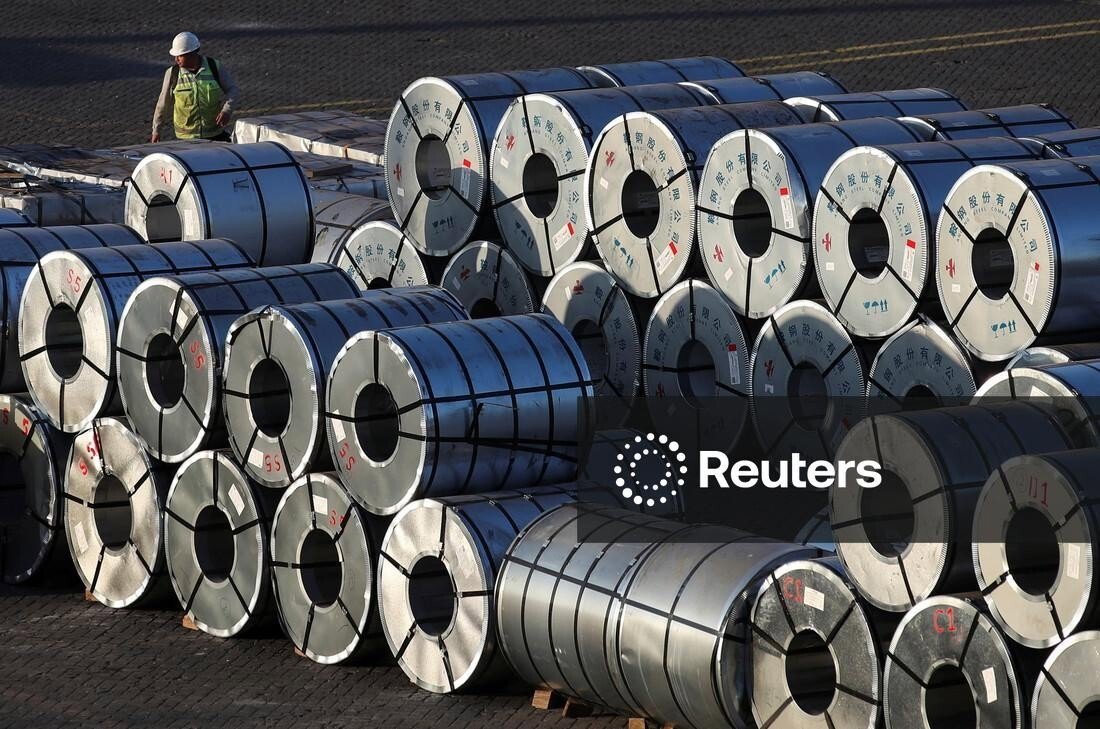
The Gulf was China’s second-largest steel export destination last year, accounting for about 16% of China’s record-high steel exports, as other countries put up trade barriers.
In China, iron ore demand currently remains close to peak levels, providing strong support for iron ore prices, a note from Shanghai Metals Market said.
Global crude steel demand is forecast to rise by 0.3% this year to 1.72 billion metric tonnes, the World Steel Association said on Tuesday.
Other steelmaking ingredients on the DCE advanced, with coking coal and coke up 1.6% and 2.6%, respectively.
Due to rising hot metal output, coking coal and coke demand were strong, with steel mills having relatively low coke inventory levels, leading to urgent procurement of coke cargoes, a separate note from Shanghai Metals Market said.
Reporting with Reuters
🎧A warning from International Monetary Fund
The world’s financial and economic elite are descending on Washington DC.
The International Monetary Fund is holding a series of meetings and warning that the energy crisis is going to mean (at the very least) lower growth and higher inflation.
In today’s ABC Business Daily episode, we hear more from Carrington Clarke and ABC Business Reporter Stephanie Chalmers.
World economy risks running on empty, analyst warns
The ever cheery Rabobank global strategist Michael Every again ponders aloud why global markets are rallying into what the IMF has warned is a potential global recession.
“With US stocks up, the Nasdaq with its longest winning streak since 2021, and screen oil down for a second day in a row, markets continue to price the starkly binary physical outcomes smack in front of us on the side that’s full of stardust,” he writes.
As the IMF indicated — warning that its “adverse scenario” was now looking increasingly likely, which means its “severe scenario” of global recession is eminently possible — the world risks running short on oil soon and prices could hit unprecedented heights, taking inflation along for the ride.
“Even if Hormuz reopened tomorrow, it would take at least 60 and possibly as many as 150 days before normal oil flows could be restored, according to IEA,” Every observes.
He then gives a striking metaphor to elucidate the current situation.
“Imagine driving home in a convoy through a blazing desert in an air-conditioned car knowing you all have 50 miles of fuel in the tank, and the next station is 30 miles away … and then hearing on the radio that it could be shut, and the following one is at least 60 miles away.
“That’s where much of the world economy stands now — and markets are opting to pump up the radio and aircon and say, ‘The next station will be open and I want a slushy.'”
With the last tankers to have left the Strait of Hormuz before it shut now reaching their destinations, the world is probably only weeks, at most months, away from finding out whether it will get that slushy or be stuck in a blazing desert of energy shortages.
Loading
Breaking: Wright Prospecting awarded royalties after legal battle with Gina Rinehart
Australia’s richest person Gina Rinehart has been dealt a blow, with a court finding the family of former mining pioneer Peter Wright has the right to potentially hundreds of millions of dollars worth of past and future royalties from lucrative Pilbara mining assets.
Read more here while my colleague Nicolas Perpitch is gathering more information as we speak.
🎥:Lithium price could double as demand for EVs rises, says UBS
Co-head of mining research at UBS Australia, Lachlan Shaw, says lithium is in its ‘third major price upcycle’, as prices have trebled from cycle lows.
Watch more here.
Loading…
Best and worst performing stocks, by far
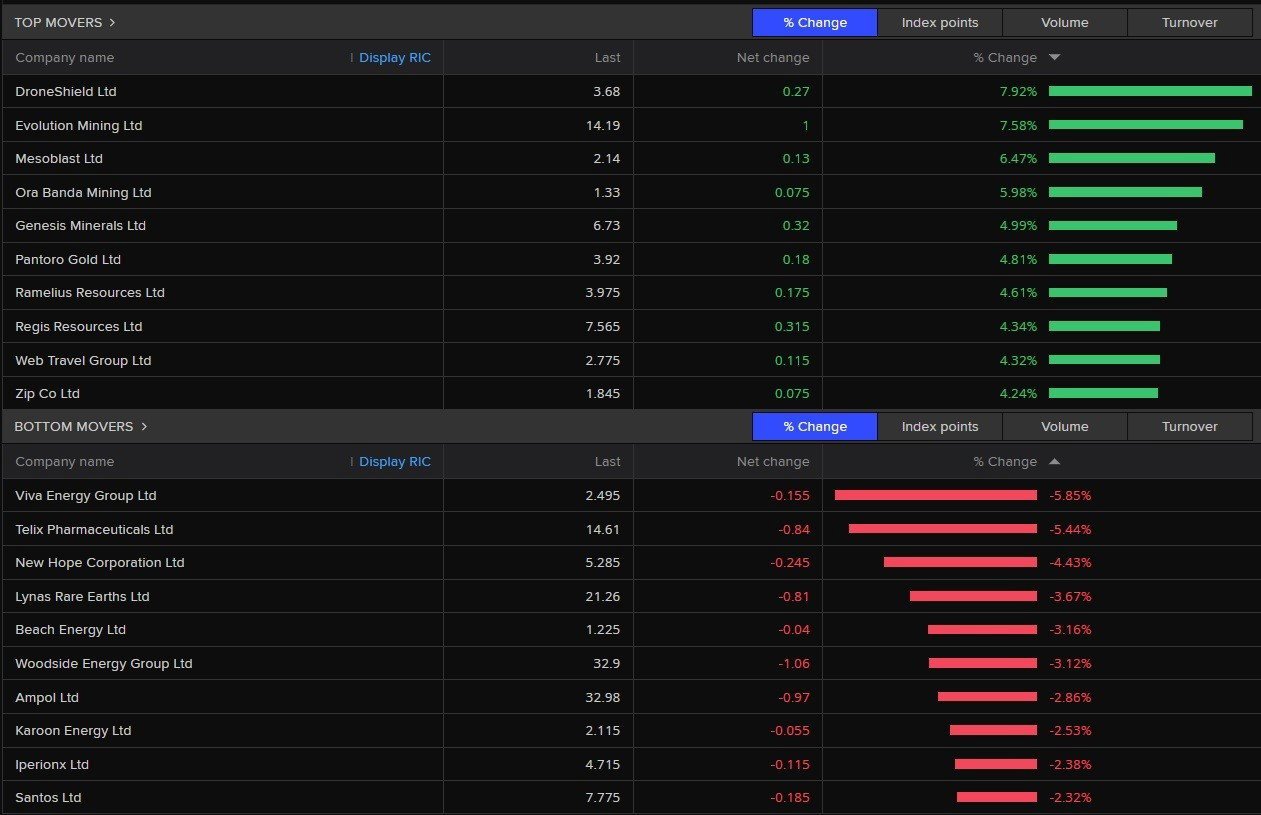
Among the best performing individual stocks on the ASX200 today were,
- Mesoblast, +8%
- Evolution Mining, +7.7%
- DroneShield, +6.3%
- Ora Banda Mining, +6.2%
- Ramelius Resources, +5.4%
The worst performing stocks were,
- Telix Pharmaceuticals, -6%
- Lynas Rare Earths, -5.6%
- Viva Energy, -5.1%
- Beach Energy, -3.6%
- Vulcan Energy Resources, -3.5%
More on Virgin domestic flight cuts
Earlier, we reported on Virgin Australia’s announcement to reduce domestic capacity by a further 1% between April and June.
My colleague Stephanie Chalmers has pulled more details together for you to read here.
New data finds resilience in Australian office markets in Q1
Four of the six monitored CBD office markets in Australia recorded positive net absorption in the first quarter of 2026, despite the uncertain macro environment, according to the latest data from JLL Australia.
The headline national vacancy rate was unchanged at 15.2%, it said.
The Sydney CBD was a standout performer in Q1, recording 29,800 sqm of net absorption and a reduction in vacancy to 14.1%, while Melbourne and Canberra were the two CBD office markets to record negative net absorption.
Meanwhile, tenant options in higher quality assets in Brisbane CBD are limited with prime vacancy tightening to 8.6% in the first quarter, the data shows.
James Montague, Head of Office Leasing – Australia, said Brisbane businesses were facing the tightest office market in a decade.
“We have seen an uplift in Brisbane CBD leasing enquiry over the first few months of 2026.”
The Adelaide CBD recorded a ninth successive quarter of positive net absorption in Q1, and the Perth CBD recorded 1,300 sqm of net absorption, with a reduction in vacancy to 16.3%.
Canberra’s vacancy rate increased to 10.5% – the highest level since the fourth quarter of 2019.
Inflation or unemployment? Analysis of an interesting question
Interesting take from the IMF, Why must price stability (through higher rates) be prioritised over growth? Higher rates, lower inflation leads to unemployment which can have much more sever impacts, like homelessness & the inability to access food/medicine, on actual people (not the imaginary aggregate) vs higher inflation which just means everyone pays a little more (destructive in the long term, fine in the short term). How is that even a decision.
– C
Hi C,
You make a very interesting point.
In general, inflation is particularly bad for creditors as it erodes the real value of the debts they are owed over time.
Banks are the world’s key creditors, along with high-wealth individuals.
Perhaps that offers a hint as to why economic management currently prioritises price stability over full employment.
That said, with Australia’s current restrictive wage setting mechanisms and weak bargaining power for employees, pay rises have struggled to keep up when inflation jumps (unlike in the 1970s), so inflation has been pretty harsh for working people too.
Market snapshot
- ASX 200: +0.2% to 8,984 points
- Australian dollar: flat at 71.25 US cents
- Wall Street: Dow Jones (+0.7%), S&P 500 (+1.2%), Nasdaq (+2%)
- Europe: Stoxx 600 (+1%), DAX (+1.3%), FTSE (+0.3%)
- Spot gold: flat to $US4,841/ounce
- Brent crude futures (oil): -0.1% to $US94.66/barrel
- WTI futures (oil): -0.6% to $US90.75/barrel
- Iron ore: +0.2% at $US105.55/tonne
- Bitcoin: +0.6% at $US74,544
Prices current at around 12:22pm AEST
Live updates on the major ASX indices:
New Fuelcast episode: Qantas and Virgin are feeling the pinch of higher fuel prices
Qantas says its fuel bill could be up to $800 million higher than expected because of the ongoing energy crisis, and it plans to reduce flights to offset some of those cost blowouts.
Virgin has also flagged fare changes as it responds to higher costs.
So how badly could this hit travellers in the months ahead, and how is the conflict involving the US, Israel, and Iran affecting the price of jet fuel?
Carrington Clarke and Ian Verrender discuss these latest developments in their latest Fuelcast episode. You can listen to their insights here.
Boss Energy plummets after downgrade FY26 production
The shares of uranium producer Boss Energy have plunged by over 11% after it downgraded its FY26 production guidance for its Honeymoon project in South Australia.
The company said the heavy rain disruptions and infrastructure delays were to blame.
Boss’s share price was trading at $1.52 per share, down 11.6%, giving it a market cap of $716.08 million.
Australian consumers should brace for ‘negative income shock’, says Westpac chief economist
Westpac’s chief economist Luci Ellis has also provided some commentary on the IMF’s latest report — which outlines various scenarios on how much the global economy would suffer as a result of the Middle East war.
“They have some quite extreme scenarios in terms of prices staying high for a really long time,” she told the ABC News Channel this morning.
Ms Ellis said the Westpac economics team are forecasting an 8-week closure for the Strait of Hormuz, and then “a slow reopening from there”.
She said Australia and the global economy are now facing a “higher inflation, lower growth scenario”.
Westpac’s economics chief said it will result in a “negative income shock for most consumers as they’re contending with higher prices”.
She also explained that “for the economy as a whole, we do get that extra tax revenue from energy exports and we can do those gas-for-oil deals that the Government is already doing.”
So while this may be great for government revenue, it’s not so great for commoners like you and me.
RBA likely to announce three more interest rates hikes by end of 2026, says Westpac chief economist
“It gives me no pleasure to forecast three more rate hikes,” said Westpac’s chief economist Luci Ellis, in response to a question on what the Reserve Bank might do next with interest rates.
She previously made this dire forecast on March 30, and her view has only solidified after another fortnight of war in the Middle East.
“Australia already started the period with inflation above the Reserve Bank’s target,” Ms Ellis said in an interview with ABC News presenter Gemma Veness this morning.
“The Reserve Bank has been very clear that it sees getting inflation back into its 2% to 3% target range. and back to that 2.5% midpoint, as job number one.
“And the communication that they have been putting out over the last weeks and months has been ‘they see that the Australian economy does actually need to slow, and consumption and business investment does need to moderate in order to make room for what is a constrained supply’.
“We’ve also been quite alarmed by the number of other prices beyond petrol that are already starting to increase, and that’s something we’re watching very closely in thinking about the near term inflation outlook, and I’m sure that the Reserve Bank is doing the same.”
The RBA has already lifted interest rates twice this year, taking the cash rate to 4.1%.
If Ms Ellis’ prediction ends up being correct, then the central bank would have announced five rate hikes by Christmas, which would lift the cash rate to 4.85% — its highest level in 17 years.
In fact, it would be the highest rate since November 2008 (during the global financial crisis), when the rate was 5.25%.
Such a sharp increase in borrowing costs, while inflation is still rising, would lead to higher unemployment and slower economic growth.
Each successive rate hike would also increase the risk of stagflation and Australia facing another recession.
Super fund HESTA appoints Robbie Campo as its new CEO
HESTA has more than a million members in its super funds, a punchy reputation for ‘engaging’ with listed companies and a big problem last year when an IT upgrade locked members out of their money.
Now it has a new boss, experienced superannuation executive Robbie Campo will be the new CEO of the $100 billion profit-to-members industry fund from August.
She replaces Debby Blakey, who has been a thorn in the side of some of Australia’s biggest companies as HESTA pushed them on ESG (environment, social, governance) issues in recent years – using their substantial shareholdings to influence change.
HESTA Chair Nicola Roxon congratulated Ms Campo on the appointment, saying in a release:
“Robbie brings extensive experience across executive and CEO roles, leading organisations, big and small, through complex regulatory, operational and investment environments to deliver better outcomes for members.
“As HESTA grows beyond more than one million members and $100 billion in assets, Robbie’s skills will position her well to lead the Fund as it enters an exciting new chapter – striving always to help our members feel confident, connected and well prepared for the future.
“Alongside our shared commitment to improving the financial futures of working people, particularly women, Robbie’s an inspiring leader who will bring fresh eyes and new energy to amplifying the positive impact HESTA has for generations of our members.”
Ms Campo is currently the CEO of ESSSuper and has worked at CBUS and Industry Super Australia (ISA). She is Chair of Women in Super, and has served as a non-executive director of Victoria Legal Aid and as a Director at Industry Fund Services.
80% of HESTA’s members are women, and Ms Campo said she felt privileged to be chosen to lead an organisation
“I am thrilled to be appointed as HESTA’s CEO, a role which will allow me to continue my passion for improving the economic security of Australians and, in particular, improving retirement outcomes for women.
“HESTA is a top performing fund with a proud history of constant and courageous advocacy, global leadership in responsible investment and a strong track record of supporting its members. The nurses, carers, educators, and community service workers that make up the Fund contribute so much to the community, and it will be an honour to help them achieve a more secure retirement.”
Virgin shares jump, while oil and gas companies fall sharply on hope of further US-Iran talks
Many of today’s worst performing stocks are oil and gas businesses, after a sharp fall in oil prices overnight as markets are expecting the US and Iran to hold another round of ‘peace talks’ soon.
Companies like Viva Energy (-5.9%), Beach Energy (-3.2%), Woodside (-3.1%), Ampol (-2.9%) and Santos (2.3%) are experiencing some of the heaviest losses.
Conversely, their shares tend to do well when oil prices surge as a response to negative headlines which suggest the Middle East war could drag on for longer than expected.
On the flip side, the stocks experiencing the largest gains include gold miners Evolution Mining, Pantoro Gold and Regis Resources after a rebound in the precious metal’s spot price.
Other top performers include healthcare stock Mesoblast, travel company Web Travel and defence contractor Droneshield.
Meanwhile, shares of Virgin Australia jumped 6.6% after the airline provided a trading update, essentially saying the spike in fuel prices won’t have a major impact on its finances (at least until June 30).
Market snapshot
- ASX 200: +0.3% to 8,994 points
- Australian dollar: +0.1% at 71.3 US cents
- Wall Street: Dow Jones (+0.7%), S&P 500 (+1.2%), Nasdaq (+2%)
- Europe: Stoxx 600 (+1%), DAX (+1.3%), FTSE (+0.3%)
- Spot gold: -0.1% to $US4,834/ounce
- Brent crude futures (oil): -0.2% to $US94.64/barrel
- WTI futures (oil): -0.6% to $US90.75/barrel
- Iron ore: flat at $US105.30/tonne
- Bitcoin: +0.6% at $US74,604
Prices current at around 10:20am AEST
Live updates on the major ASX indices:
Iron ore prices fall as BHP reported to be close to China deal
CBA’s commodity analyst Vivek Dhar say iron ore prices fell below $US105 a tonne amid reports that China’s centralised and state-owned iron ore buyer, the China Mineral Resources Group (CMRG) is starting to lift some of the restrictions on BHP iron ore that it has had in place since late last year.
“The restriction that was reportedly relaxed was the ban on purchasing new BHP iron ore cargoes denominated in US dollars,” notes Dhar.
“This was just one of the unofficial restrictions put in place by CMRG in response to BHP’s rejection of their proposed terms in price negotiations for iron ore supply starting in September last year.
“CMRG has also unofficially restricted Chinese steel mills from purchasing certain BHP products (i.e. Jimblebar and Jingbao fines) as price negotiations have persisted since late last year.”
China has been attempting to use its 70-75% dominance of the global iron ore import market to try and place pressure on BHP in contract negotiations.
However, the contractual pressure hasn’t been without cost to China, given BHP’s sizeable position in the global iron ore trade.
“With BHP cargoes accounting for ~15% of the seaborne market, traders and steel mills in China are forced to value the remaining ~85% of seaborne trade at a higher level,” Dhar observes.
“This has meant that iron ore spot prices are trading at an artificially higher level.
“Therefore, if a deal is reached between BHP and CMRG soon, iron ore spot prices are vulnerable to a selloff. We think iron ore prices may fall to ~$US95/t if a CMRG‑BHP deal is reached in the near term.”
Dhar says there’s a reasonable chance that iron ore prices could even fall below that level by the end of the year.
“Headwinds to China’s construction sector, particularly property, remains the key drag on China’s iron ore demand,” he notes.
“Seaborne supply is also rising with Guinea’s Simandou iron ore project delivering its first shipment to China in January this year.”
My colleagues Yiying Li and Stephen Dziedzic did some great reporting on this contractual battle last year.