Wed 22 Jul 2026 at 2:22pm
Market snapshot
- ASX 200: +0.25% at 8,815 points
- Australian dollar: +0.01% at 69.98 US cents
- Wall Street: Dow Jones (+0.7%), S&P 500 (+0.9%), Nasdaq Composite (+1.3%)
- Europe: FTSE (+0.6%), Stoxx 600 (+0.6%)
- Spot gold: +1.27% to $US4,128/ounce
- Oil (Brent futures): +1.24% to $US92.14/barrel
- Oil (WTI futures): +1.13% to $US85.29/barrel
- Iron ore: -0.48% at $US98.05/tonne
- Bitcoin: -0.07% at $US66,336
Prices current at around 2:20pm AEST
Live updates on the major ASX indices:
Wed 22 Jul 2026 at 3:22pm
Landmark victory for low-paid Domino’s workers in underpayment class action
The Federal Court’s Justice Murphy has delivered an important judgement today, regarding Domino’s Pizza.
Phi Finney McDonald (a litigation law firm) has issued this press release in response, summarising what’s happened:
Thousands of low-paid Domino’s franchisee workers could be entitled to significant compensation following a landmark victory against Domino’s Pizza Enterprises.
The Federal Court has found that Domino’s pizza misled franchisees by directing them to underpay thousands of drivers and in-store staff under outdated employment agreements over five years that excluded key entitlements.
In 2019, Phi Finney McDonald launched the class action against Domino’s on behalf of lead applicant Riley Gall, a former Domino’s delivery driver, for underpayment of wages under the Australian Consumer Law for loss caused by misleading and deceptive conduct.
The class action covers delivery drivers and in-store workers employed by Domino’s Australian franchisees between 2013 and 2018.
The Court found that Domino’s instructed its Australian franchisees to pay delivery drivers and in-store workers under enterprise bargaining agreements when some employees were covered under the Fast Food Industry Award that has better terms and conditions.
These workers should have received benefits under the award, including a 25% loading for casual workers, additional penalty rates for working after-hours, on weekends and public holidays and minimum three-hour shifts.
A forensic investigation conducted by the Retail and Fast Food Workers’ Union’s (RAFFWU) uncovered the underpayments.
His Honour Justice Bernard Murphy found the “Award rather than the Agreements applied to the employment of the applicant and a substantial cohort of Delivery Drivers and In-Store Workers employed by franchise operators during the relevant period”.
Consequently, Domino’s conduct in making the representations was “objectively wrong”, and “was therefore misleading or deceptive conduct or conduct which was likely to mislead or deceive, in contravention of s 18 of the ACL”, he said.
He did not accept Domino’s contention that claims for award entitlements could only be brought through the Fair Work Act. “It is likely that similarly situated group members employed in award stores also suffered causally connected loss, but the scope of the initial trial only allows determination of the applicant’s loss,” he said.
A further hearing will be held to decide group member claims.
Wed 22 Jul 2026 at 2:48pm
Clean Energy Regulator cracking down on problematic solar installation businesses
Australia’s green energy watchdog suspended almost two dozen companies from the federal government’s solar subsidy scheme over claims they were unfit to hold a licence.
In an update released this morning, the Clean Energy Regulator said it had struck 21 firms from the small-scale renewable energy scheme in the quarter between April and June this year.
The suspensions came after the regulator found the installers had failed “to meet fit and proper person requirements”.
Under the requirements, companies must show they have complied with the law “and that they have the integrity, capability and competence to effectively fulfil their role as a provider” of the solar scheme.
One company singled out by the CER was Asun Solar Pty Ltd, which “was suspended for failing to meet these obligations”.
According to the watchdog, another firm was hit for falsely claiming that systems it had installed were complete and capable of generating electricity “when they in fact weren’t”.
Carl Binning, the acting chair of the CER, said false statements and incomplete work were unacceptable.
Mr Binning said the regulator was now using artificial intelligence tools to help its oversight of the industry.
“False statements and incomplete work will not be tolerated,” Mr Binning said.
“We’re warning installers that we will fail their applications and send them back to site if things aren’t done properly the first time.”
Under the scheme, installers must be accredited by the regulator to be eligible for the taxpayer incentives that help slash the upfront cost of the technology for consumers.
More than 4 million Australian homes and small businesses have solar installations on their roofs.
Wed 22 Jul 2026 at 2:26pm
Podcast: What Australians get wrong about interest rates
Today’s episode of ABC Business Daily is live.
The latest results of an RBA survey are out today, capturing how Australians experience and understand the economy.
While public awareness for the RBA is high, survey results seem to suggest that people don’t have a great handle on how inflation is affected by interest rates. So, what problem does this present for the RBA, whose one blunt tool is to move rates?
And a new set of draft recommendations from the ASX’s Advisory Group on Corporate Governance raises the question: can diversity targets influence a company’s economic outcome?
Daniel Ziffer and ABC Business Reporter Steph Chalmers break it all down:
Wed 22 Jul 2026 at 2:18pm
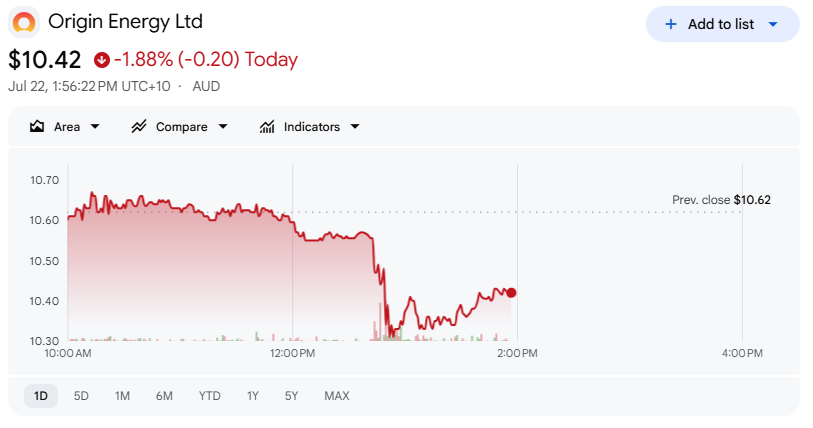
Origin shares down 1.88pc
Origin Energy shares are staging a very slow recovery after that initial drop, but they’re still down 1.88% at this point.
Wed 22 Jul 2026 at 2:09pm
A reasonable misunderstanding
I think the results of that RBA survey show the difference between where the RBA work, and where everyday people work. The RBA see their acts as having an impact on this calculated inflation number, that includes and excludes all sorts of things, but back in the real world, it has a direct and immediate impact on people’s day to day expenses: their cost of living is rising as a result of the RBA’s decisions, that’s inflation to them. They need to do more to show how their rate rises have changed their measure of inflation. If they can’t do that, they can’t link up the direct chain between reduced economic demand and lower prices, people will never see their acts as those of reducing inflation, because in reality, it’s not.
– m
Thanks for your comment, M.
Re: this statement of yours, “[The RBA] has a direct and immediate impact on people’s day-to-day expenses: their cost of living is rising as a result of the RBA’s decisions, that’s inflation to them.”
I tend to agree with that. If your household has a mortgage and the RBA lifts interest rates, your interest rate payments will go up pretty much immediately. That will have an immediate impact on your household’s ability to pay for things.
How many people are making a distinction between “consumer price inflation” and “everything our household has to pay for this month”?
The RBA wants people to know that it will reduce inflation in the medium term by lifting interest rates, but in the short term, households may feel that their major household expenses are just increasing from the higher interest rates.
So, the RBA is essentially asking people to “look through” their rising household expenses in the short term so that they can appreciate lower and more stable prices in the medium term.
It’s a big conceptual leap.
Wed 22 Jul 2026 at 1:42pm
KPMG ‘raking it in’ on multi-million-dollar contracts, Greens say
The Australian Greens are drawing people’s attention to new biannual government data that records consulting contracts published on AusTender worth more than $2 million, which shows the multi-million-dollar value of government contracts held by KPMG.
As of July 1, 2026, KPMG held eight active large contracts worth $51.4 million between January 1, 2026, to June 30, 2026.
It has contracts with Defence, Finance, Home Affairs, Services Australia, and other departments.
On June 24, the Department of Finance announced an independent review of KPMG Australia in light of reports of the misuse of clients’ confidential information.
The review will be completed by September 30, 2026 and will inform the Commonwealth as to whether KPMG Australia has breached the Supplier Code of Conduct.
Greens finance and public service spokesperson senator Barbara Pocock says:
“The Department of Finance alone has three multi-million-dollar contracts worth over $25 million combined — the same department that is investigating KPMG for its unethical behaviour.
“As scandal engulfs KPMG and it appoints long-term insiders to fill the shoes of the disgraced leadership, Australians want to know why KPMG is keeping multi-million-dollar government contracts and has not been removed from bidding panels.
“Labor needs to stop feeding the beast and get on with the job of reforming a sector gone rogue.
“The Big 4 have lost their social licence. Australians have had enough of the repeated scandals. It’s time to end the gravy train and properly regulate the Big 4.”
Wed 22 Jul 2026 at 1:21pm
Are you an Origin Energy customer?
Are you an Origin Energy customer? Are you concerned about a potential data breach or have you noticed anything?
Let us know in the comments or email business correspondent David Taylor (taylor.david@abc.net.au).
Wed 22 Jul 2026 at 1:16pm
Reports hacker accessed Origin customer details
Wed 22 Jul 2026 at 1:09pm
Origin Energy shares fall on data breach probe
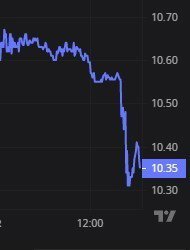
Shares in Origin Energy are down 2.5% after the company said it was investigating a potential breach of customer data.
Looking at the share price chart, you can see the announcement to the ASX had an impact:
Wed 22 Jul 2026 at 12:59pm
Origin Energy investigating potential cyber incident
Energy retailer Origin Energy is investigating “a potential security incident”, which it says may involve unauthorised access to some customer data.
In a statement to the ASX, Origin said it does not believe customers’ credit card or bank details were among the accessed information.
More to come.
Wed 22 Jul 2026 at 12:53pm
Australians aware of RBA’s inflation target, less aware of full employment responsibility
RBA survey continued…
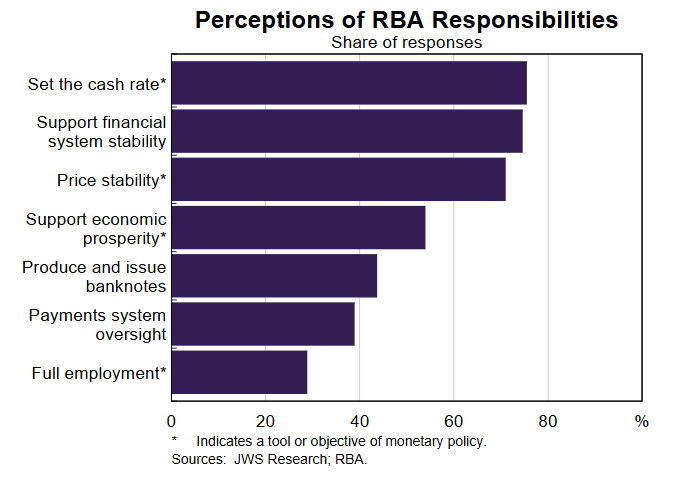
The RBA survey also found that an awareness of the RBA and its price stability mandate was high, but awareness of its other responsibilities weren’t as high.
Most respondents showed an understanding of the RBA’s core monetary policy role, including that it sets the cash rate and aims to maintain price stability.
More than half also correctly identified that the inflation target range is between 2–3 per cent using a multiple choice question.
However, by contrast, awareness of the RBA’s full employment objective is much lower, with only about one-quarter of respondents identifying this responsibility.
Is that result surprising?
Ask an Australian what the RBA’s inflation target is, and they’d have a reasonably good chance of saying something like 2.5%, or 3%, or somewhere between 2-3% (as the survey found).
But what does “full employment” mean, in this day and age?
The RBA would say it refers to the rate of unemployment at which inflation is sitting sustainably around 2.5%.
How many Australians would be able to provide that answer off the top of their head?
“Full employment” has no hard target, like the inflation target. You can’t put a number on it. The media is always talking about the RBA missing its inflation target but it rarely (if ever) talks about the RBA missing or achieving its full employment target in those terms.
So given its abstract nature, is it any wonder that Australians are less aware that full employment is one of the RBA’s responsibilities?
Wed 22 Jul 2026 at 12:20pm
RBA survey finds majority of respondents think higher interest rates lead to higher inflation
RBA survey continued…
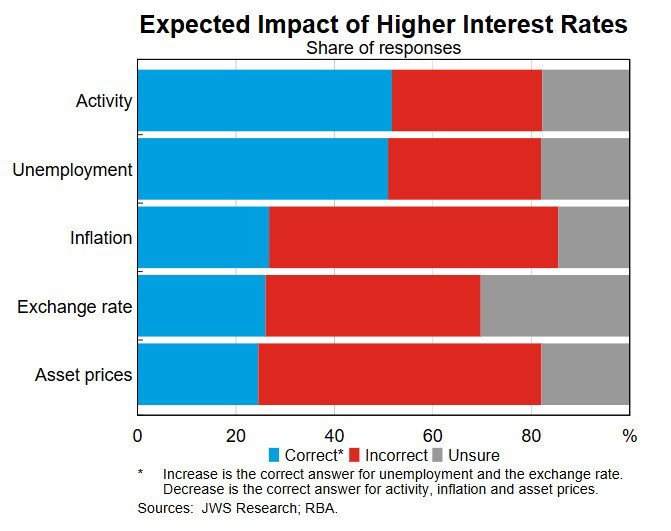
The RBA’s survey of Australians also found that the public generally understands how interest rates affect economic activity, but the effect on inflation is less well understood.
Part of the survey’s economic literacy component assessed respondents’ knowledge of the RBA and how monetary policy works. Respondents were asked how they thought higher interest rates influenced key economic variables.
About 50 per cent of respondents correctly assessed that higher interest rates would be expected to slow economic activity and employment, compared with about 30 per cent of respondents who incorrectly judged that higher interest rates would increase economic activity and employment (the remainder were unsure).
These findings are in line with recent international experimental evidence that has also identified relatively high levels of public understanding of how interest rates affect economic activity and employment.
When it comes to how interest rates affect inflation, the survey found a large amount of confusion.
The survey identified a large gap in the Australian community’s understanding of how interest rates affect inflation.
“Only 25 per cent of respondents assessed correctly that higher interest rates would ultimately lead to lower inflation, while more than half indicated that higher interest rates would lead to higher inflation.
“This finding shows that most respondents expect interest rates to have the opposite effect on inflation to central bank economists.
“This is not unexpected given that, in practice, interest rates affect inflation through multiple channels.”
The RBA says the finding that households expect higher interest rates to increase, rather than reduce, future inflation has important implications for how monetary policy decisions are understood by the Australian community.
It says it could contribute to community frustration with monetary policy decisions if the decisions are interpreted as adding to inflation and, in turn, this could weaken confidence and trust in the RBA.
It could also make it more difficult for households to interpret economic developments and make informed financial decisions.
Wed 22 Jul 2026 at 12:00pm
Candle company Dusk in court over sale of button battery products attractive to children
The consumer watchdog has commenced Federal Court proceedings against fragrance and candle company Dusk for some of their products that are often exposed to children.
The Australian Competition & Consumer Commission (ACCC) is alleging that Dusk supplied homewares containing button batteries that did not comply with mandatory button battery safety and information standards, breaching Australian Consumer Law.
The ACCC alleges that between May 17, 2023, and December 12, 2024, Dusk supplied 66,453 products, comprising 29 different product lines, that did not comply with mandatory button battery safety and information standards.
The items include:
- Candles
- Diffusers
- Tealights
- Snow globes
- Other Easter, Christmas or Halloween themed LED products
“Button batteries can cause catastrophic injuries or death if swallowed by young children, so it is crucial that businesses take their product safety obligations seriously,” says ACCC Deputy Chair Catriona Lowe.
“Failing to test products for compliance with the mandatory button battery standards before supply to consumers creates an unacceptable safety risk, particularly for young children.”
The ACCC alleges 25 of the product lines sold were not tested prior to supplying them to consumers, as required under the mandatory safety standard.
Dusk later obtained tests to confirm the products passed the relevant safety requirements, although products had already been supplied to customers.
In addition, four product lines failed to include the safety warnings required by the mandatory information standard, leaving customers unaware the products contained button batteries.
“Compliance with the mandatory button battery standards is an ACCC compliance and enforcement priority. Businesses must ensure they have adequate policies and procedures in place to comply with these standards,” says Ms Lowe.
It is also alleged that Dusk breached a court-enforceable undertaking it had previously provided to the ACCC back in April 2023.
At this time, the ACCC accepted a court-enforceable undertaking from Dusk after it supplied Halloween-themed novelty products containing button batteries that did not comply with the mandatory safety standards.
Dusk also paid $106,560 in penalties after the ACCC issued eight infringement notices relating to the supply of non-compliant button battery product lines.
“We are extremely concerned as Dusk allegedly supplied tens of thousands of products that did not comply with button battery standards designed to protect young children who are most at risk of serious injury, despite having previously given an undertaking to the ACCC that it would not do so,” says Ms Lowe.
The ACCC is seeking declarations, penalties, costs and an order requiring Dusk to pay an amount reflecting any financial benefit it obtained from the alleged breaches, and other orders.
If you have been affected or have any information you’d like to share, please feel free to contact me: miller.adelaide@abc.net.au
Wed 22 Jul 2026 at 11:48am
RBA survey finds Australians most concerned about inflation, then housing
The Reserve Bank has released the latest results of its relatively new survey of Australians.
It introduced the new survey in February 2025 to better understand how Australians experience and understand the economy, and public perceptions of the RBA.
Three survey waves have been conducted to date, with the most recent taking place in late February/early March 2026.
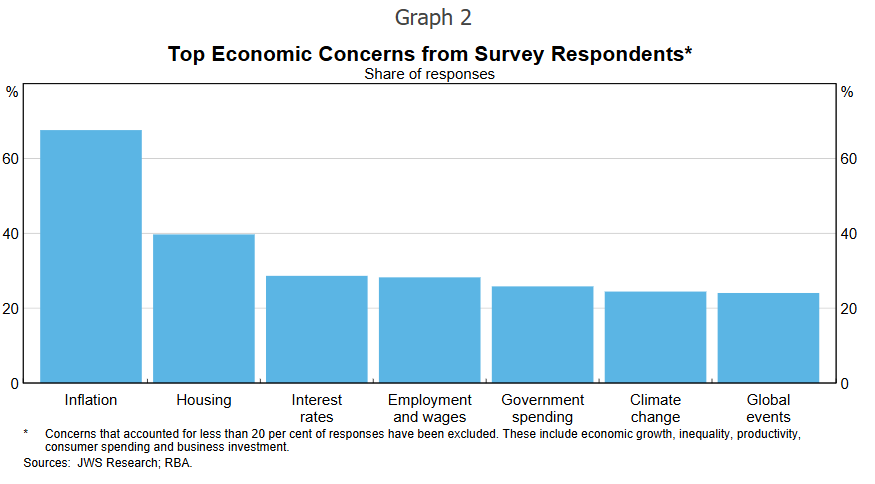
Results confirm that inflation remains the top economic concern, and by some margin.
They also show that while public awareness of the RBA is high, there are fundamental gaps in understanding of how monetary policy works, particularly in how interest rates affect inflation.
Public trust in the RBA is comparable with other Australian and international institutions and has been stable since early 2025.
However, trust varies across the community, and is closely linked to understanding of the economy and perceptions of how the RBA operates.
Higher trust is associated with lower inflation expectations, highlighting that trust is important in its own right, and also for the transmission of monetary policy.
Survey results and key findings
The RBA says inflation emerged as the single most pressing concern for all Australians across the three survey waves.
Housing came in second, followed by interests rates and employment and wages.
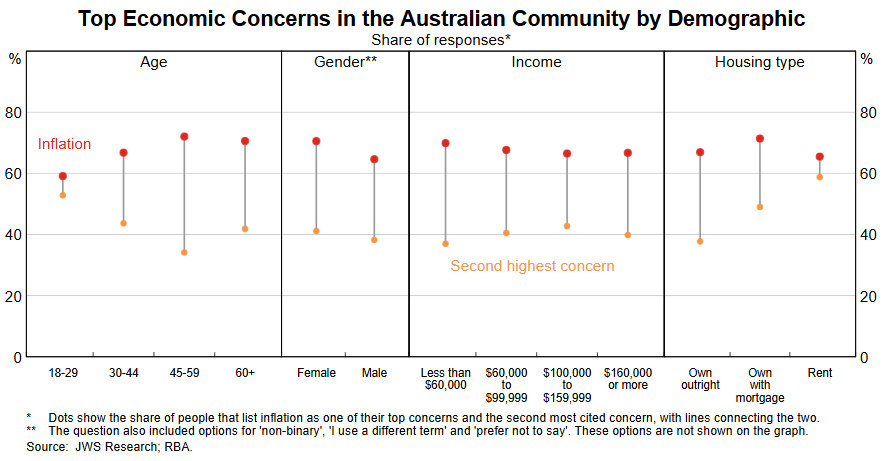
It says concern about inflation is especially pronounced among lower-income households, “who tend to be more vulnerable to changes in the cost of living as they have less ability to cut back on non-discretionary spending or access savings to smooth their consumption”.
Concern about inflation is also closely associated with views about the economic outlook. Respondents who cited inflation as one of their top concerns were more likely to expect both economic conditions and their own household financial situation to worsen over the next 12 months.
Continued…
Wed 22 Jul 2026 at 11:23am
Insurers urged to be transparent about premium costs
As David Chau kindly mentioned earlier, I have been investigating Suncorp home insurance claims, with my latest piece published this morning about a family of seven forced to live in an overcrowded shed and caravan due to damage caused by insurer contractors.
One of the points in my report that Prue Monument, general manager of the General Insurance Code Governance Committee, made is the importance of insurer transparency with customers.
A report by the General Insurance Code Governance Committee (GICGC) has found that some insurers are not giving customers clear and accessible information about whether paying monthly, fortnightly or quarterly premiums will cost more overall than paying annually.
Chair of the GICGC Veronique Ingram says this should not be difficult information to access.
“Customers should be able to easily see, at renewal, whether one payment option will cost more than another. That is basic price transparency,” she says.
The report titled Clear costs at renewal: payment options and pricing transparency, found some renewal notices used vague statements that annual payment “may” be cheaper or told customers that instalment fees “may” apply, without clearly setting out the cost difference.
Prue Monument says the difference in premium price depending on when you paid was between 7 and 11%.
“So it would definitely make a big difference for customers that are paying more frequently,” she says.
Of the 20 insurers the report looked at, Ms Monument says eight of them were found not to charge any difference depending on when payments were made.
Of the ones that do charge a different price, some “were really clear and upfront as to what that means for customers, which really help people make informed choices”.
“So there’s no reason why insurers can’t be transparent and make it really easy,” she says.
Wed 22 Jul 2026 at 10:57am
ASIC reads accounting firms riot act
The corporate regulator, ASIC, has penned a letter to Australia’s largest accounting firms asking them to shape up.
The subject of the letter is: “Compliance with auditor obligations”
The first paragraph tells much of the story:
“I am writing at a time when there is significant focus on the conduct of auditors and audit firms and concerns about trust and confidence in the profession,” ASIC Commissioner Kate O’Rourke writes.
And there is a warning from ASIC:
In relation to ASIC enforcement, auditor misconduct is one of our specific enforcement priorities.
We will commence investigations where we have sufficient initial concerns regarding a possible breach of the Corporations Act 2001 (Corporations Act) and we have done so in relation to recently raised allegations.
Where we identify sufficient evidence that a registered company auditor has failed to comply with their obligations and meet the standards required of them, we may take enforcement action which can include an application to the Companies Auditors Disciplinary Board seeking cancellation or suspension of their registration, issuing an infringement notice or taking civil action.
And there are some firm directives from the corporate cop:
- Be independent – Corporations Act requirements
- Provide accurate, complete and timely information to ASIC
- Report relevant matters to ASIC
- Act ethically – APES 110 Code of Ethics for Professional Accountants (APES 110)
ASIC also says it will be initiating twice-yearly meetings open to all RCAs (Registered Company Auditors) where it will discuss its priorities, focus areas, findings and recommendations for good practice and hear from the RCAs about any emerging issues and questions they might have.
Wed 22 Jul 2026 at 10:56am
Tech and healthcare are among today’s worst performing Australian stocks
It turns out technology is one of today’s worst performing sectors on the ASX 200.
Usually, local tech stocks follow the movements of the Nasdaq and US tech firms up or down — depending on what sentiment is like on the day.
And today Australian tech is not following the strong rebound in chipmakers and semiconductors, also known as the ‘AI trade’.
Shares of data centre operators NextDC are flat, while Goodman Group is down 1.4%.
Software stocks like Xero (-3.4%), TechnologyOne (-2.5%) and WiseTech Global (-1.8%) are doing poorly as well.
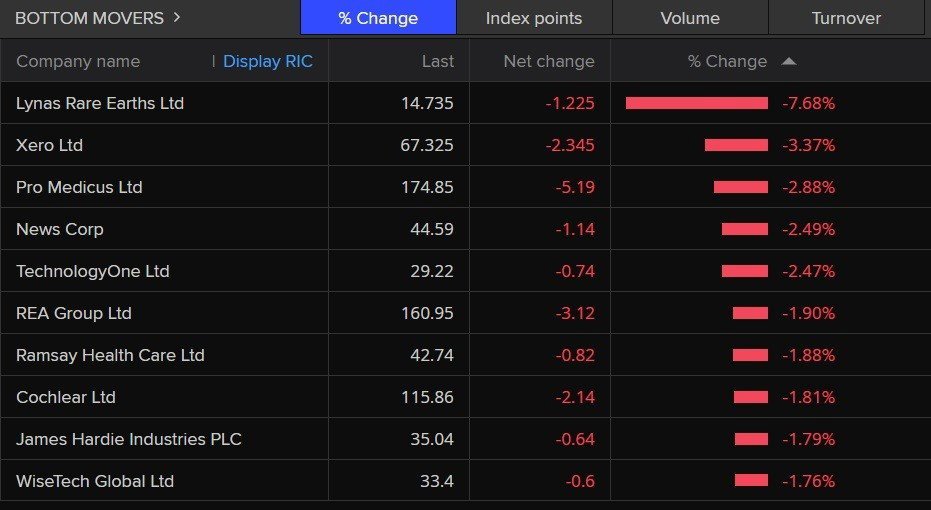
These software-as-a-service (Saas) stocks have fallen sharply in recent months on fears the rapid advance in AI will make some of their services obsolete.
Traders have even coined a term for that — the SaaSpocalypse!
Also doing badly today are shares of Lynas Rare Earths (-7.7%). Even though it reported a 40% jump in quarterly revenue, its result was still below the market’s very high expectations.
Healthcare companies aren’t faring too well either, with Cochlear (-1.8%), Ramsay Healthcare (-1.9%) and Pro Medicus (-2.9%) down sharply.
Wed 22 Jul 2026 at 10:43am
Surge in mining and energy stocks keeping ASX afloat
The local share market is trading 0.4% higher even though most sectors have fallen into negative territory.
The only two sectors posting gains are materials (+1.9%) and energy (+1.4%)
BHP, Rio Tinto and Fortescue are doing the heavy lifting with shares in the mining giants up between 1.2% and 3%.
But it’s the smaller miners that are recording the biggest increases to their share price.
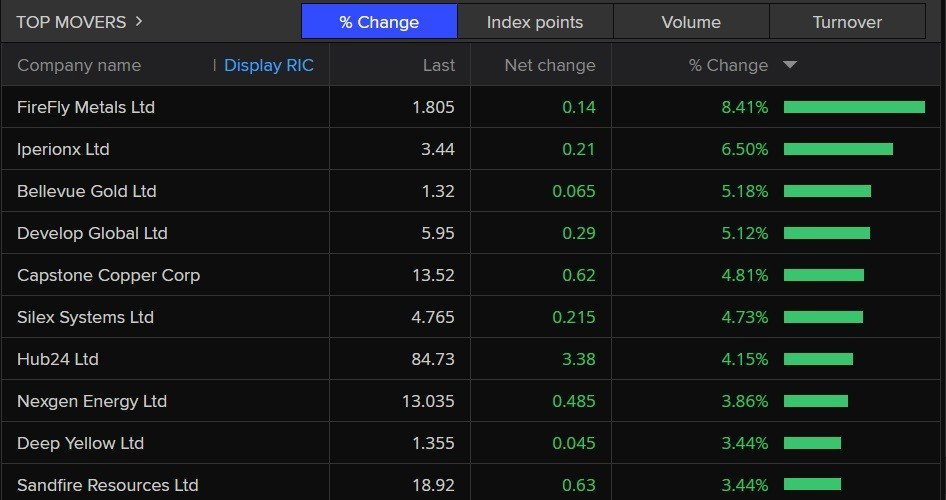
Today’s best performing stock is a speculative gold-copper explorer, Firefly Metals (+8.4%).
Also doing well is a critical minerals company IperionX (+6.5%), gold producer Bellevue Gold (+5.2%), Capstone Copper (+4.8%) and Sandfire Resources(+3.4%). along with uranium stocks Nexgen Energy (+3.9%) and Deep Yellow (+3.4%)
Wed 22 Jul 2026 at 10:23am
Shares of Lynas Rare Earths slump, despite its quarterly revenue surging 70 per cent
Lynas Rare Earths has published a solid trading update, saying its quarterly revenue has jumped nearly 70% to its highest level in four years.
The company’s gross sales revenue was $288.9 million in the June quarter, which is a sharp increase from $170.2 million a year earlier.
Still, its revenue fell below Visible Alpha’s consensus estimate of $359.8 million.
That might explain why Lynas’s share price experienced a steep fall in morning trade — down 7.2% to $14.81 about 10:20am AEST.
It’s also today’s worst-performing stock on the ASX 200 so far.
The company’s earnings were propped up by a higher average selling price for its rare earth minerals and strong demand from customers seeking sustainable supply chains outside China.
Lynas’ average selling price rose to $98.20 per kilogram during the quarter, up from $60.20 per kg a year earlier.
“Customers continue to focus on securing sustainable, outside China supply chains due to geopolitics and export restrictions,” the company said.
Lynas is the world’s largest rare earths producer outside of China.
It posted total rare earth oxide production of 3,481 metric tons, up from 3,212 metric tons a year ago.
– with reporting by Reuters